GRAVÜR DÜNYASI
Digital Engraving Library
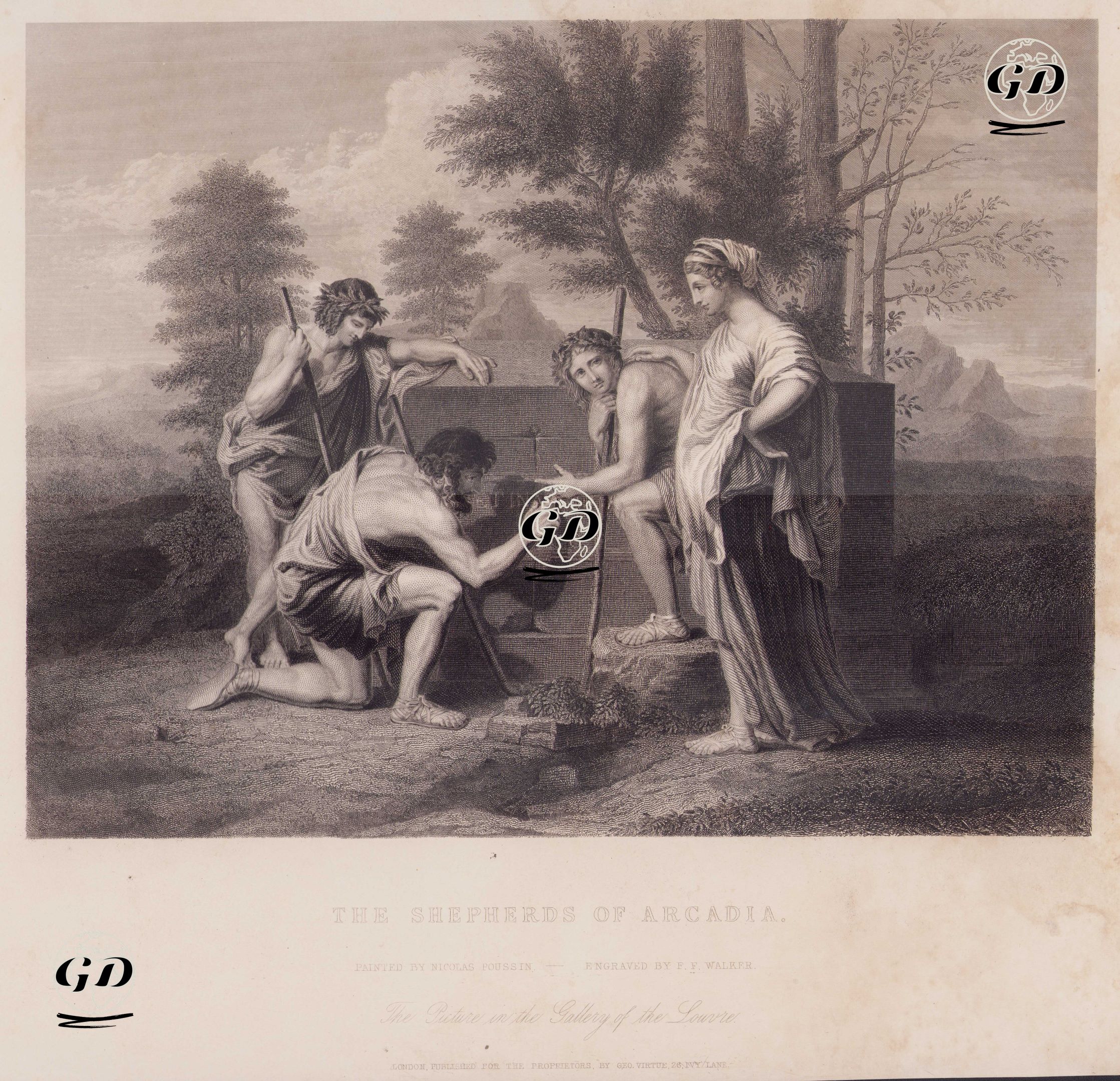
| Artist | Nicolas Poussin (1594-1665) |
| Engraver | F.F.Walker |
| Date | 1846 |
| Technique | Steel Engraving |
| Category | Masterpiece Painting |
| Source | Gems of European Art-London, Published For the Proprietors By Geo. Virtue, 26 Ivy Lane |
The Shepherds of Arcadia is undoubtedly the most famous and debated of Nicolas Poussin's paintings. Art historians have differing interpretations of the painting. The painting's subject is Arcadia. Arcadia was a region in Greece described in ancient times as a kind of terrestrial paradise, surrounded by mountains where its inhabitants lived happily and harmoniously, with nature undisturbed. The painting depicts three shepherds and a statuesque woman (Athena, according to some interpretations) gathered around a large stone tomb engraved with the inscription "Et in Arcadia ego." One of the two shepherds recognizes the shadow of his friend (Apollo, according to others) on the tomb and traces its silhouette with his finger. This drawing is considered the moment of the discovery of painting, and the shepherd's shadow is considered the first image in art history. This shadow is also interpreted as a symbol of death. Furthermore, the Latin phrase "Et in Arcadia ego," translated as "Even in Arcadia I am," refers to the contents of the tomb: death. These shepherds thus discover their own mortality, and they look towards the grave and around them with the knowledge of their mortality forming a heavy burden on their shoulders.