GRAVÜR DÜNYASI
Digital Engraving Library
| Artist | John Martin (1789-1854) |
| Engraver | Edward John Roberts (1797-1865) |
| Date | 1824 |
| Technique | Steel Engraving |
| Category | Masterpiece Painting |
| Source | Published by T.Hurst & Co. St. Pauls Churchyard, & R. Jennings, 2 Poultry. Printed by Mc.Queen. |
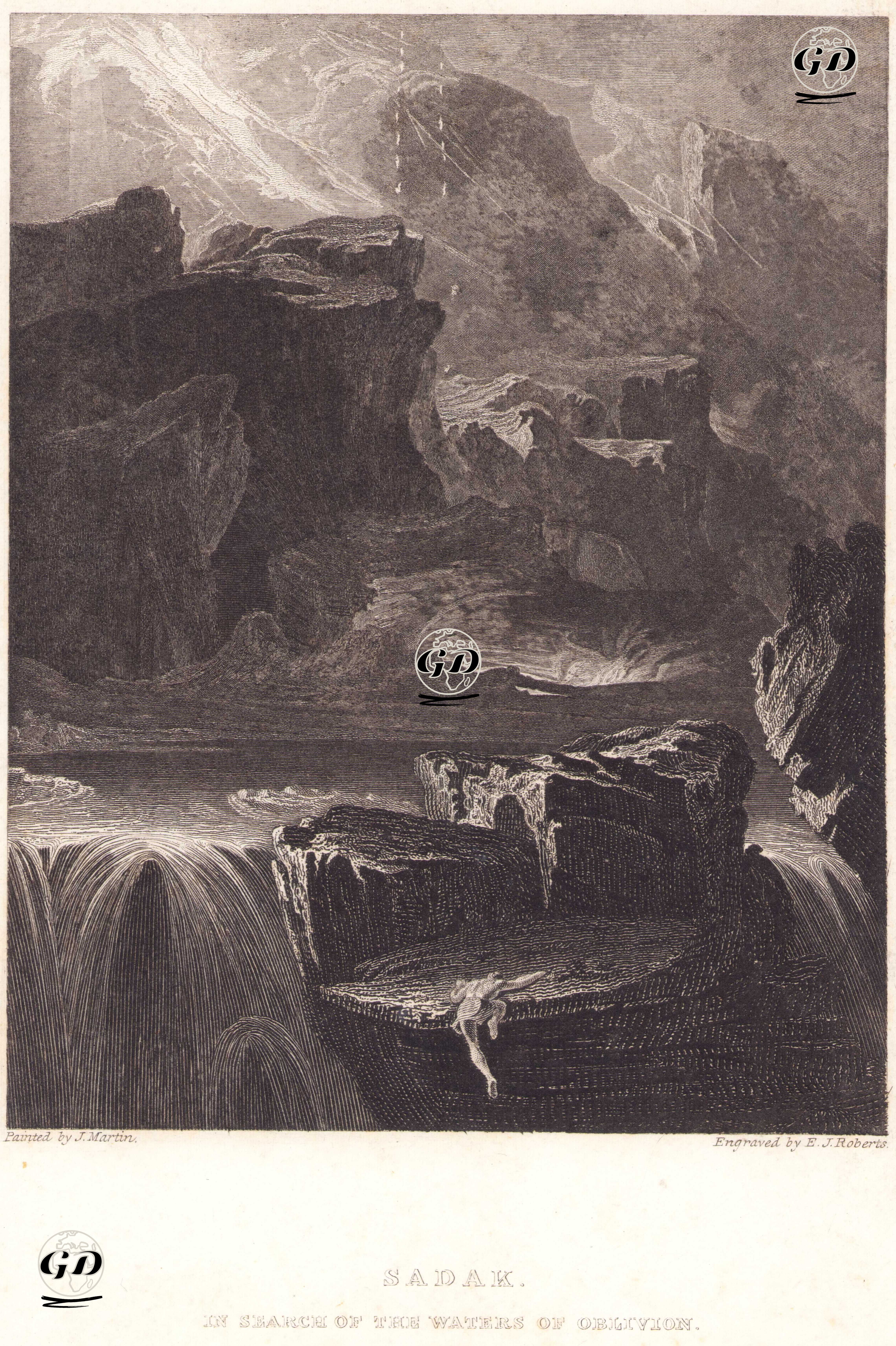
This engraving is based on the famous composition "Sadak in Search of the Waters of Oblivion," painted by English Romantic artist John Martin and engraved by Edward John Roberts. The plot is taken from James Ridley's 1764 work "The Tales of the Genii." In the story, the hero Sadak is tasked by Sultan Amurath to find the "waters of oblivion." The Sultan intends to use these waters to corrupt the fidelity of Sadak's wife, Kalasrade, and seduce her, but Amurath's plan fails and he ultimately dies. After all these ordeals, Sadak ascends to the throne and becomes Sultan. Martin's dramatic composition represents the most formidable of the supernatural obstacles Sadak faces during his extraordinary journey. The engraving offers a visual depiction of Sadak's final struggle to reach the "waters of oblivion" amidst cliffs and waterfalls. The composition bears typical elements of Romanticism. While the human figure remains tiny and almost indistinct, nature dominates the scene as a vast, terrifying, and sublime force. Sadak's desperate climb up the cliff's edge symbolizes the individual's powerlessness in the face of nature, as well as the boundlessness of human will. Martin, considered a master of dramatic landscape painting, uses light in the engraving, with harsh beams of light filtering through the clouds, transforming Sadak's journey into a struggle that is both sacred and tragic. This light perfectly reflects the "sublime" (sublime and terrifying beauty) aesthetic of the Romantic period. The dense line texture used in the engraving's details conveys the hardness of the rocks, the flow of the water, and the movement of the sky with extraordinary theatrical effect. Ultimately, this engraving transforms a story with literary roots that is uniquely Eastern into a universal narrative, interpreted through the dramatic and allegorical language of Western Romanticism. Sadak's struggle on the edge of a precipice simultaneously expresses humanity's resilience in the face of oblivion, the power of love and loyalty, and its fragility in the face of nature.