GRAVÜR DÜNYASI
Digital Engraving Library
| Artist | William Blake Richmond (1842-1921) |
| Date | 1880's-1890's |
| Technique | Lithography Pencil Signature By Artist (Signed By William Blake Richmond in Pencil) |
| Category | Masterpiece Painting |
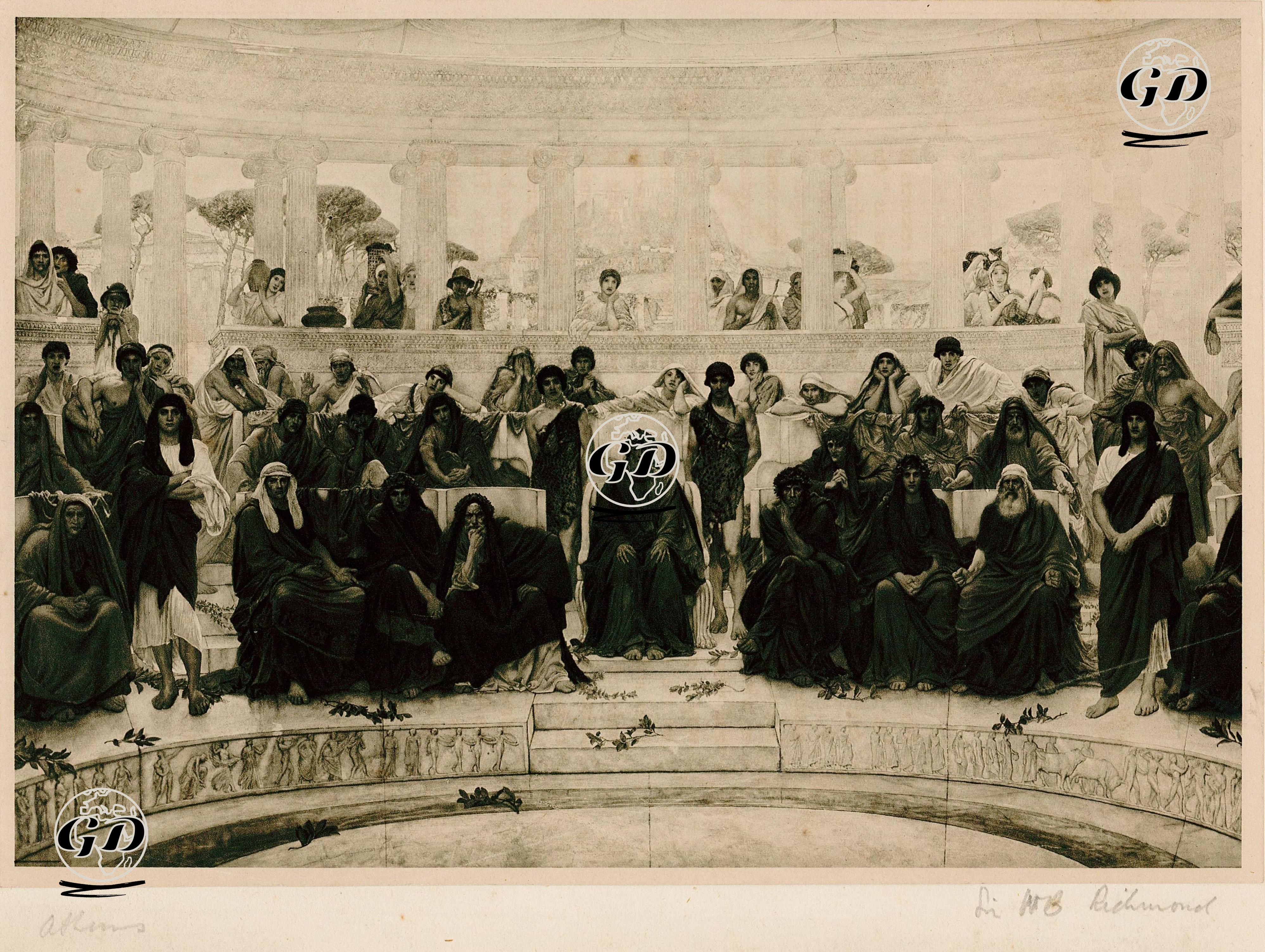
This engraving was produced by the artist Sir William Blake Richmond. The artist's pencil signature appears in the lower right corner and the word "Athens" appears in the lower left corner. The work is a fine example of the meticulous reconstruction of scenes from classical antiquity. The engraving depicts the play Agamemnon, the first part of Aeschylus's famous tragic trilogy, the Oresteia. This play depicts Agamemnon returning from the Trojan War, being greeted by his wife, Clytemnestra, who seeks revenge for the sacrifice of their daughter, Iphigenia, and his subsequent assassination. The engraving depicts the audience's emotional reactions during the dramatic scene of Agamemnon's murder by his wife, Clytemnestra, thus reflecting the holistic nature of ancient theater. At the center of the composition, a priest of Dionysus, god of wine, entertainment, and theater, is seen seated in a throne-like chair, representing the theater's authority and religious dimension. Next to the priest are two male attendants wearing animal skins, characteristic of Dionysian worshippers, associated with the primitive aspects of Dionysian worship. These figures allude to the primitive and ritualistic aspects of the Dionysian cult. This iconographic detail emphasizes that tragedy is not merely a staged performance but also a religious ritual. The sadness, shock, and horror in the audience's facial expressions visually convey the catharsis (purification) experienced by the audience as they witness Clytemnestra murder her husband. The presence of the Acropolis of Athens and the Temple of Theseus in the background demonstrates that the scene is not merely a mythological tale but also a representation of Greek identity and religious and social memory. Thus, Richmond established both a historical and cultural context by combining ancient tragedy with the spatial fabric of Athens. The engraving is also notable for its composition, featuring a wide array of figures. The weight of the figures depicted in dark tones in the foreground intensifies the tragedy's darker atmosphere, while the lighter tones in the background emphasize the grandeur of the mythological setting. The hierarchy Richmond creates in the stage layout reflects the religious and dramatic dimensions of tragedy with powerful symmetry. Ultimately, this engraving is not merely a staging of Aeschylus's Agamemnon, but also an allegorical visualization that brings together the religious, social, and artistic aspects of ancient Greek theater. By conveying the cathartic (purifying) function of tragedy through the audience's emotional responses, Richmond's engraving conveys the essence of ancient theater to modern audiences.