GRAVÜR DÜNYASI
Digital Engraving Library
| Date | 1840`s |
| Technique | Copper Engraving |
| Category | Architecture And Design |
| Source | Stahlstich (Direction v. Kleinknecht) aus der Schweinfurter Graviranstalt des Bibliographisches Institut, Hildburghausen, Amsterdam, Paris & Philadelphia |
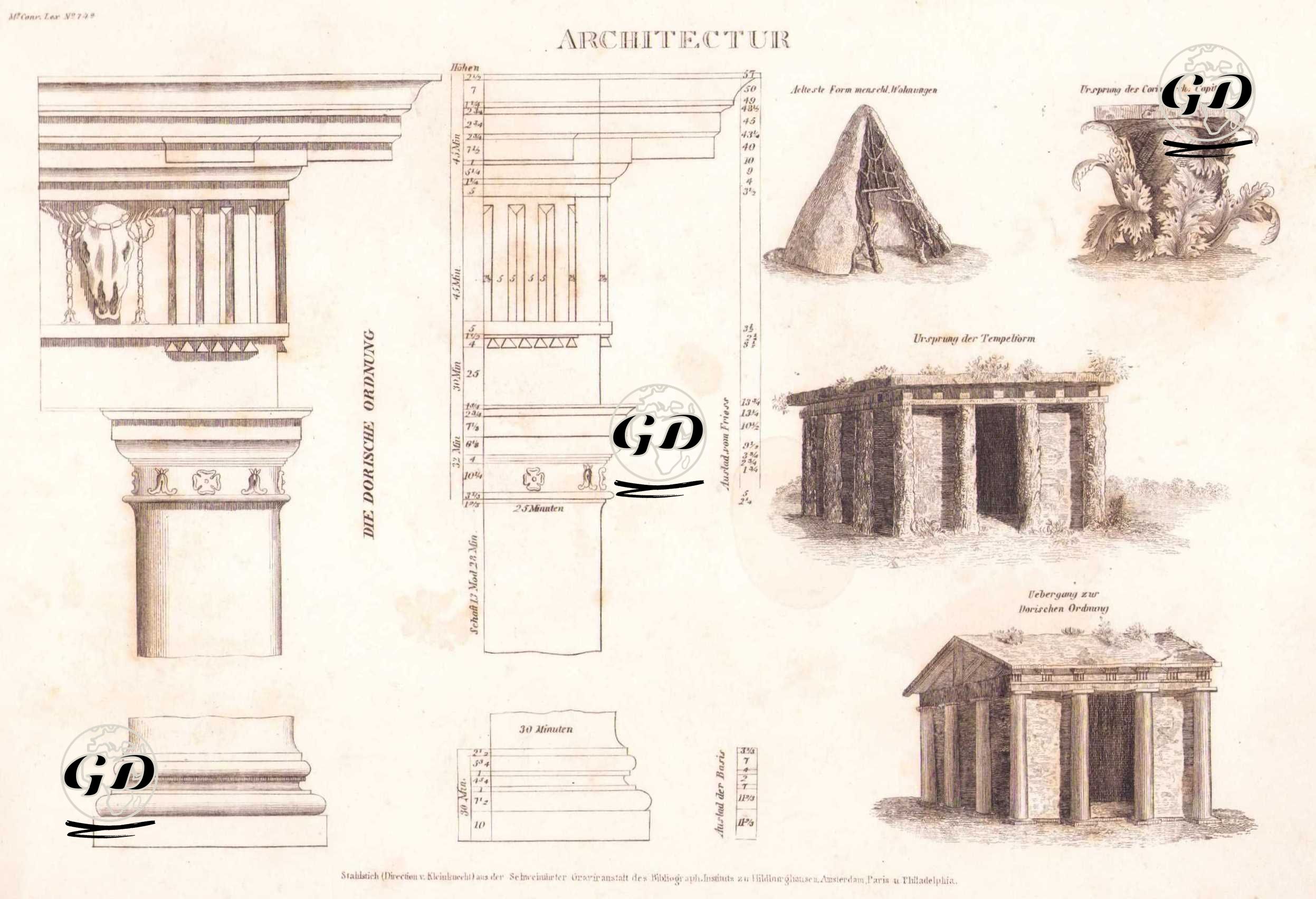
This engraving illustrates an evolutionary interpretation scheme developed in the 19th century regarding the "Origin of the Doric Order," a pivotal turning point in architectural history. According to this view, prevalent in 18th- and 19th-century architectural theories, the first form of Greek temples emerged inspired by humankind's earliest experiences of shelter. The schematic tent form in the upper right represents an abstraction of the "first human shelter." The stone and log structure immediately below represents the transition from this temporary organic shelter to a permanent stone structure. At the bottom, this stone shelter, with its arrangement of columns, horizontal beams, ornamental band, and triangular pediment, evolved into the first example of the Doric order as we know it. This construction visualizes the thesis of the "organic evolution of architectural form" in 19th-century academic architectural thought (especially in the discourse originating from the French and German Ecole des Beaux-Arts). The depiction of the vegetal origin of the Corinthian capital in the upper right corner of the same plate is also part of this ideological framework. The ancient myth (the post-Vitruvian classical narrative) that the Corinthian capital derives from acanthus leaves is presented here as direct iconographic evidence. The left side of the engraving shows in detail the Doric superstructure (entablature) and column proportions, module dimensions, and the projections of the frieze. This technical drawing is not only a stylistic example but also a teaching representation of the "module measurement" system. Thus, the page presents both an archaeological-mythical narrative of origin (cultural origin) and an academically rationalized module system (technical theory). This combination is a unique approach to 19th-century architectural education. It combines the concepts of proportion, measure, and system with a historical understanding that argues that form emerges from nature, function, and cultural memory. In this respect, the engraving is not only a stylistic example but also a visual summary of the modernization of architectural thought.