GRAVÜR DÜNYASI
Digital Engraving Library
| Date | 1875 |
| Technique | Steel Engraving |
| Category | Architecture And Design |
| Source | Bilder-Atlas: Ikonographische Encyklopädie der Wissenschaften und Künste ; ein Ergänzungswerk zu jedem Conversations-Lexikon ; 500 Taf. in Stahlstich, Holzschnitt u. Lithographie ; in 8 Bd.. 5 by bearb. von Karl Gustav Berneck … - Druck und Verlag von F. A. Brockhaus in Leipzig |
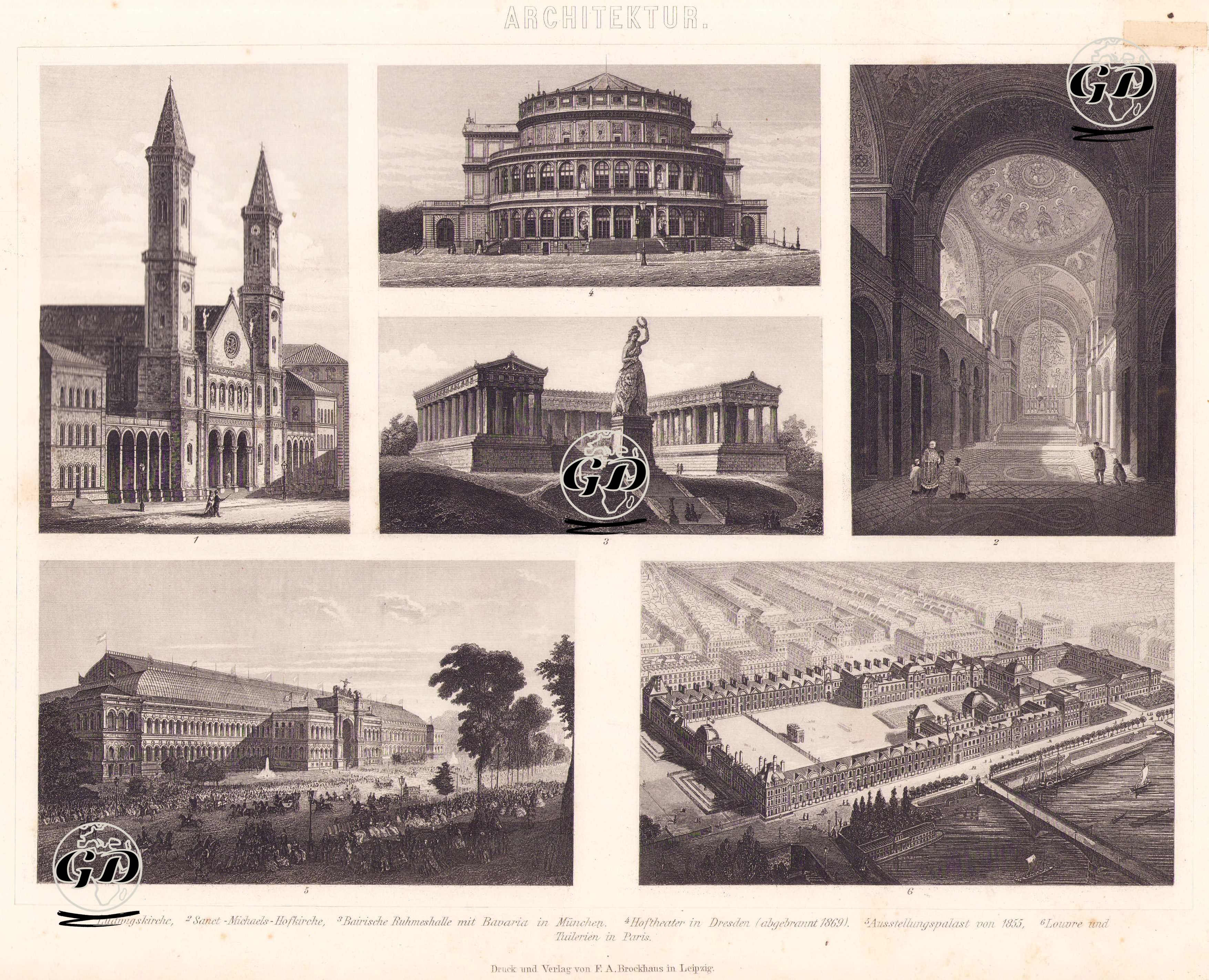
This engraving brings together within the same composition both the "monument concept" of 19th-century European public architecture, which alludes to historical heritage, and the "state representational architecture" that developed alongside modern urbanization. Buildings such as the Ludwigskirche and St. Michael's Hofkirche in the upper row are products of the ideal of rebuilding Munich as a "classical city of art and culture" during the reign of King Ludwig I of Bavaria. Here, the columned façade, borrowed from ancient Greek temple architecture, is transformed into an ideological representational language of 19th-century Catholic church architecture, positioning the religious structure as a part of national memory. The "Ruhmeshalle," built during the same period, and the "Bavaria" statue in front of it form a symbolic whole that unites the modern understanding of the nation-state with the ancient heroic cult. This structure represents the spatial transformation of the modern heroic narrative within the form of an ancient temple. Although the Dresden Hoftheater was destroyed by the fire of 1869, this lost architecture demonstrates the central role of palace theaters in social life in Germany. The Exhibition Palace and the Louvre-Tuileries complex seen in the lower right part of the engraving reveal how exhibition culture, imperial ideology and urban planning in France were combined into a single visual program. Thus, this engraving demonstrates not only the “formal development process” of architecture, but also how the concepts of state, nation, religion, culture and representation were reconstructed through architecture in 19th-century Europe.