GRAVÜR DÜNYASI
Digital Engraving Library
| Date | 1875 |
| Technique | Steel Engraving |
| Category | Architecture And Design |
| Source | Bilder-Atlas: Ikonographische Encyklopädie der Wissenschaften und Künste ; ein Ergänzungswerk zu jedem Conversations-Lexikon ; 500 Taf. in Stahlstich, Holzschnitt u. Lithographie ; in 8 Bd.. 5 by bearb. von Karl Gustav Berneck … - Druck und Verlag von F. A. Brockhaus in Leipzig |
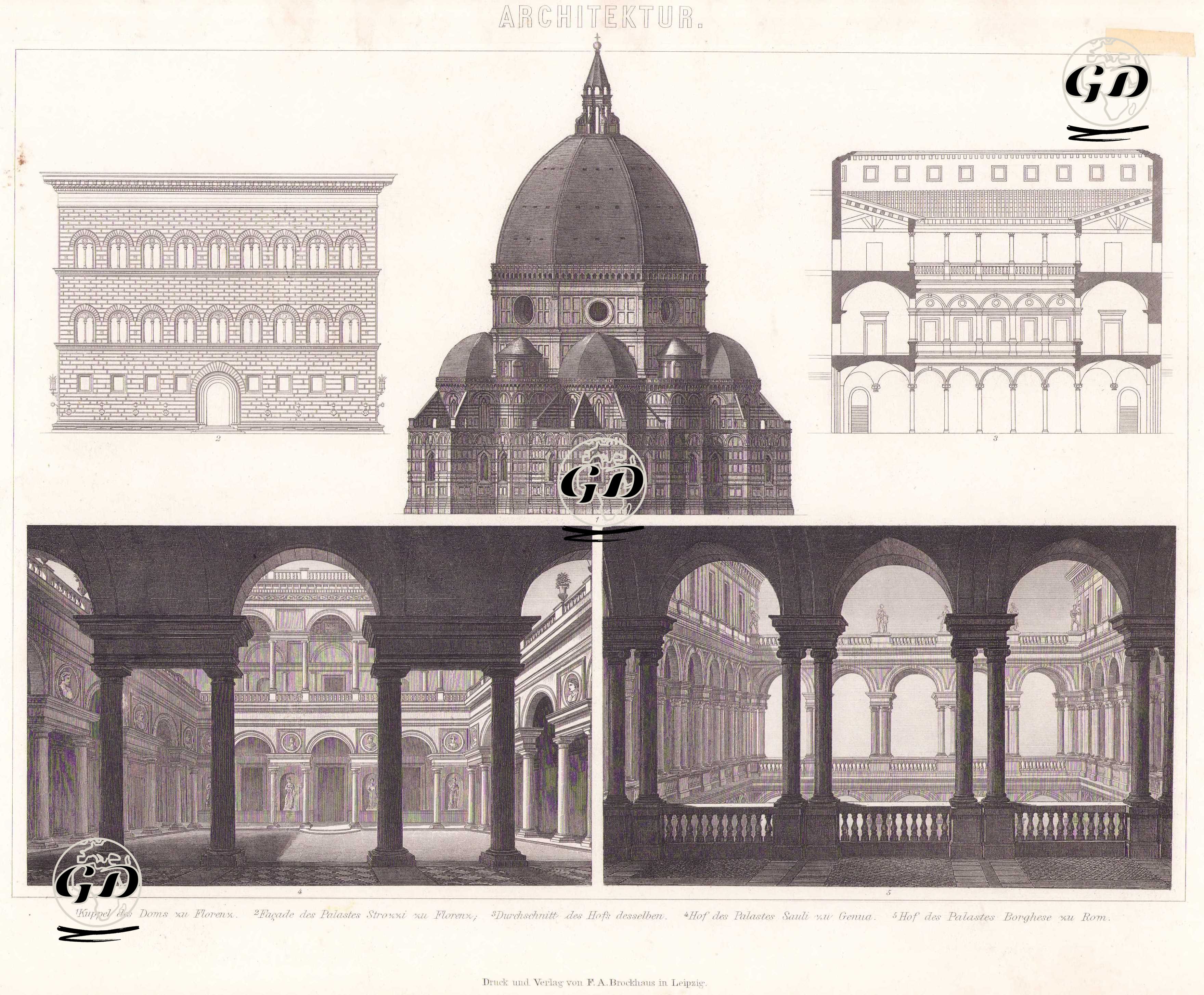
This engraving compares the architectural order and spatial understanding of Florence and Rome, two major centers of the early Renaissance. At its center is Filippo Brunelleschi's dome of Florence Cathedral (1420-1436), which revolutionized the history of engineering. Brunelleschi's double-dome system transcended the boundaries of the Gothic tradition and revitalized the structural heritage of ancient Rome. Therefore, the dome is both a symbol of the return to the classical period and a milestone representing the "technical revolution" of the Renaissance. The courtyards of the Palazzo Strozzi in Florence and the Palazzo Borghese in Rome, shown on the left and right, reflect the ideal order of Italian Early Renaissance palace architecture. This order is based on classical proportions, series of pilasters, rhythmic arches, and the hierarchical arrangement of floors. This courtyard typology reinterprets the tradition of the domus and peristyle courtyard of ancient Rome and, from the 15th century onward, becomes the primary focus of "everyday aristocratic representation" in Italian city palaces. All the structures in this engraving demonstrate the rupture in European architectural history brought about by the Early Renaissance. Building structure is no longer merely a structural system but a visual mathematics determined by proportion and geometry. A departure from the linear and ornamental complexity of the Gothic period, Vitruvius's understanding of classical order is once again adopted as the fundamental criterion, and a perspectival understanding of space constructs the relationship between the inner courtyard and the exterior within a mathematical order. Therefore, this engraving is significant for its comparative presentation of early Renaissance architecture in Florence and Rome, through the classic examples of the period, in terms of both building types (cathedral and palace) and structural elements (dome and courtyard).