GRAVÜR DÜNYASI
Digital Engraving Library
| Date | 1875 |
| Technique | Steel Engraving |
| Category | Architecture And Design |
| Source | Bilder-Atlas: Ikonographische Encyklopädie der Wissenschaften und Künste ; ein Ergänzungswerk zu jedem Conversations-Lexikon ; 500 Taf. in Stahlstich, Holzschnitt u. Lithographie ; in 8 Bd.. 5 by bearb. von Karl Gustav Berneck … - Druck und Verlag von F. A. Brockhaus in Leipzig |
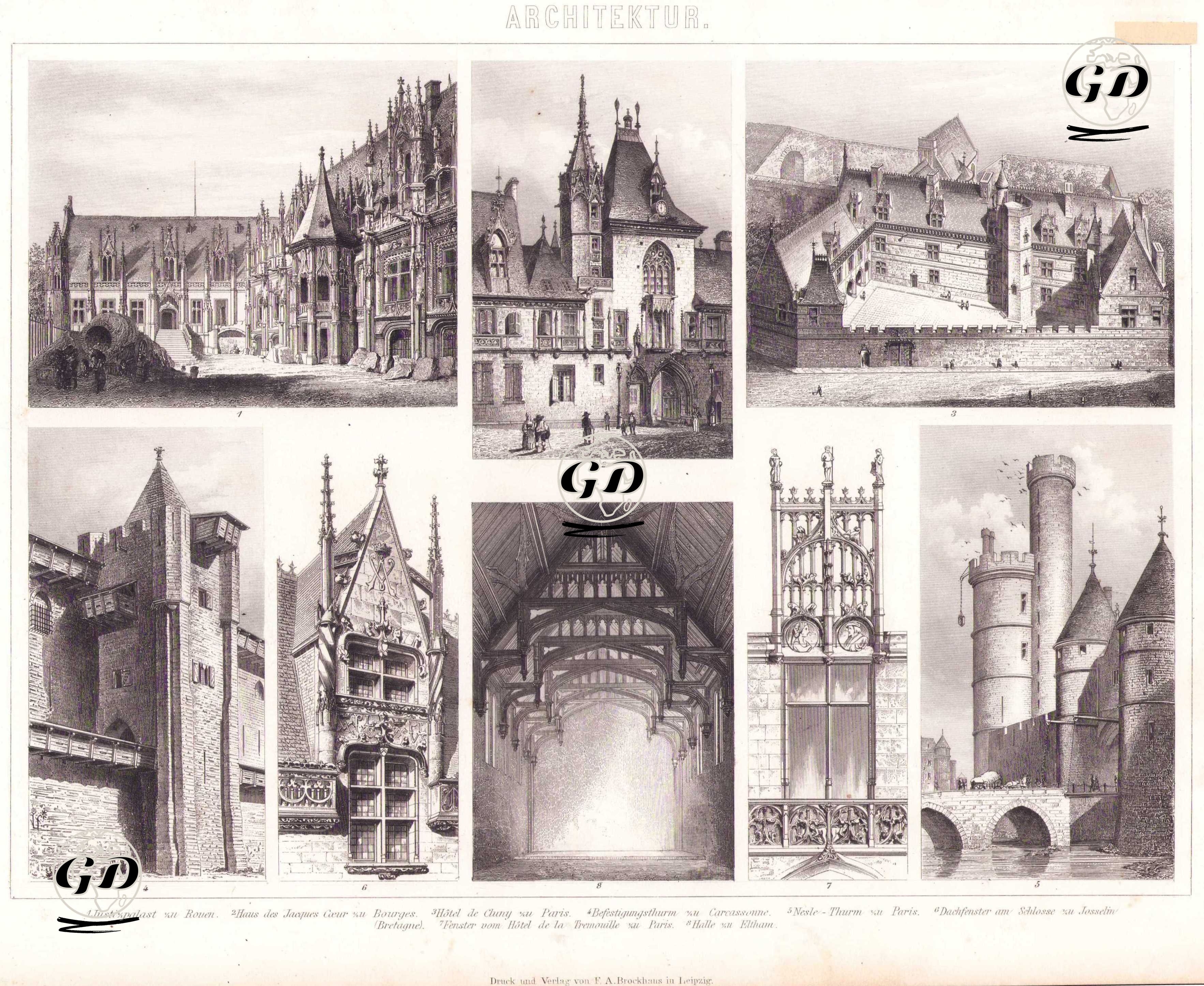
This engraving demonstrates the most prominent use of the late Gothic style, known as "Flamboyant" in French civil architecture between the late 15th and early 16th centuries. The juxtaposition of palace, city residence, municipal building, and castle elements within the same composition demonstrates that Gothic architecture was not limited to religious cathedrals but also served as an active language in the visual representation of royalty, the bourgeoisie, and institutions of justice. Structures such as the Palais des Justices in Rouen, the residence of Jacques Coeur in Bourges, and the Palace of Cluny in Paris reflect a period in which trade and financial power were transformed into artistic representation. Fortifications such as Carcassonne and Josselin demonstrate the final phase of defensive elements such as towers, battlements, machicolations, and fortified entrance systems in medieval military architecture. Detailed engravings of windows, roofs, and interiors, along with carved wooden ceilings, floral reliefs, intricately carved windows, and Gothic rosettes, demonstrate how late French art, in both stone and woodwork, brought a refined aesthetic dimension to its architecture. These examples demonstrate how French Gothic architecture was defined not only by the ideals of verticality and elevation, but also by urban life, commercial representation, aristocratic residential culture, and functional diversity within the "establishment."