GRAVÜR DÜNYASI
Digital Engraving Library
| Date | 1875 |
| Technique | Steel Engraving |
| Category | Architecture And Design |
| Source | Bilder-Atlas: Ikonographische Encyklopädie der Wissenschaften und Künste ; ein Ergänzungswerk zu jedem Conversations-Lexikon ; 500 Taf. in Stahlstich, Holzschnitt u. Lithographie ; in 8 Bd.. 5 by bearb. von Karl Gustav Berneck … - Druck und Verlag von F. A. Brockhaus in Leipzig |
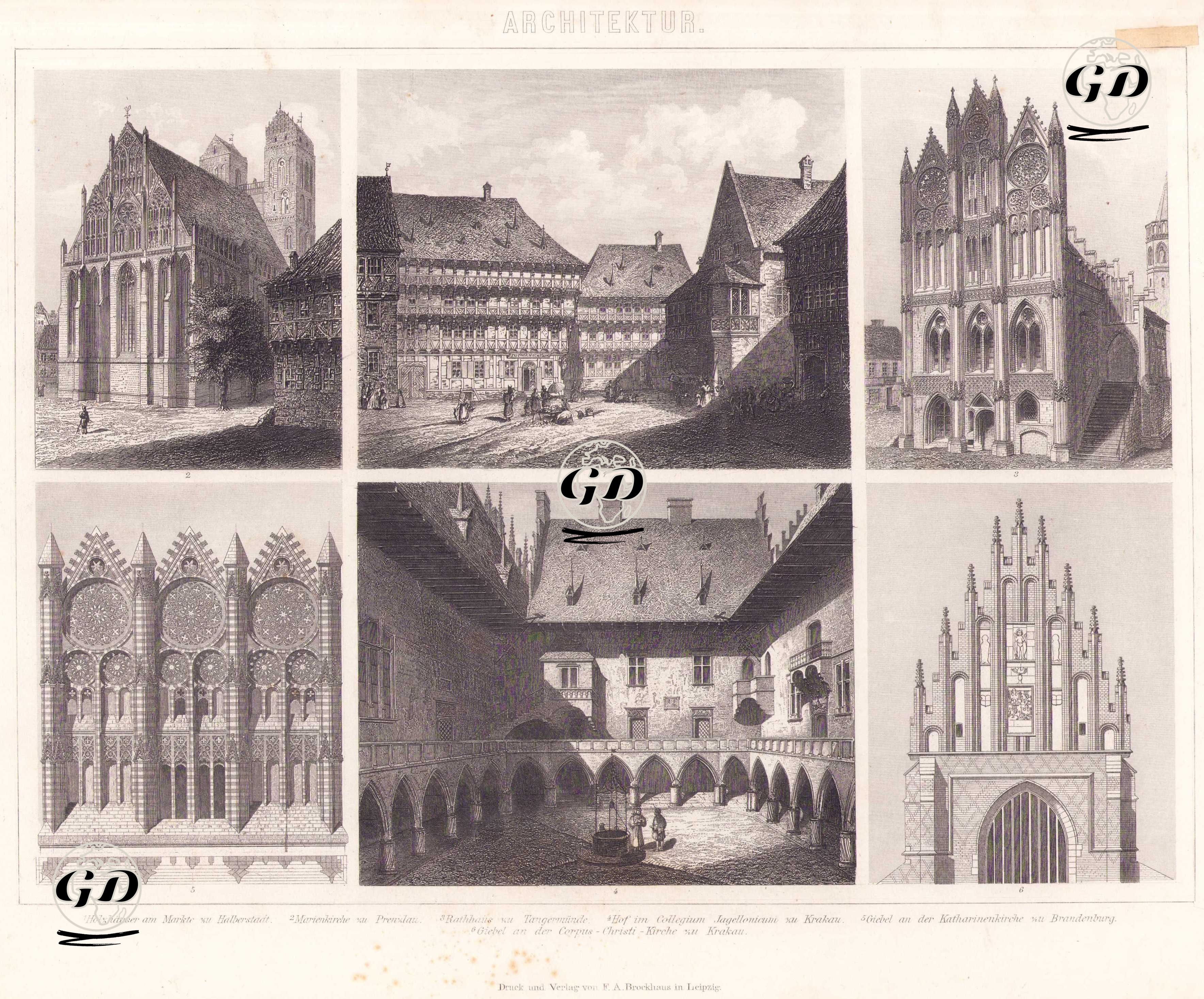
This engraving depicts examples of "civil Gothic architecture" in Central and Northern Germany and Central Europe. The municipal buildings, merchant guilds, town houses, college courtyards, and facade claddings found here demonstrate the profound and decisive role that Gothic form played not only in cathedrals and religious buildings but also in the civic organization of urban life. Comparing the timber construction tradition of Halberstadt, in particular, with the richly modeled facades of "Brick Gothic" centers like Prenzlau and Brandenburg, one sees that the Gothic style, while varying depending on the material, retained its essence. Regardless of the material used, this style consistently maintained its core characteristics, such as vertical emphasis, rhythmic window rows, slender rib systems, and complex niche geometries. The courtyard of the Collegium Jagellonicum in Krakow is particularly noteworthy for its demonstration of how Gothic could be adapted to public educational spaces in late medieval academic architecture.