GRAVÜR DÜNYASI
Digital Engraving Library
| Date | 1875 |
| Technique | Steel Engraving |
| Category | Architecture And Design |
| Source | Bilder-Atlas: Ikonographische Encyklopädie der Wissenschaften und Künste ; ein Ergänzungswerk zu jedem Conversations-Lexikon ; 500 Taf. in Stahlstich, Holzschnitt u. Lithographie ; in 8 Bd.. 5 by bearb. von Karl Gustav Berneck … - Druck und Verlag von F. A. Brockhaus in Leipzig |
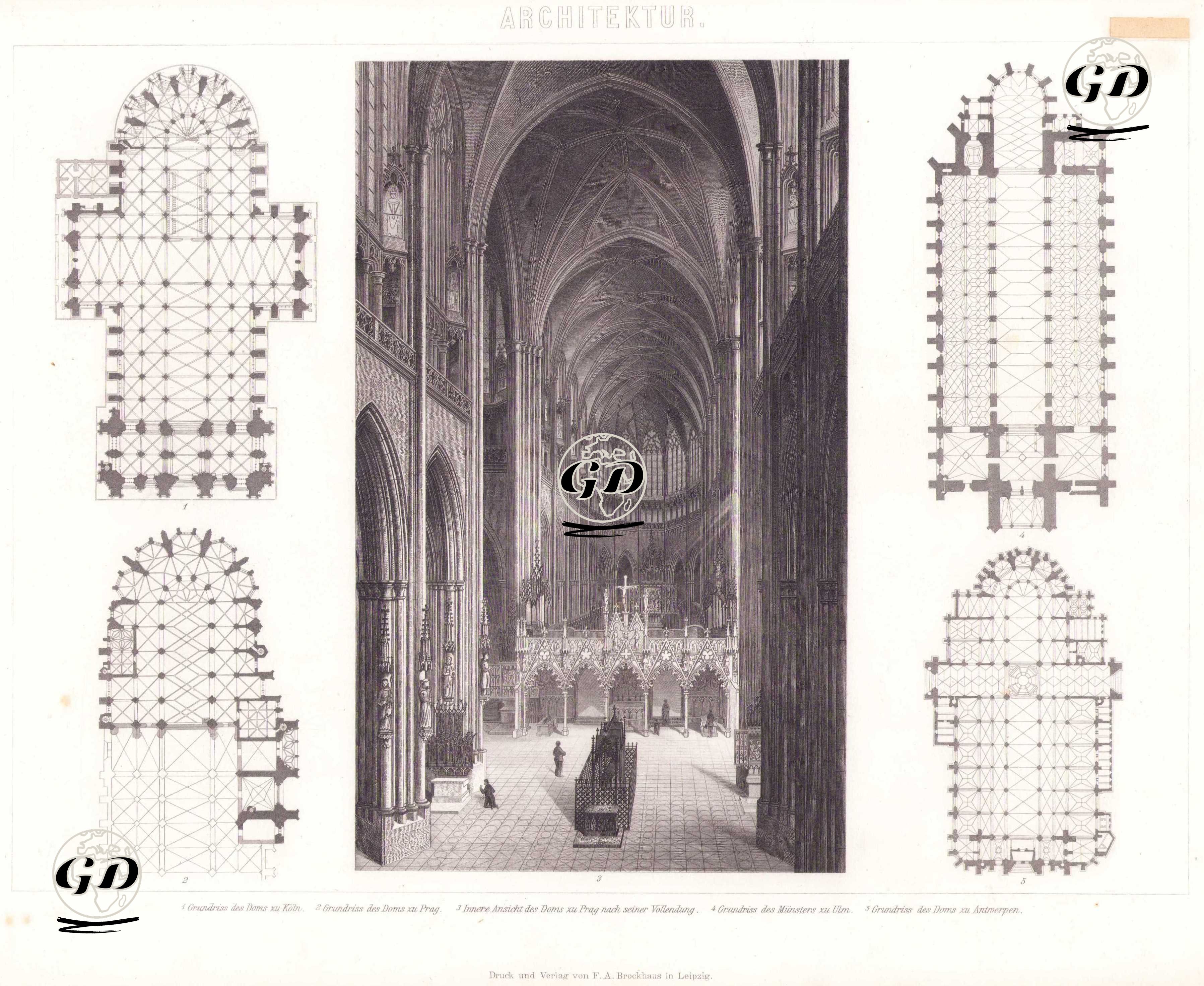
This engraving provides a comparative plan view of the cathedral typology, representing the highest stage of maturity in European Gothic architecture. The spatial projection of Gothic ideals of proportion, light, and height is provided alongside the plan drawings. The depiction of the interior in the central panel impressively reflects the fundamental idea of elevation and the concept of space elevated by light, both fundamental characteristics of Gothic architecture. Pointed arches, ribbed vaults, and ascending colonnades symbolize the inherent idea of "ascent from earth to heaven." The plan types seen on either side (Cologne Cathedral, Prague Cathedral, Ulm Minster, and Antwerp Cathedral) represent different regional interpretations of Gothic. While remaining within the same structural language, elements such as the main nave length, the proportions of the side aisles, the arrangement of chapels, and the transept layout differ. Such comparisons were used in 19th-century art history publications as a didactic method for classifying architectural types.