GRAVÜR DÜNYASI
Digital Engraving Library
| Date | 1875 |
| Technique | Steel Engraving |
| Category | Architecture And Design |
| Source | Bilder-Atlas: Ikonographische Encyklopädie der Wissenschaften und Künste ; ein Ergänzungswerk zu jedem Conversations-Lexikon ; 500 Taf. in Stahlstich, Holzschnitt u. Lithographie ; in 8 Bd.. 5 by bearb. von Karl Gustav Berneck … - Druck und Verlag von F. A. Brockhaus in Leipzig |
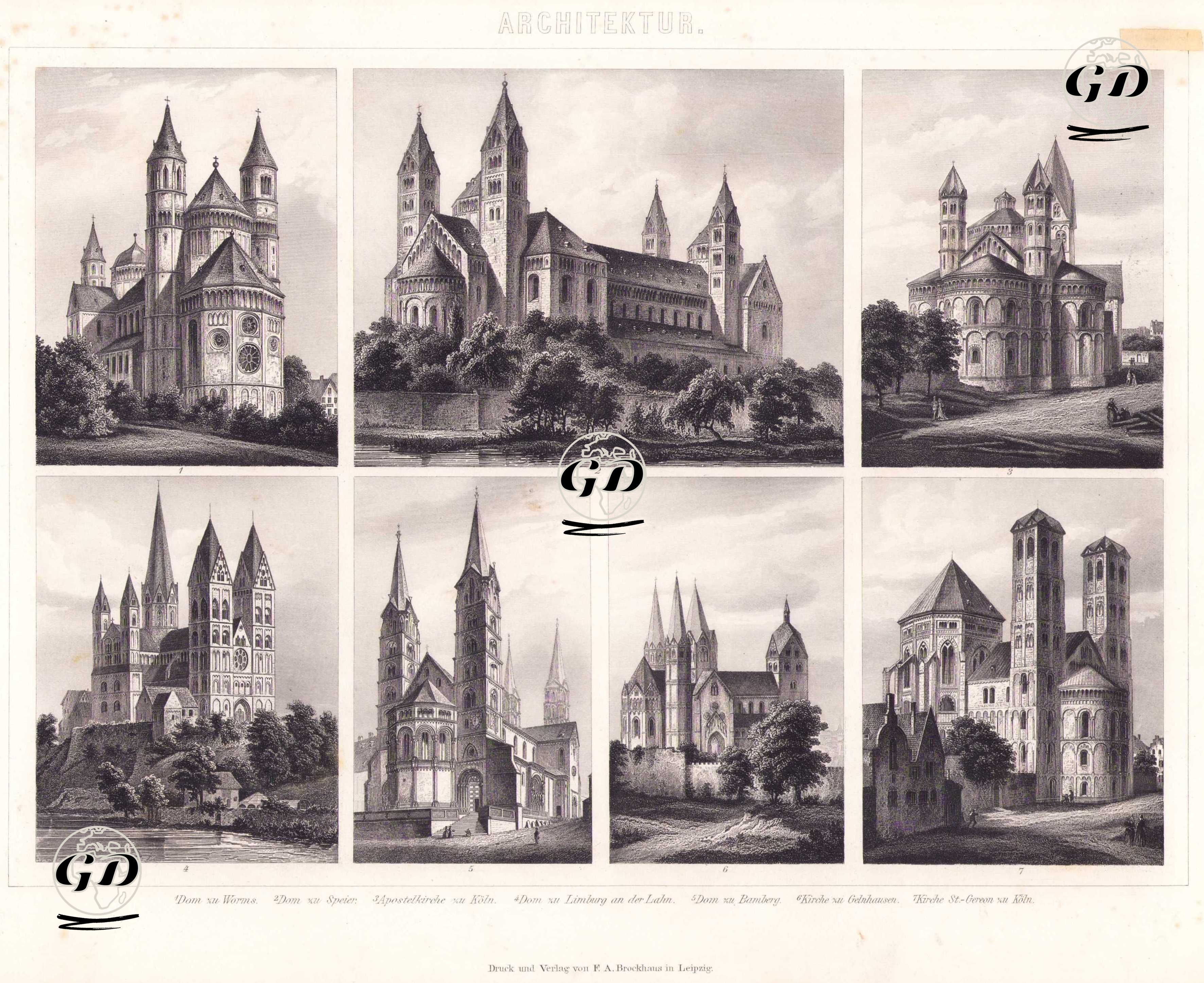
This engraving shows the most important cathedrals and churches of Romanesque architecture in Germany. The Romanesque style (circa 10th-12th centuries) represents the early petrification of medieval architecture in Western Europe. This style is characterized by its thick walls, semicircular arches, vaulted ceilings, and massive towers. Each structure in the engraving dominated Germany's medieval urban fabric as a symbol of both religious and political power. Worms Cathedral, in the upper left, was built in the early 12th century and is among the most important Romanesque structures in Germany. Speyer Cathedral, in the middle section, built between 1030 and 1106, was the largest cathedral in the Holy Roman Empire and the tomb church of the emperors. Mainz Cathedral, in the upper right, stands out with its red sandstone facades and maintained its importance as the religious and political center of Germany throughout the Middle Ages. Limburg Cathedral, seen in the bottom row, is one of the most refined examples of the Rhenish Romanesque style. Its multi-towered façade composition, raised arched spans, and geometric proportions are both a precursor to Gothic and an elegant representation of late Romanesque. St. Gereon Church (Cologne), in the bottom right, maintains the geometric balance inherited from Roman architecture with its ten-sided central plan, and its interior dome reflects Byzantine influence. This engraving emphasizes themes of the Romanesque period, such as architectural continuity, the culture of pilgrimage in Christianity, and the permanence of sacred space. These examples of German Romanesque style reflect both the technical proficiency of local stonemasonry and the disciplined geometry of monastic architecture.