GRAVÜR DÜNYASI
Digital Engraving Library
| Date | 1875 |
| Technique | Steel Engraving |
| Category | Architecture And Design |
| Source | Bilder-Atlas: Ikonographische Encyklopädie der Wissenschaften und Künste ; ein Ergänzungswerk zu jedem Conversations-Lexikon ; 500 Taf. in Stahlstich, Holzschnitt u. Lithographie ; in 8 Bd.. 5 by bearb. von Karl Gustav Berneck … - Druck und Verlag von F. A. Brockhaus in Leipzig |
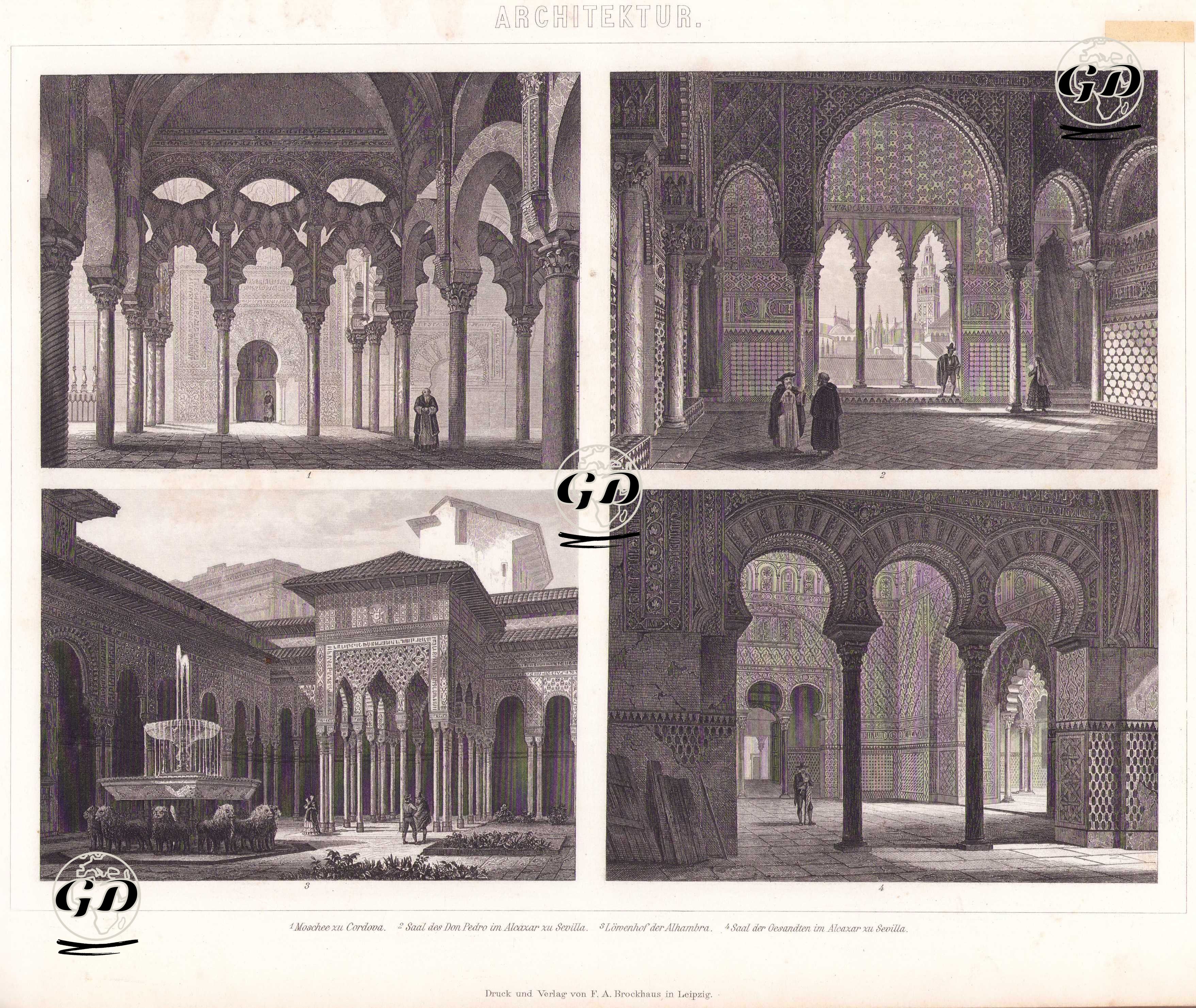
The engraving depicts the interiors of four monumental structures selected from the cities of Cordoba, Seville, and Granada in southern Spain. These structures strikingly represent the architectural, decorative, and lighting influences of the Umayyad-Andalusian style (8th-15th centuries AD) on Western European art history. Above left, the interior of the Great Mosque of Cordoba (Mezquita de Cordoba). This scene is one of the most impressive examples of the multi-columned hypostyle order, known as the forest of columns in Islamic architecture. The rhythmic perspective created by the red and white arched bands gives the space both boundless expanse and divine symmetry. The mosque was begun by the Caliph Abd al-Rahman I in the 8th century and expanded by subsequent Umayyad rulers. Above right, a hall from the Alcázar Palace in Seville is depicted. This place, one of the most elegant examples of the Mudejar style (a form of Islamic aesthetics continued in the Christian period), attracts attention with its horseshoe arches, stalactite decorations (muqarnas) and walls adorned with geometric plasterwork. The view in the background overlooks the Giralda Tower, the former minaret of Seville Cathedral. The scene in the lower left shows the Patio de los Leones (Lions' Courtyard) of the Alhambra Palace in Granada. The marble pool supported by twelve lion statues is a symbolic aquatic center that reflects the idea of a garden of paradise in Islamic art. The Alhambra Palace, built in the 14th century during the Nasrid dynasty, is an example of the culmination of Islamic architecture's harmony between light, water, and ornament. The engraving in the lower right also depicts an interior of the Seville Alcázar. The multi-layered arch system here indicates a transitional architecture that blends Umayyad tradition with Gothic and Renaissance influences. This synthesis also demonstrates the influence of Andalusian art on the European Renaissance. Architectural elements throughout the engraving (horseshoe arches, stalactite vaults, geometric arabesques, and Kufic borders) visualize the abstract aesthetic ideal of Islamic architecture.