GRAVÜR DÜNYASI
Digital Engraving Library
| Date | 1875 |
| Technique | Steel Engraving |
| Category | Architecture And Design |
| Source | Bilder-Atlas: Ikonographische Encyklopädie der Wissenschaften und Künste ; ein Ergänzungswerk zu jedem Conversations-Lexikon ; 500 Taf. in Stahlstich, Holzschnitt u. Lithographie ; in 8 Bd.. 5 by bearb. von Karl Gustav Berneck … - Druck und Verlag von F. A. Brockhaus in Leipzig |
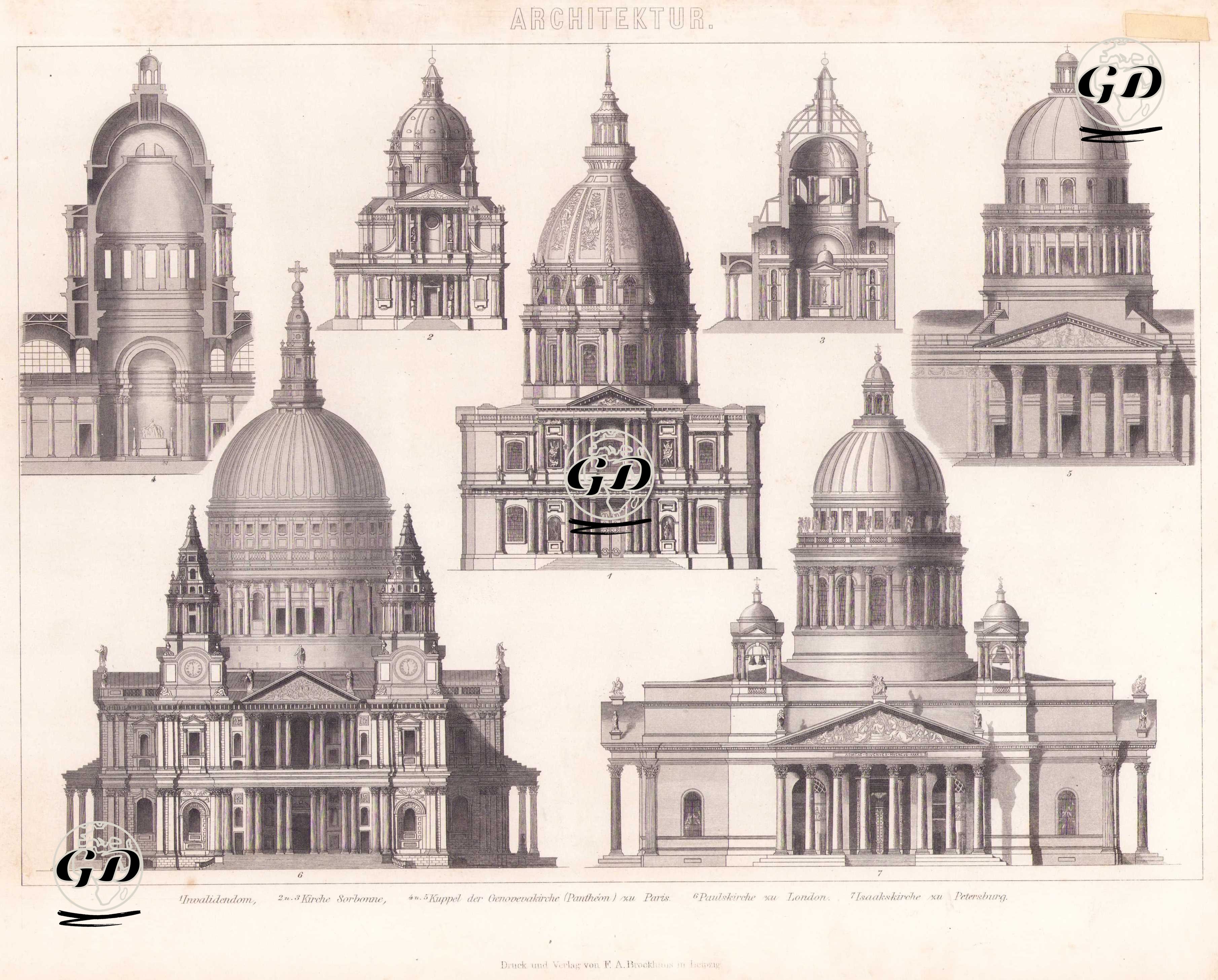
This engraving comparatively depicts the most outstanding examples of Baroque and Neoclassical cathedral architecture, which rose in Europe in the 17th and 18th centuries. The drawings emphasize the construction of dome structures, their section plans, and façade layouts. The building at the center of the engraving is St. Paul's Cathedral (London), built by the English architect Sir Christopher Wren between 1675 and 1710. The engraving shows in detail both the cathedral's façade and the double-shell dome system of the interior. Wren's design combines the central plan approach inspired by the Italian Renaissance with the elegance of English Baroque. In this respect, St. Paul's is considered an iconic structure in Protestant Europe, equivalent to St. Peter's Basilica in Rome. The other examples in the upper sections reflect the evolution of dome architecture in various European cities. Planned by Michelangelo and founded by Bramante, St. Peter's Basilica (Rome) provided the model for domes throughout Europe. The dome of the Church of Les Invalides in Paris, designed by Jules Hardouin-Mansart, is a symbol of French Baroque architecture and embodies rational grandeur with its geometric symmetry. The Church of Saint Geneviève (Pantheon) in Paris, completed by Soufflot in the late 18th century, is a most impressive example of Neoclassical formalism. St. Isaac's Cathedral (St. Petersburg), designed by Auguste de Montferrand, is the religious monument of the 19th-century Russian Empire that most strongly reflects Western European influences. Each structure in the engraving is considered in conjunction with the theological and political symbolism of architectural form. Representing both the perfect circle of heaven and the idea of divine centrality, the dome is the most universal element of sacred architecture.