GRAVÜR DÜNYASI
Digital Engraving Library
| Date | 1875 |
| Technique | Steel Engraving |
| Category | Architecture And Design |
| Source | Bilder-Atlas: Ikonographische Encyklopädie der Wissenschaften und Künste ; ein Ergänzungswerk zu jedem Conversations-Lexikon ; 500 Taf. in Stahlstich, Holzschnitt u. Lithographie ; in 8 Bd.. 5 by bearb. von Karl Gustav Berneck … - Druck und Verlag von F. A. Brockhaus in Leipzig |
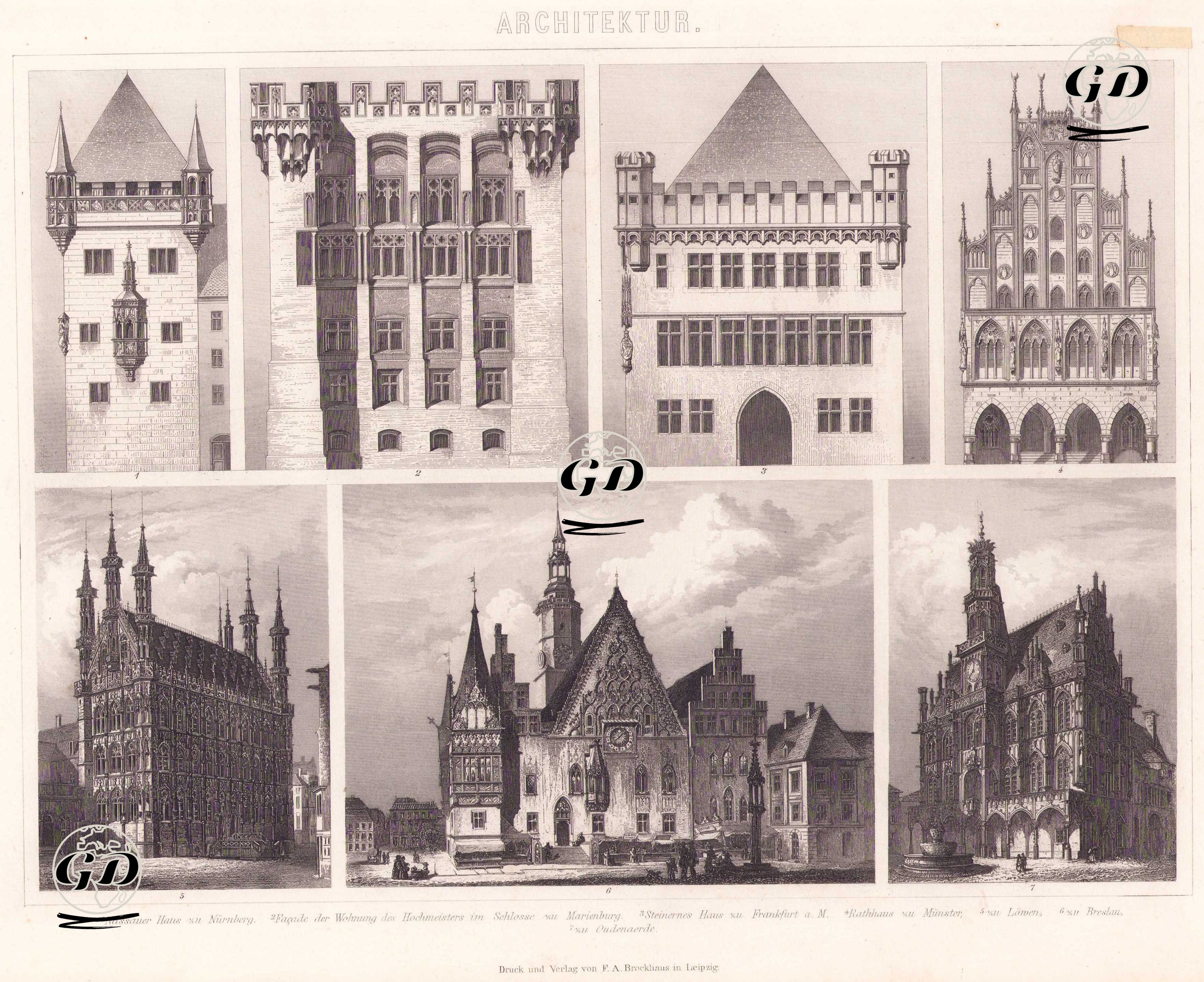
This engraving documents in detail the late Gothic and early Renaissance town halls (Rathaus) and townhouses built between the 14th and 16th centuries. The North German tradition of brick Gothic architecture, which flourished in northern Europe, manifested itself in these building types as symbols of commercial wealth and local autonomy. The façade drawings at the top of the engraving are of civic buildings from various German cities. On the left, the town house (Nassauer Haus) in Nuremberg, with its tower-like structure and pointed roof tower, represents a residential form derived from medieval defensive architecture. The central façade depicts the residential wing of the Grand Master of the Teutonic Order at Marienburg Castle. Its thick masonry and narrow vertical windows reflect the architectural character of the late Gothic period. The building on the right, Stralsund Town Hall, is one of the most magnificent examples of the "brick Gothic" style in northern Germany. With its pointed arched windows, rosette openings and façade niches, it reflects the rich aesthetic sense of the Hanseatic cities. The bottom row depicts the most important municipal buildings of the period in perspective. On the left, Leuven Town Hall (Belgium) stands out for its elaborate stonework and tower-adorned façade of late Flemish Gothic architecture. In the center is the municipal complex known as the Frankfurt Römer. With its triple pediment and Gothic windows, this structure is a symbol of German city government. On the right, the Münster and Bremen Rathauses stand out as symbols of commerce and urban identity in northern European civic architecture. The Bremen Town Hall's rich relief decorations and sculptural bands demonstrate how Renaissance influences were incorporated into the Gothic tradition.