GRAVÜR DÜNYASI
Digital Engraving Library
| Date | 1875 |
| Technique | Steel Engraving |
| Category | Architecture And Design |
| Source | Bilder-Atlas: Ikonographische Encyklopädie der Wissenschaften und Künste ; ein Ergänzungswerk zu jedem Conversations-Lexikon ; 500 Taf. in Stahlstich, Holzschnitt u. Lithographie ; in 8 Bd.. 5 by bearb. von Karl Gustav Berneck … - Druck und Verlag von F. A. Brockhaus in Leipzig |
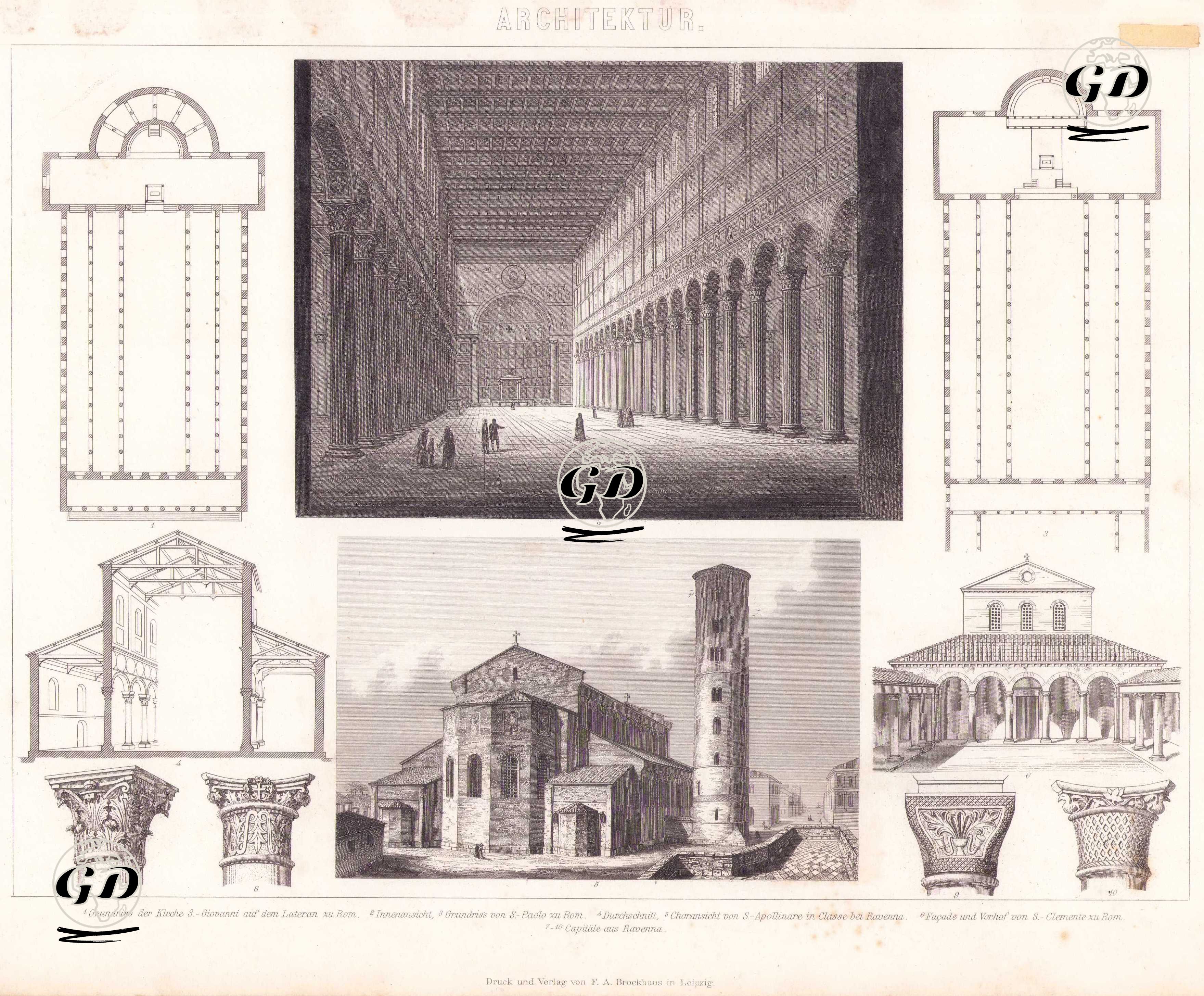
This engraving presents examples of the most important early Christian religious buildings in Rome, such as San Clemente, San Paolo fuori le Mura (Saint Paul Outside the Walls), and San Apollinare in Classe (Ravenna), along with plans, sections, and elevations. The interior view at the center of the engraving is a perspective of the nave (main aisle) of the Basilica of St. Paolo fuori le Mura. Built in the late 4th century during the reign of Emperor Theodosius, this structure represents the basilica plan of early Christian architecture in its purest form. The wide central nave is separated from the side naves by rows of Corinthian columns, and a flat-ceilinged, apse-like layout is preferred. This design is a typical example of adapting the architectural tradition of Roman public buildings to the Christian liturgy. The plan drawings in the upper left and right sections illustrate the symmetrical layout of the Basilica of San Clemente (Rome) and similarly planned structures. In these plans, the rectangular main space ends with a semicircular apse. The atrium at the entrance served as a gathering place for early Christian communities. The lower section, depicting San Apollinare in Classe (Ravenna), exemplifies the impact of Byzantine influence on Italy. Known for its apse mosaics, this structure reflects Byzantine artistic dominance in the 6th century, while its exterior maintains the simple, brick-built basilica architecture. The adjacent cylindrical bell tower is a typical architectural element of Ravenna. The column capitals seen at the bottom of the engraving shed light on the decorative style of the period. One is adorned with acanthus leaves of classical Corinthian origin, while the others bear the stylized crosses, palmettes, and braid motifs of the early Byzantine period. These details represent the transitional period when pagan classical style merged with Christian symbolism.