GRAVÜR DÜNYASI
Digital Engraving Library
| Engraver | Heloise Leloir |
| Date | 1850's |
| Technique | Lithography-Original Hand Colored |
| Category | Fashion |
| Source | Imp. Mariton - L’Iris: Journal de Modes et d’Arts |
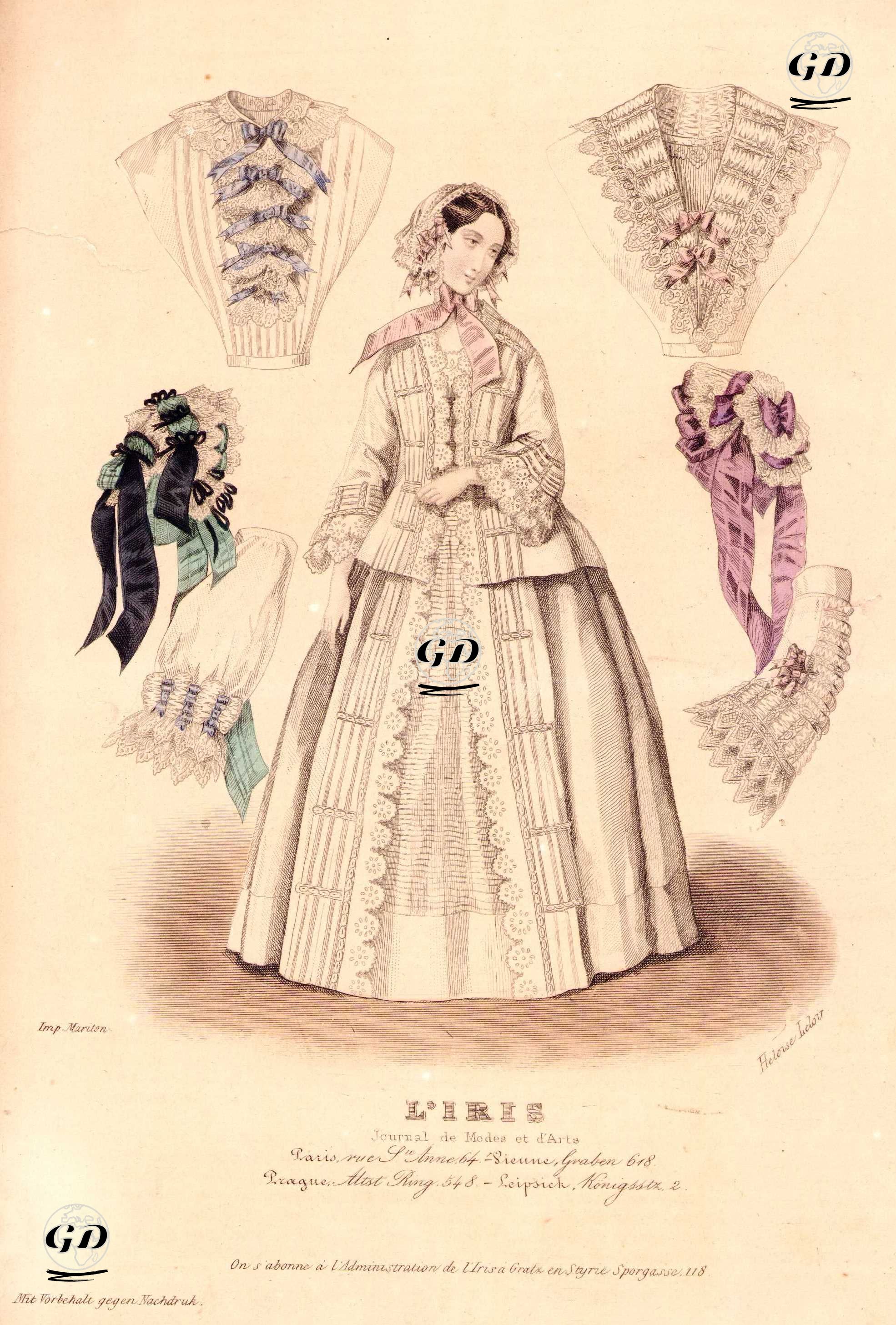
This elegant fashion engraving was published in the Paris-based women's magazine L'Iris- Journal de Modes et de Littérature. Published in the mid-19th century, L'Iris, along with publications such as Le Follet, La Mode Illustrée, and Journal des Demoiselles, played a significant role in shaping French fashion during the Napoleonic era. It served as a fashion and lifestyle magazine that conveyed not only clothing trends but also literary, cultural, and moral refinements to women. The female figure at the center of the engraving should be interpreted through the silhouette of the crinoline period (particularly prominent in the late 1850s and early 1860s). The waistline is emphasized, the upper body more controlled, while the skirt is distinctly wide and "bell-shaped" thanks to its internal structure (cage crinoline/similar). This silhouette is not merely an aesthetic choice but a clothing regime linked to the technological and industrial transformation of the period (the widespread use of mass-producible internal structures such as steel-hoop crinolines). The wide skirt geometry in the plate strongly evokes this historical moment. The most instructive aspect of the composition is the accessory-variant vignettes placed around the main figure. Different collar front arrangements are seen in the upper part, bonnet-head alternatives on the sides, and possible cuff-sleeve options. The engraving shows not only the "complete garment" but also how the parts that make up the garment can be diversified. Thus, the engraving describes fashion not as a single image, but as a system of combinable pieces. In the engraving, there is a "refined" appearance, not only through the fabric itself, but also through details such as the density of lace, the extent of ribbon use, and the balance of flowers/rosettes in the headdress. Here, fashion is not merely a layer covering the body, but a visual code that regulates how the body is read within society. Therefore, it is more accurate to consider the engraving not as a photograph directly documenting the daily life of the period, but as a normative stylistic discourse desired, encouraged, and reproduced by that era.