GRAVÜR DÜNYASI
Digital Engraving Library
| Artist | William Etty (1787-1849) |
| Engraver | Charles Wentworth Wass (1822-1905) |
| Date | 1848 |
| Technique | Steel Engraving-Etching-Mezzotint (Proof) |
| Category | Mythology |
| Source | The Art Journal - Printed by Brooker & Harrison - Published by Art Union of London - Proof |
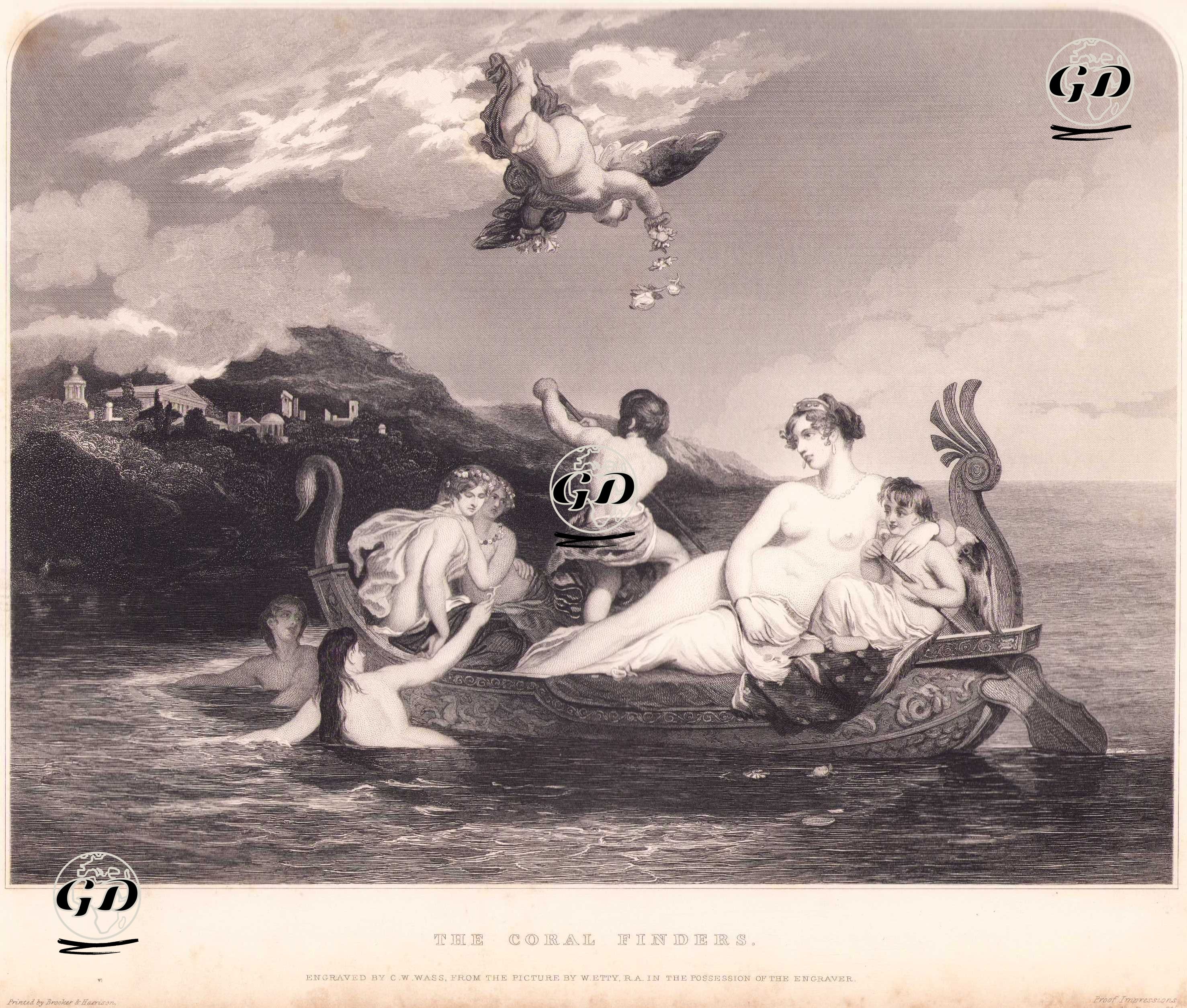
"The Coral Finders," produced by William Etty in 1820 and engraved by Charles Wentworth Wass, is considered one of the artist's most striking and poetic works. First exhibited at the Royal Academy in England, this work was introduced in catalogs as "Venus and her youthful attendants arriving at the Isle of Paphos" but later became widely known as "The Coral Finders." The composition depicts Venus (Aphrodite), the goddess of love and beauty born from sea foam in Greek mythology, arriving on the shore in a boat with her retinue of young figures. In the engraving, Venus is shown reclining gracefully on a boat, surrounded by figures of Eros, young women, and sea nymphs. The figure of a putto floating in the sky adds a mythological richness to the scene. The figures in the water accompany Venus and collect the gifts of nature. The title "The Coral Finders" is not based on the young figures in the water searching for coral, but rather on an allegorical connotation. In 19th-century painting, coral was both an exotic and elegant object, and a precious "jewel" extracted from the depths of nature, often compared to the beauty of women. At the same time, in mythology, coral, pearls, and seashells are among the symbols of Venus, representing beauty, fertility, and the gifts of nature. Therefore, the gathering of coral by Venus's entourage is not merely a literal act but a symbolic search for the beauty and gifts of nature to offer Venus. Ultimately, "The Coral Finders" is both an interpretation of the Venus myth and a symbolic narrative linking nature's riches with love and beauty. While the engraving reflects William Etty's poetic approach to mythological subjects, it also reveals how the idealized body of Venus and the gifts of nature were presented in visual harmony in the art of the period.