GRAVÜR DÜNYASI
Digital Engraving Library
| Artist | F. Catherwood |
| Engraver | H. Adlard |
| Date | 1840`s |
| Technique | Steel Engraving |
| Category | Uncategorized |
| Source | Incidents of Travel in Yucatan by John Lloyd Stephens - London: Longman & Co. |
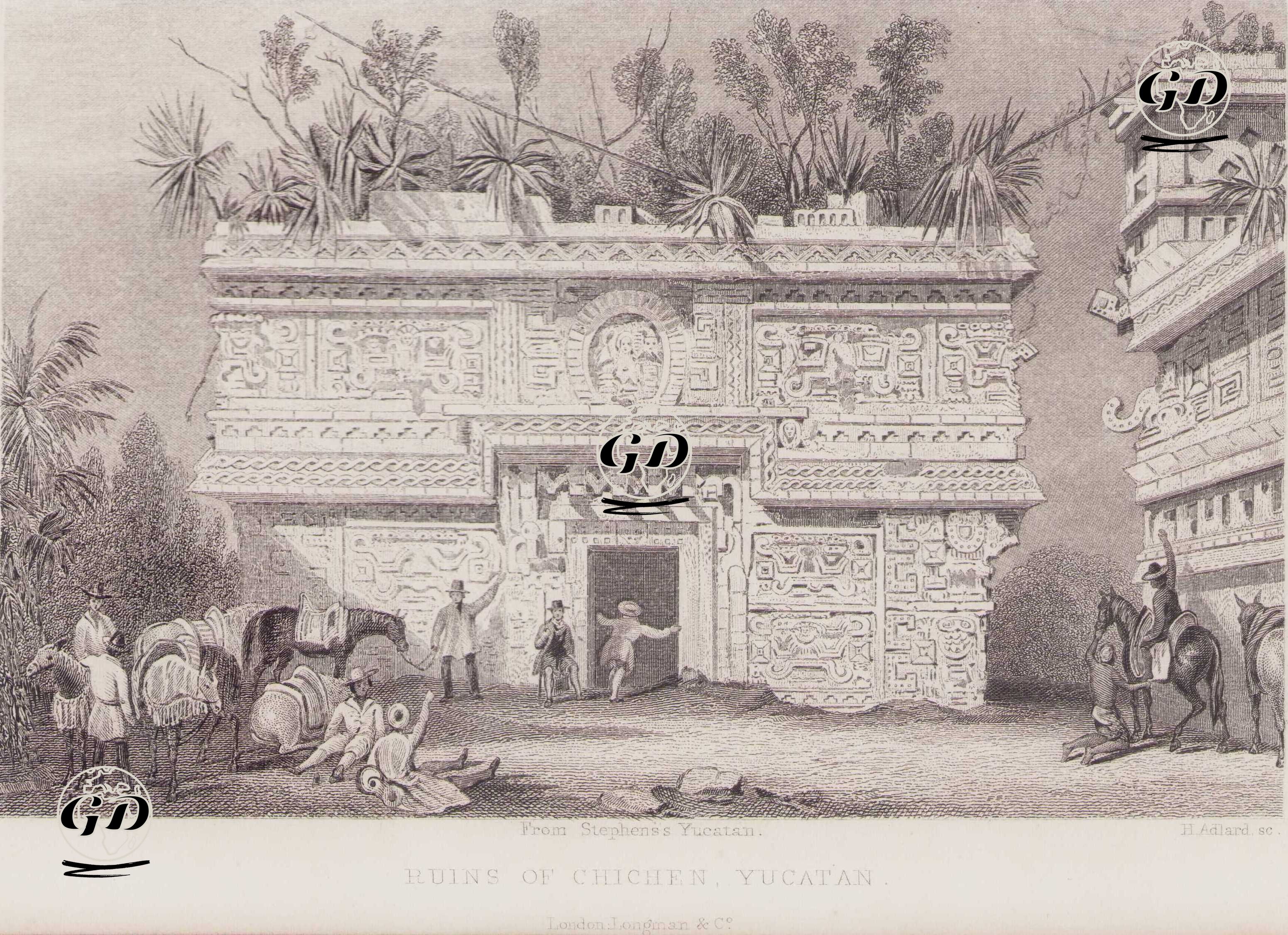
This engraving, titled "Ruins of Chichen, Yucatan," is based on John Lloyd Stephens's mid-19th-century travelogue "Incidents of Travel in Yucatan." The engraving's illustrations were created by renowned architect and artist Frederick Catherwood. The work is based on observations made at the ruins of the ancient city of Chichen Itza during Stephens and Catherwood's archaeological expeditions in Central America in the 1840s. The scene depicted in the engraving depicts the architectural ruins of Chichen Itza, one of the most magnificent centers of the Maya civilization, located on Mexico's Yucatan Peninsula. Founded in the 6th century AD, Chichen Itza became the political, economic, and religious capital of the region, particularly from the 9th to the 12th centuries. Inscribed on the UNESCO World Heritage List in 1988, Chichen Itza is now considered one of the most visited archaeological sites in Latin America. The structure at the center of the complex is the Casa de las Monjas (House of the Nuns), one of the most outstanding examples of the Puuc style of Mayan architecture. This structure is notable for its rich geometric reliefs, divine mask figures (especially the facial depictions of the rain god Chaac), and intricate stonework. The decorations along the façade, featuring serpent motifs, symbolic forms, and mythological elements, reflect Maya society's understanding of cosmic order, the balance between natural forces and deities. The engraving also features European travelers and indigenous figures in front of the structure, documenting the atmosphere of exploration and colonial archaeology during the period. The mounted travelers and resting natives illustrate how 19th-century researchers observed the region and introduced the Maya civilization to the Western world. Stephens and Catherwood's discoveries are among the first visual documents that introduced the artistic and architectural heritage of the Maya civilization to the Western world. These drawings were later used as early visual sources of archaeology in travel books published in Europe and America. The engraving also highlights the influence of nature on the structures, namely the revitalization of plants on stone architecture.