GRAVÜR DÜNYASI
Digital Engraving Library
| Date | 1800`s |
| Technique | Copper Engraving |
| Category | Uncategorized |
| Source | Printed for R. Phillips, St. Paul’s Church Yard, London |
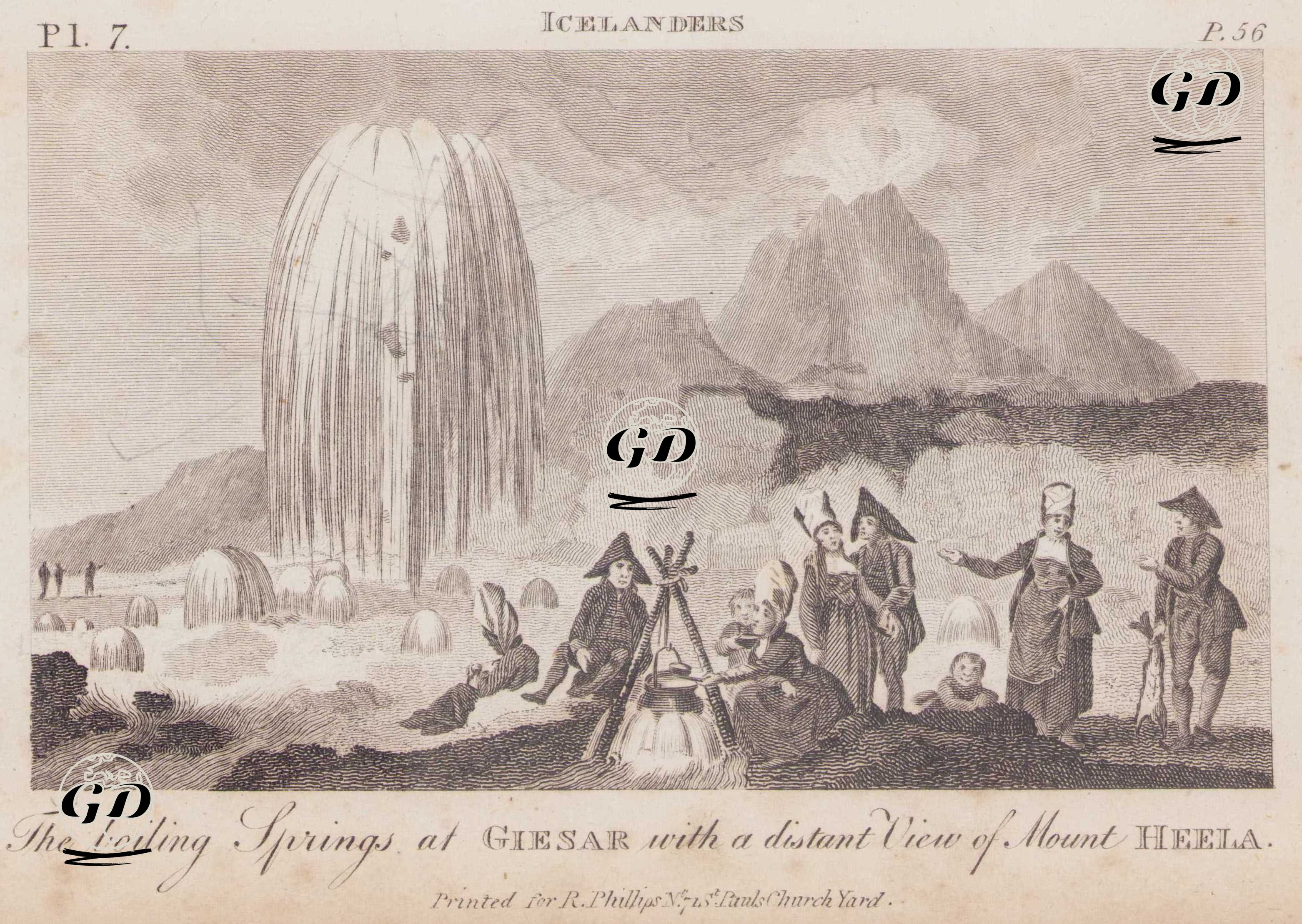
This engraving is an important natural depiction from the late 18th-century European geography of exploration. It depicts the hot water gushes (geysers) that occur in the Geysir region, one of Iceland's most famous geothermal areas. In the foreground, Icelandic people, depicted in traditional clothing, are seen gathered near the natural hot springs. One woman places her pot on the geyser, taking advantage of the natural heat, while others observe this extraordinary natural phenomenon in amazement. A massive column of hot water suddenly rising in the background emphasizes the power and dramatic energy of nature. Mount Hekla, located on the horizon, was depicted as an active volcano known in 18th-century Europe as the "gateway to hell." Geysir hot springs are formed by the eruption of geothermal energy from underground. Magma-heated water is forced upwards by pressure, causing periodic eruptions. The surrounding soil exhibits a yellowish-white hue caused by sulfur, silica, and minerals. Iceland's most famous spring is the historic Great Geysir. Known since the 13th century, this natural formation could sometimes gush hot water and steam up to 70 meters. Although its activity has diminished today, the nearby geyser Strokkur continues to gush hot water every 5–10 minutes to a height of approximately 20–30 meters. Mount Hekla is one of Iceland's most famous and active volcanoes. Located in the south of the country, about 110 kilometers east of the capital, Reykjavik, it reaches an elevation of 1,491 meters above sea level. According to historical records, Hekla has experienced at least 20 major eruptions since 874 AD. One of the most devastating eruptions occurred in 1104, blanketing large areas of surrounding settlements in ash. For this reason, in Medieval Europe, Hekla was called the "Gate of Hell" and was popularly believed to be a mountain where demons lived.