GRAVÜR DÜNYASI
Digital Engraving Library
| Date | 1770`s |
| Technique | Copper Engraving |
| Category | Uncategorized |
| Source | A New, Royal and Authentic System of Universal Geography |
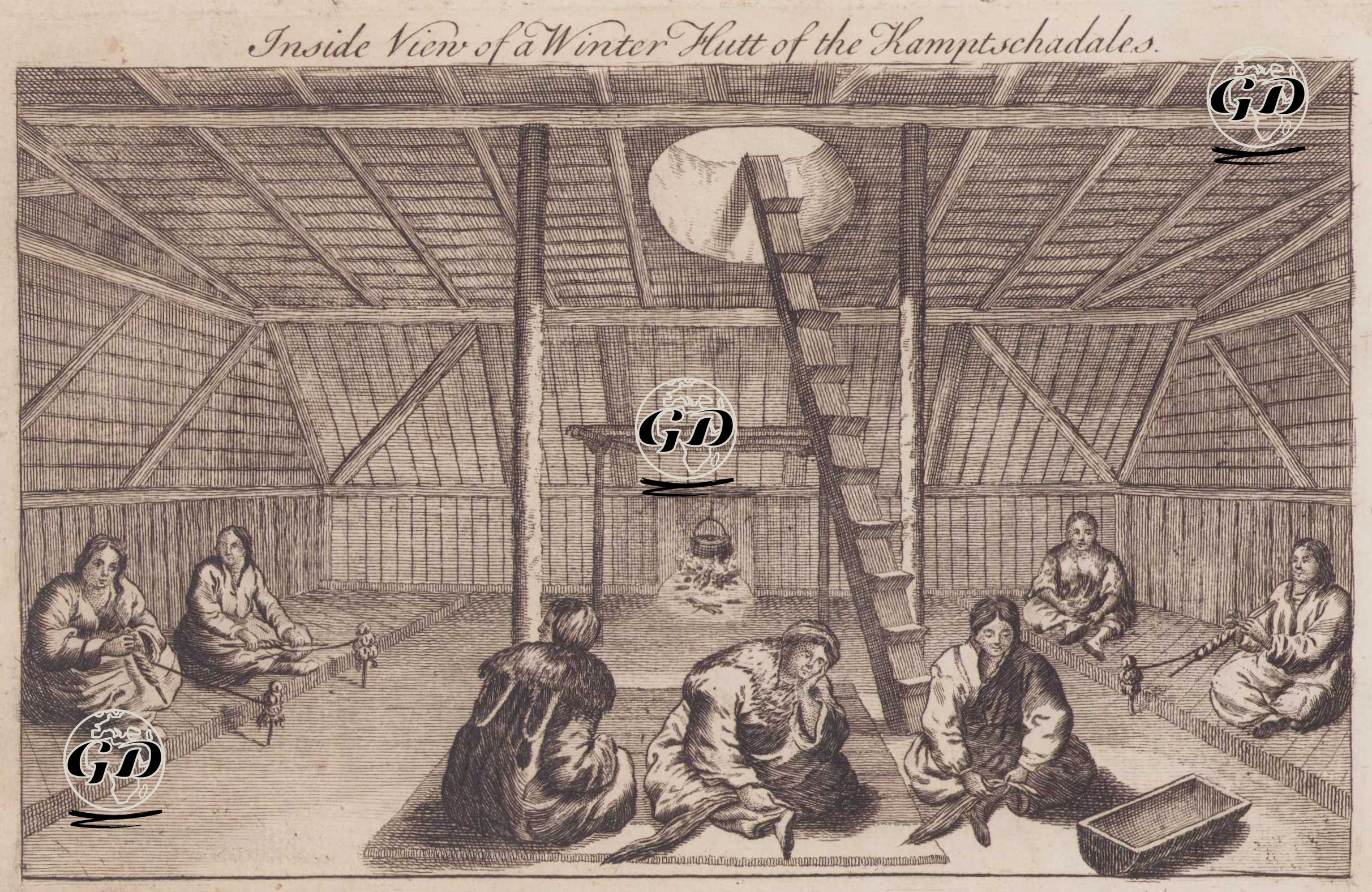
This engraving, dating from the 18th century, is one of the earliest visual documents of the daily life of the Kamchatka indigenous communities, who have lived for thousands of years on the Kamchatka Peninsula, the easternmost point of the Russian Empire. It depicts the interior of a winter shelter partially buried underground, supported by wooden beams. At the center of the structure, a staircase extends to a ceiling opening, and below it, a hearth (a stone oven) used for heating and cooking is visible. The circular opening in the ceiling serves both as a smoke outlet and an entrance. Figures of men and women, clad in heavy fur, sit in rows along the wall, some engaged in crafts, others resting. The composition reflects both the functional organization of the space and the social unity inherent in Kamchatka culture. The primary indigenous communities of the Kamchatka Peninsula are the Itelmens, Koryaks, Evens (Lamuts), and Chukchis. The Itelmens, one of the oldest settled peoples, live in the southern part of the peninsula and also call themselves "Kamchadal." Traditionally, they live by fishing, hunting, and reindeer herding. The Koryaks, on the other hand, live a nomadic life in the north, moving their reindeer herds to pastures according to the seasons. Both communities have shamanistic beliefs and a rich animistic worldview developed through the worship of nature spirits, mountains, animals, and ancestors. This scene in the engraving is a visual representation of the ethnographic information that reached Western Europe as a result of the 18th-century expeditions of explorers such as Vitus Bering and Georg Wilhelm Steller to the Kamchatka Peninsula. With the arrival of Russian explorers in the 18th century, the Kamchatka natives were affected by colonization, disease, and cultural assimilation. Over time, the Russian language and Orthodoxy spread, and a large portion of the indigenous population became ethnically mixed. Today, the Kamchatka natives are recognized within the Russian Federation as the "Small Indigenous Peoples of the North," and to preserve their cultural heritage, they are working to revive their local language, music, dance, and shamanic ceremonies. The region is still considered one of the original examples of Siberian indigenous life, with its reindeer culture, fishing villages, wooden totems, and tundra shamanism.