GRAVÜR DÜNYASI
Digital Engraving Library
| Artist | S.Wale |
| Engraver | J.Hall |
| Date | 1770`s |
| Technique | Copper Engraving |
| Category | Uncategorized |
| Source | A New, Royal and Authentic System of Universal Geography |
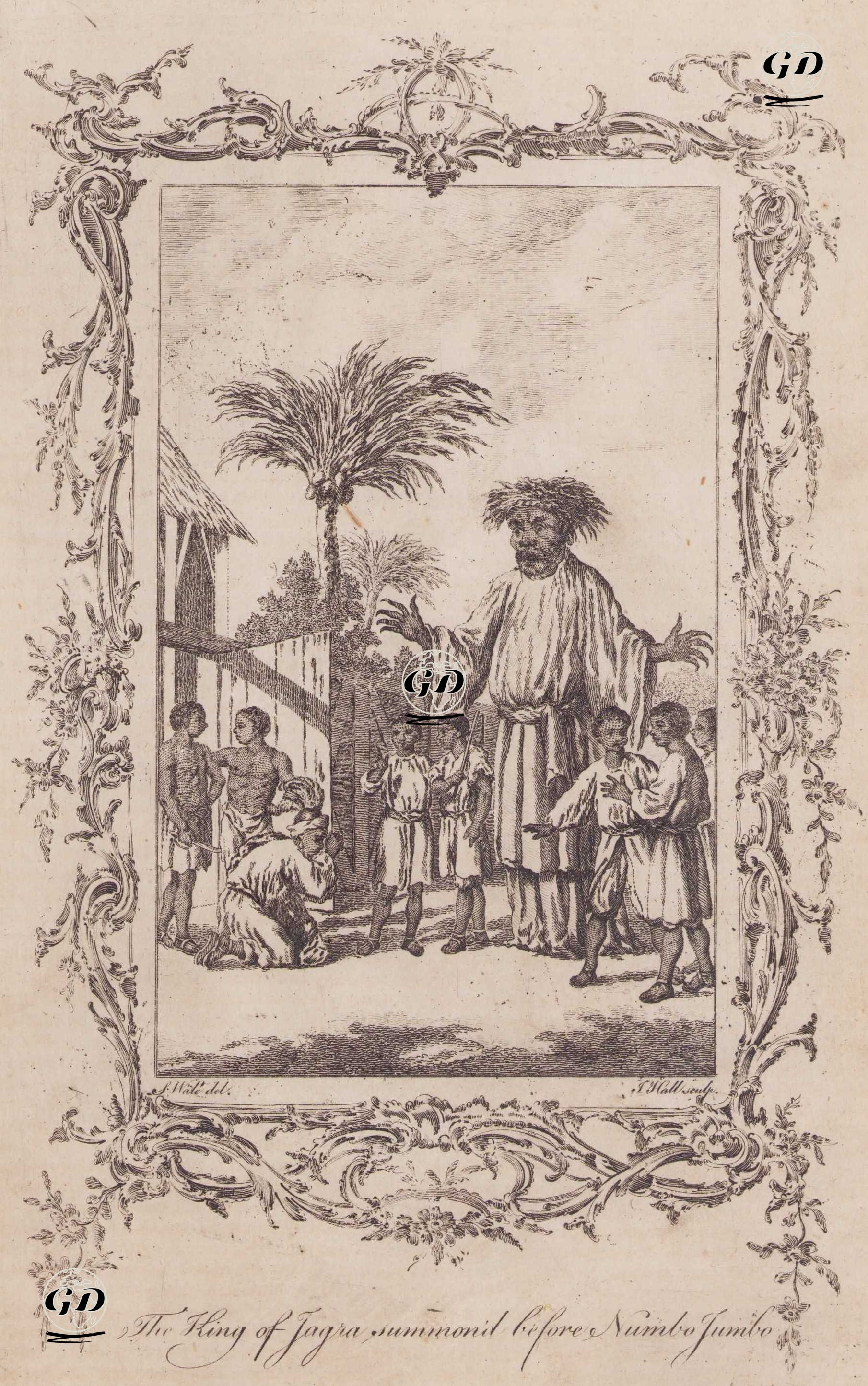
This engraving is one of the imaginative representations of West African societies in 18th-century Europe. The composition depicts a scene purportedly reflecting African village life and local forms of governance. In the center, a superhuman-sized figure in long robes (a ceremonial figure referred to as "Mumbo Jumbo" in European sources) appears before the king and the villagers. This character, described by contemporary European travelers as a mystical figure who "administers justice" or "disciplines women," is actually a caricatured rendering of traditional West African social rituals. In reality, "Mumbo Jumbo" is a masked dancing figure representing social order or moral authority in village life, particularly in the rituals of the Mandingo and Fula peoples of Mali and the Gambia. Mumbo Jumbo was a male figure who emerged at night, concealed his face with a large mask or cloth, and performed ritual dances, representing tribal law. European travelers in the 18th century brought this concept to the West, generalizing its meaning to "meaningless talk," "superstition," or "absurd ceremony," and using it as an ideological tool to belittle African cultures. Today, in English, the expression "mumbo jumbo" is used to belittle complex yet seemingly meaningless religious, magical, or bureaucratic discourses. In other words, this concept, originally a serious social order ritual, has evolved over time into a negative connotation, such as "meaningless chatter," in Western languages. Thus, while Mumbo Jumbo is a deeply rooted cultural symbol in West Africa, it has lost its meaning in the modern world and become an idiom. Ultimately, this engraving is significant not only as an ethnographic scene but also as a demonstration of 18th-century Europe's colonial perspective, forms of cultural marginalization, and the power of representation in knowledge production.