GRAVÜR DÜNYASI
Digital Engraving Library
| Date | 1840–1860 |
| Technique | Steel Engraving |
| Category | Uncategorized |
| Source | J. L. Rütschi (Basel) (Alman-İsviçre menşeli Holy Land albümü) |
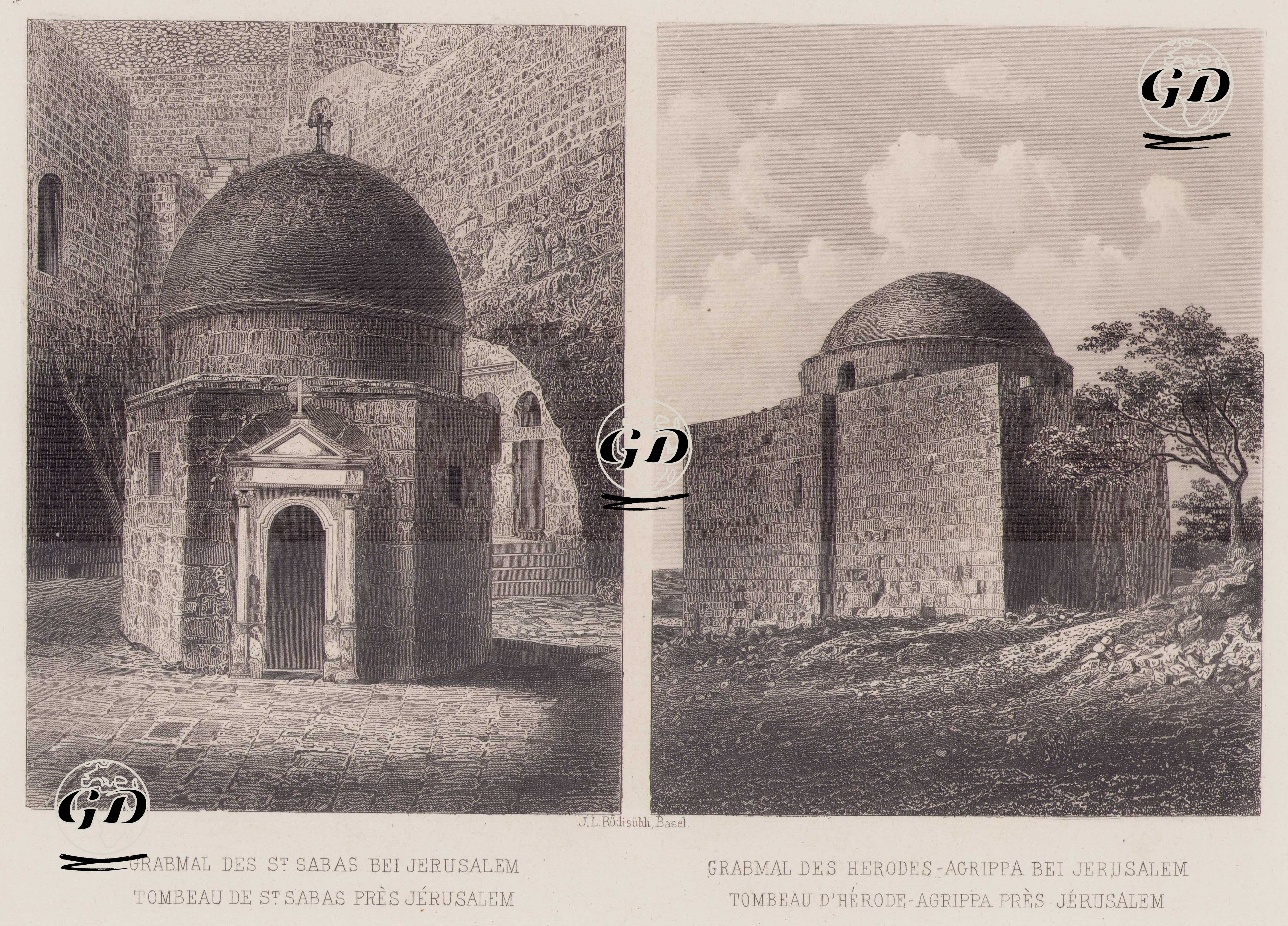
This engraving shows two important tombs located near Jerusalem: the Tomb of Saint Sabas and the Tomb of Herod-Agrippa. The structure on the left, located in the Mar Saba Monastery near Jerusalem, belongs to Saint Sabas (439–532), a renowned hermit who practiced asceticism in the Palestinian desert in the 5th century. Sabas is considered a pioneer of monasticism in Orthodox tradition. His tomb is a small domed chapel within the monastery complex, carved into the steep cliffs of the Kidron Valley. It remains an important pilgrimage site for Eastern Christianity. The structure on the right represents a mausoleum attributed to Herod Agrippa I, a prominent figure in Jewish-Roman history. Herod Agrippa, king of Judea during the Roman period, is a prominent ruler mentioned in both Jewish and Roman historical sources. This tomb structure attributed to him reflects classical Roman influence with its thick stone walls and domed architecture and is one of the rare examples of early royal burial tradition in the region. The engraving depicts in detail the stonework, domed form, and spatial configuration of both tombs. The left composition features a small domed structure and stone stairs opening onto an inner courtyard, while the right composition shows a domed monument with solid walls in an open field.