GRAVÜR DÜNYASI
Digital Engraving Library
| Artist | H.Warren from Sketches by J.B. Fraser |
| Engraver | J.H.Kernot |
| Date | 1850`s |
| Technique | Steel Engraving |
| Category | Uncategorized |
| Source | Published by Blackie & Son, Glasgow, Edinburgh & London |
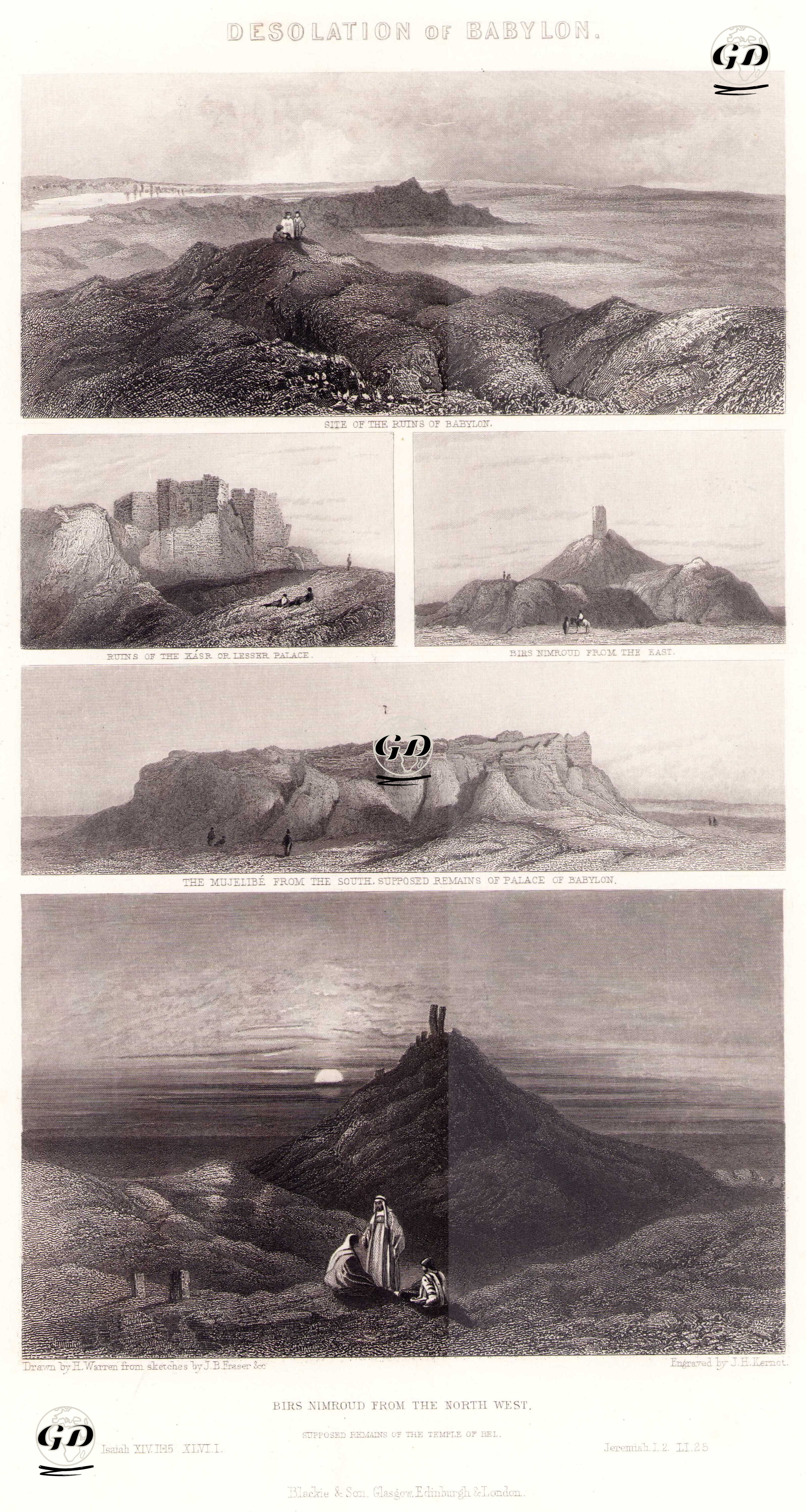
This engraving, titled "Desolation of Babylon," depicts the ruins of Babylon, one of the most famous cities in ancient Mesopotamia, in a multi-scene composition. The "Site of the Ruins of Babylon," located at the top, presents the quiet and barren landscape of this city, once considered the center of the world. The "Ruins of the Lesser Palace," located below, depicts the less well-preserved parts of the Babylonian palace complex, showing the remaining stone and brick remains of the royal architecture. The adjacent "Birs Nimroud from the East" scene captures the ziggurat, traditionally identified with the Temple of Bel (or Marduk), near Babylon, from an eastern perspective. This ruin, reaching skyward with its height, can be interpreted as both a symbol of ancient beliefs and a visual metaphor for man's desire to reach God. The middle composition, "The Mujelibe from the South," depicts the large mound south of Babylonia, once associated with palace structures. The bottom and largest scene in the engraving, "Birs Nimroud from the Northwest," presents this mound, symbolic of ancient Babylon, from the northwest, bathed in the dramatic sunset light. The verses below, Isaiah 14:19–25 and Jeremiah 51:12–15, recall biblical prophecies about the destruction of Babylon's pride by God.