GRAVÜR DÜNYASI
Digital Engraving Library
| Date | 1845 |
| Technique | Copper Engraving |
| Category | Uncategorized |
| Source | Palestine, Description Geographique, Historique et Archeologique par S.Munk, Firmin Didot Freres, Editeurs, Paris |
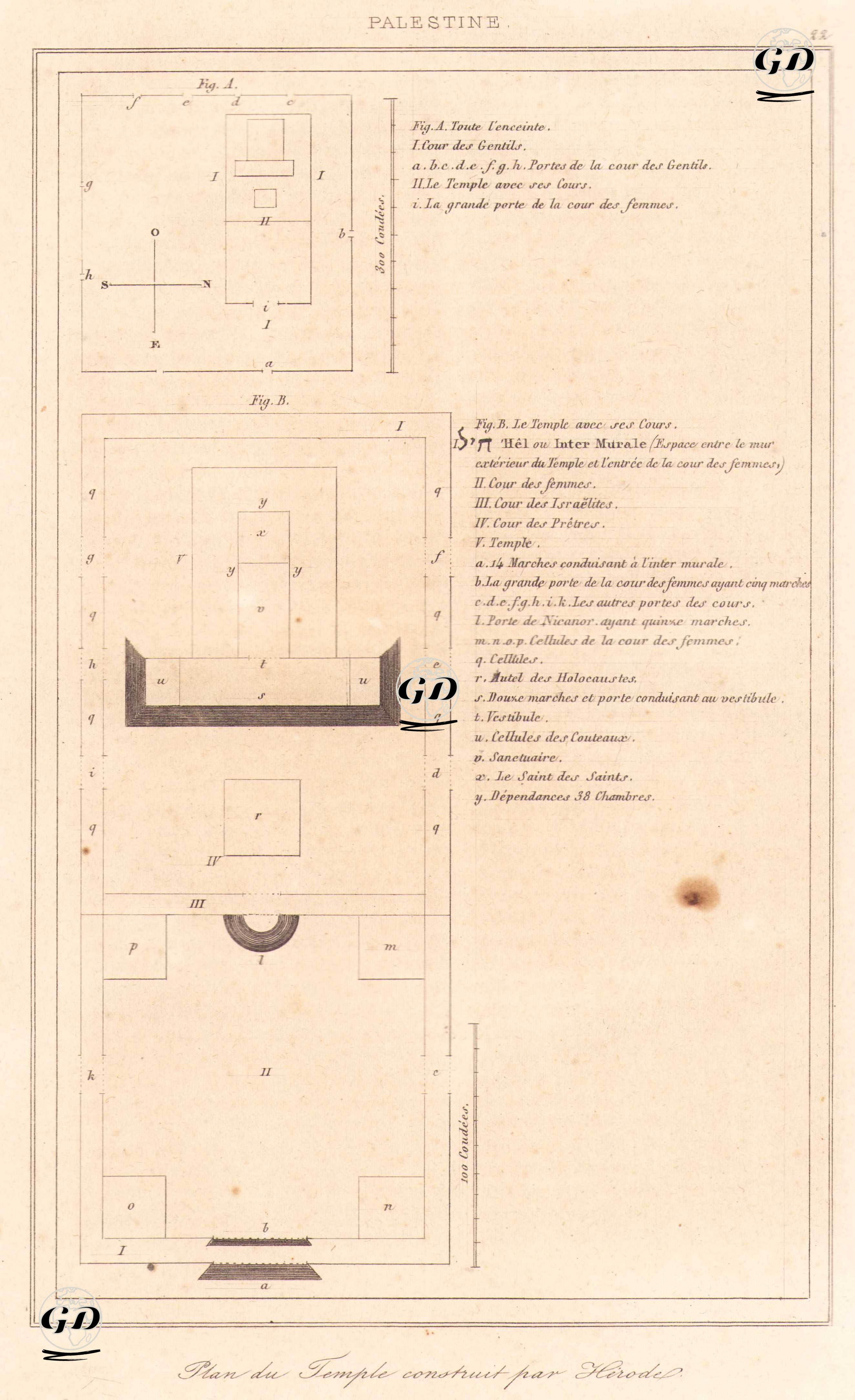
This engraving schematically depicts the architectural layout of the Temple of Jerusalem (Second Temple), renovated by Herod. Herod's massive rebuilding project, initiated in the 20s BC, both expanded the Temple Mount, one of the most important places of worship in Jewish history, and transformed it into an architecturally magnificent complex. Although the structure has not survived due to its destruction by the Romans in 70 AD, ancient written sources (especially the Jewish historian Josephus) and archaeological finds have enabled the creation of such plans. Fig. A and Fig. B in the engraving are plans of the temple, illustrated at two different scales and levels. These plans clearly identify areas such as the Gentile Court (outer courtyard of Bethlehem), the Women's Court, the Priests' Court, the Inner Sanctuary (Hekhal), and the Holy of Holies (Debir). Fig. The large rectangular area shown at B shows the general location of Herod's massive courtyards and the surrounding porticoes. The lower section contains the Nicanor Gate, the priests' chambers to the right and left, and the upper section contains columned porticoes. The nearly square structure at the end of the inner courtyard in the middle section is the Holy of Holies. This is the most sacred space, accessible only once a year and only to the High Priest. Letters marked on the plan indicate different functional spaces within the Temple complex. These include the musicians' platform, sacrificial preparation areas, water and grain storage areas, priests' chambers, court and assembly areas, rear storage areas, and service areas.