GRAVÜR DÜNYASI
Digital Engraving Library
| Engraver | Augustin Francois Lemaitre (1797-1870) |
| Date | 1848 |
| Technique | Copper Engraving |
| Category | Uncategorized |
| Source | Syrie Ancienne et Moderne par M.Jean Yanoski et par M.Jules David - L'Univers Pittoresque, Firmin Didot Freres, Editeurs, Paris |
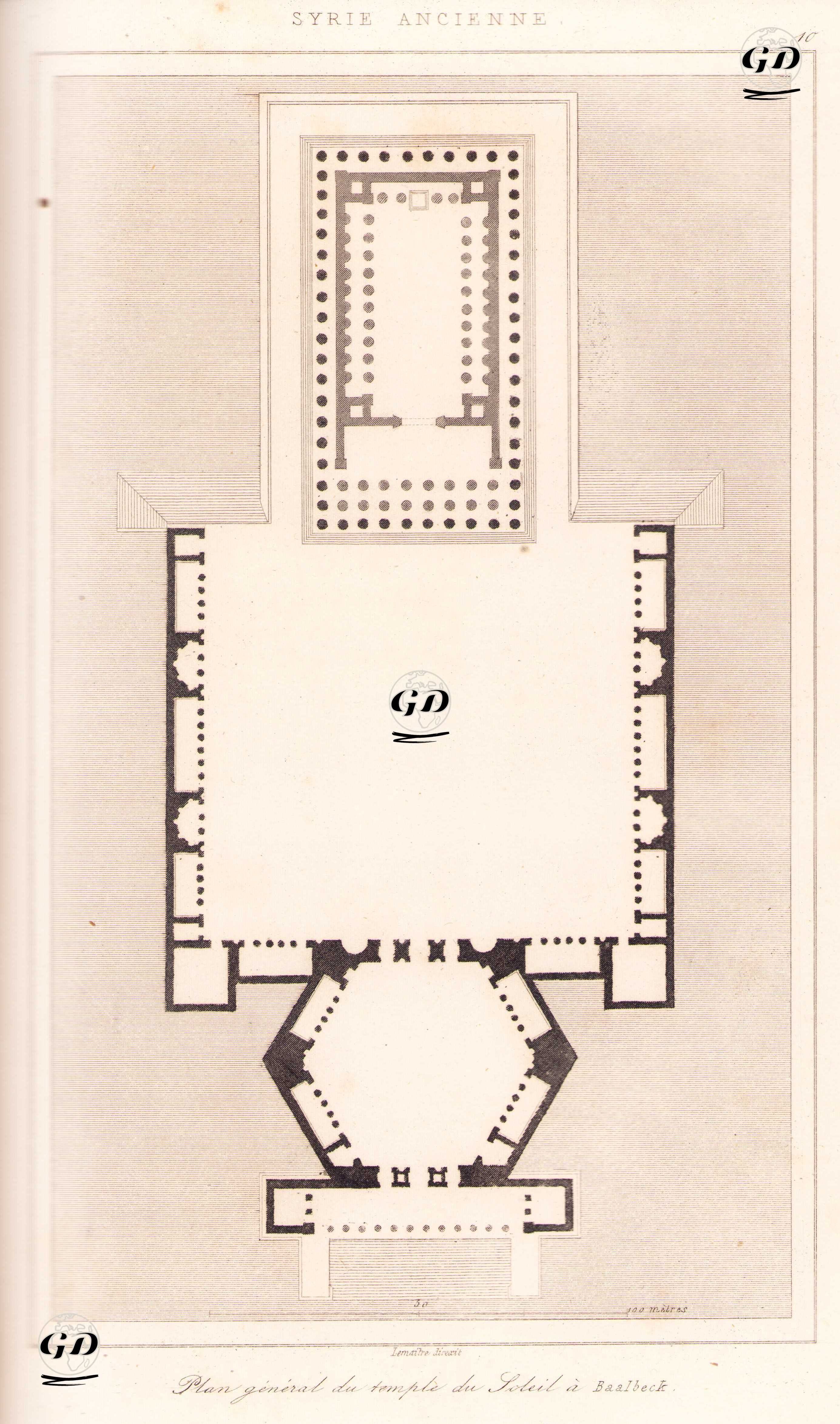
This engraving shows the general plan of the Temple of the Sun (Temple of Jupiter Helipolitanus), one of the most monumental architectural remains from the Roman period at the ancient city of Baalbek, located in modern-day Lebanon. Known in antiquity as Heliopolis, Baalbek was one of the most magnificent sacred centers of the Roman Empire in the Eastern Mediterranean, a unique example of both culture and engineering. The Temple of the Sun/Jupiter at Baalbek was the centerpiece of a large sacred complex that was expanded from the time of Roman Emperor Augustus onward. Construction of the temple took approximately two centuries and is considered the largest temple structure in the Eastern Roman provinces. Primarily dedicated to the cult of Jupiter Helipolitanus, this structure was a significant religious focal point where the local deities of the Eastern Mediterranean mingled with the Roman pantheon. The upper section of the plan shows the rectangular main structure (cella) of the Temple of Jupiter, located in the center of Baalbek, and the extensive colonnade (peristyle) surrounding it. The massive columns surrounding the temple indicate that it possessed the largest Corinthian columns in the ancient world. The double corner rooms at either end of the main structure and the interior layout suggest both ceremonial and cult functions of the temple. The large rectangular opening beneath the main temple courtyard is known as the Great Court. This courtyard formed the center of the temple's ritual life, and regularly spaced niches and columned galleries on the two long side facades enclosed it. These niches are thought to have housed cult statues, votive offerings, and ritual elements. The polygonal structure at the bottom of the plan is the Hexagonal Court, one of the most impressive elements of the complex. This hexagonal courtyard functions as a complex and innovative spatial transition unique to Baalbek architecture, serving as a dramatic connecting space between the Great Court and the main entrance. Its polygonal shape and surrounding column arrangement are a rare composition in Roman architecture. The large rectangular platform at the bottom represents the grand monumental staircase and propylon (main entrance portal) leading to the temple complex. The processional way, starting from this section, leads to the hexagonal courtyard above, and from there to the large courtyard, reaching the temple center.