GRAVÜR DÜNYASI
Digital Engraving Library
| Artist | Cassas |
| Engraver | Augustin Francois Lemaitre (1797-1870) |
| Date | 1845 |
| Technique | Copper Engraving |
| Category | Uncategorized |
| Source | Palestine, Description Geographique, Historique et Archeologique par S.Munk, Firmin Didot Freres, Editeurs, Paris |
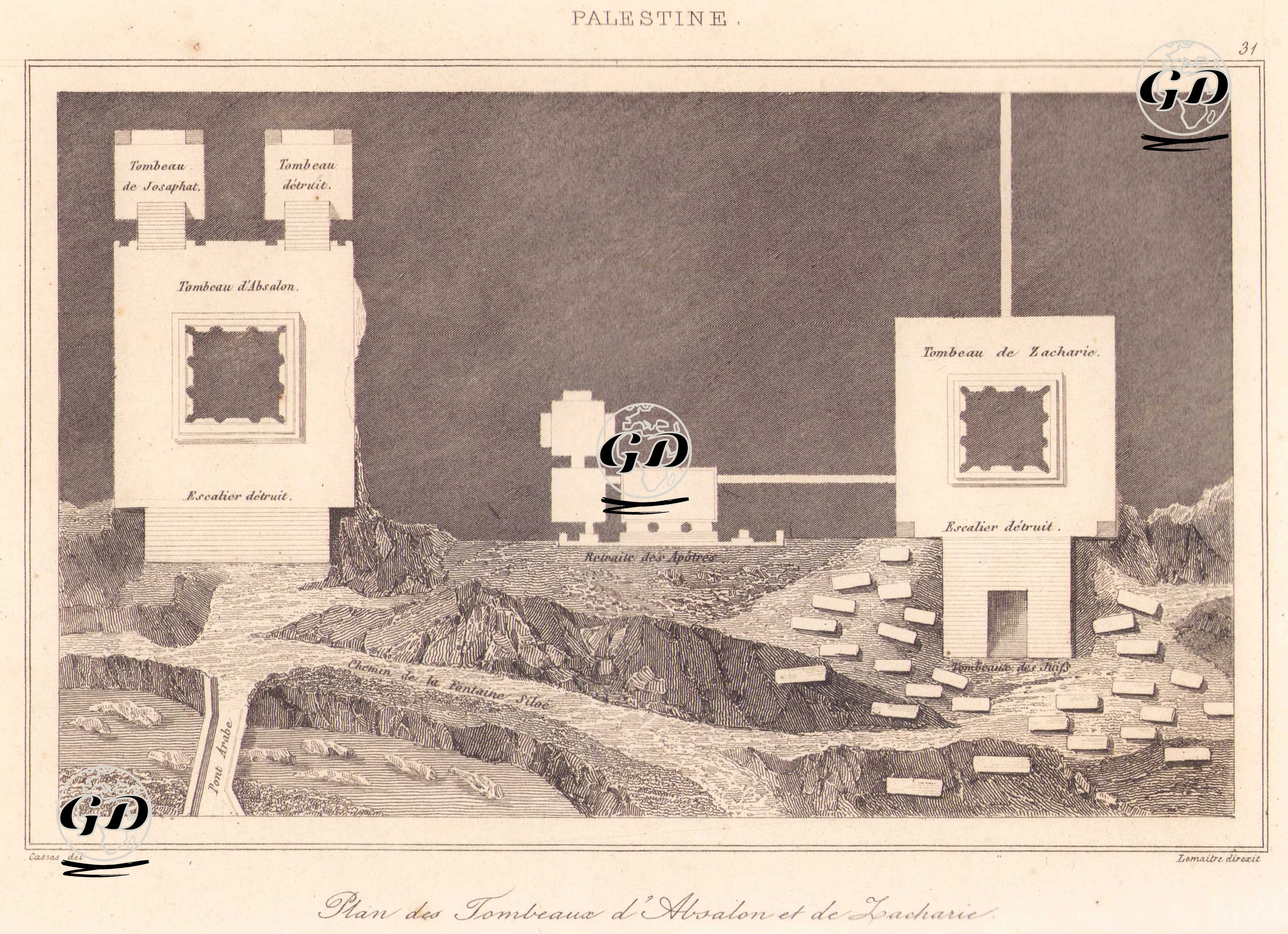
This engraving depicts the plan of three successive rock-cut tombs in the Kidron Valley (Absalom's Tomb, Zechariah's Tomb, and the rock-cut tomb attributed to Jehoshaphat). Based on topographical surveys by 19th-century European travelers, this plan presents the locations of the tombs, their entrance records, the rock-cut piles, and a comparison of the valley cemeteries, demonstrating that the Kidron Valley is a durable necropolis. The left side of the engraving shows a top view of the Absalom's Tomb. The square-shaped interior and the colors of the surrounding rocks emphasize the integrally carved character of the wealth. This variation provides a schematic representation of the tomb traditionally attributed to Jehoshaphat. While this structure is now known as the "Tomb of Jehoshaphat," modern research indicates that, like the other capitals, this attribution has no traditional basis. The right side depicts Zechariah's Tomb. This tomb, carved from a monolithic block on the exterior, is one of the most distinctive examples of Jerusalem necropolis architecture due to its square plan and its character as a single rock mass. The numerous small rectangular figures scattered around the tomb in the engraving represent surface burials, symbolizing the Kidron Valley's centuries-long use as a Jewish cemetery.