GRAVÜR DÜNYASI
Digital Engraving Library
| Engraver | Augustin Francois Lemaitre (1797-1870) |
| Date | 1845 |
| Technique | Copper Engraving |
| Category | Uncategorized |
| Source | Palestine, Description Geographique, Historique et Archeologique par S.Munk, Firmin Didot Freres, Editeurs, Paris |
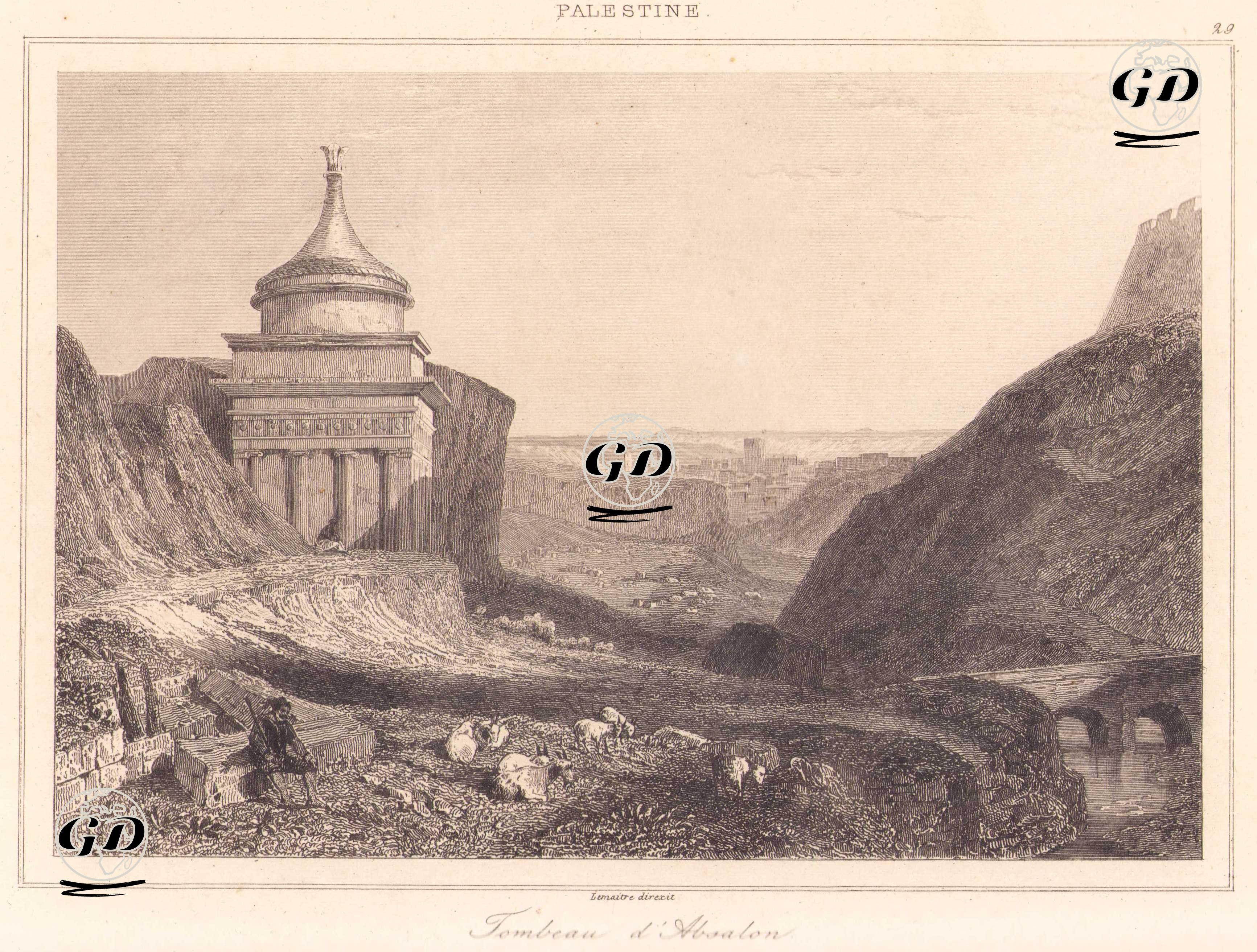
This engraving depicts the famous rock monument of Absalom (Yad Avshalom) in the Kidron Valley, east of Jerusalem. Although traditionally attributed to Absalom, son of King David, modern research indicates that this structure belonged to a wealthy aristocratic family of the Second Temple period, between the 1st century BC and the 1st century AD. Therefore, the structure is not directly associated with Absalom but is a unique example of ancient Jerusalem funerary architecture. The monument seen in the engraving consists of a square body carved entirely into the bedrock, topped by a conical roof with a raised center. The four-columned façade on the lower section and the extensive decorative bands extending above it clearly reflect the Hellenistic and early Roman influences seen in contemporary Jerusalem tombs. The monument's conical superstructure, however, bears traces of monumental tomb traditions in the Middle East and creates a unique architectural composition distinct from other rock-cut tombs in Jerusalem. The hollow and gently sloping terrain in the foreground of the engraving reflects the natural topography of the Kidron Valley in the 19th century. The arched bridge in the lower right corner points to ancient waterways in the southern part of the valley. The city walls of Jerusalem are slightly silhouetted in the background. The steep rock formations surrounding the monument accurately convey the sharp nature of the Kidron Valley's slopes.