GRAVÜR DÜNYASI
Digital Engraving Library
| Artist | Leon Gaucherel (1816-1886) |
| Engraver | Augustin Francois Lemaitre (1797-1870) |
| Date | 1845 |
| Technique | Copper Engraving |
| Category | Uncategorized |
| Source | Palestine, Description Geographique, Historique et Archeologique par S.Munk, Firmin Didot Freres, Editeurs, Paris |
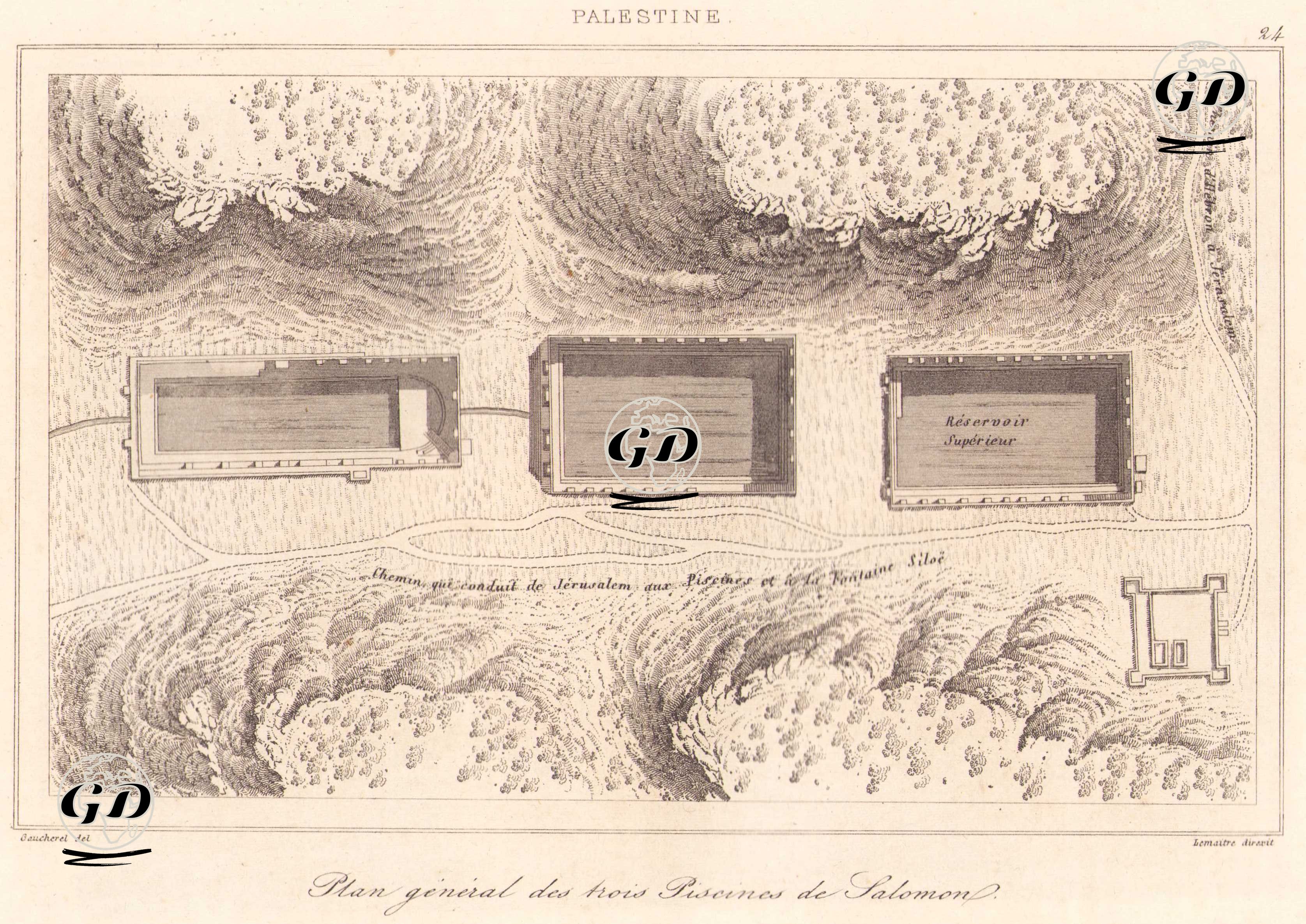
This engraving shows the schematic plan of three large ancient water reservoirs, known as the "Pools of Solomon," located southwest of Jerusalem between Bethlehem and the Etam Valley. These pools played a critical role in meeting Jerusalem's water needs from antiquity to the Ottoman period. While the pools are traditionally attributed to King Solomon, modern research indicates that these water structures were constructed after the First Temple period, particularly during the Hasmonean (2nd-1st centuries BC) and Herodian (1st century BC) periods. In the subsequent Roman, Byzantine, and Ottoman periods, the water systems were frequently repaired and expanded. The top section of the engraving shows the rectangular plans of three pools side by side: the largest pool (Lower Pool/Al-Hafire) is on the far left, the medium-sized pool in the middle, and the upper pool on the right. The inscription "Reservoir Superieur" above the pool on the right confirms its designation as the "Upper Reservoir." The fine lines between the pools indicate an ancient engineering design that linked these reservoirs into a system, allowing water to be transferred from one pool to the next in a controlled manner. The engraving, inscribed beneath the pools, reads "Chemin conduisant de Jerusalem aux Piscines et de la Fontaine Siloe," indicating the historic aqueduct connecting the Pools of Solomon to Jerusalem and the line leading to the Siloam Fountain. This route is one of the most important infrastructures in Jerusalem's water network, a complex hydraulic system comprised of both above-ground and underground channels.