GRAVÜR DÜNYASI
Digital Engraving Library
| Artist | Leon Gaucherel (1816-1886) |
| Engraver | Augustin Francois Lemaitre (1797-1870) |
| Date | 1845 |
| Technique | Copper Engraving |
| Category | Uncategorized |
| Source | Palestine, Description Geographique, Historique et Archeologique par S.Munk, Firmin Didot Freres, Editeurs, Paris |
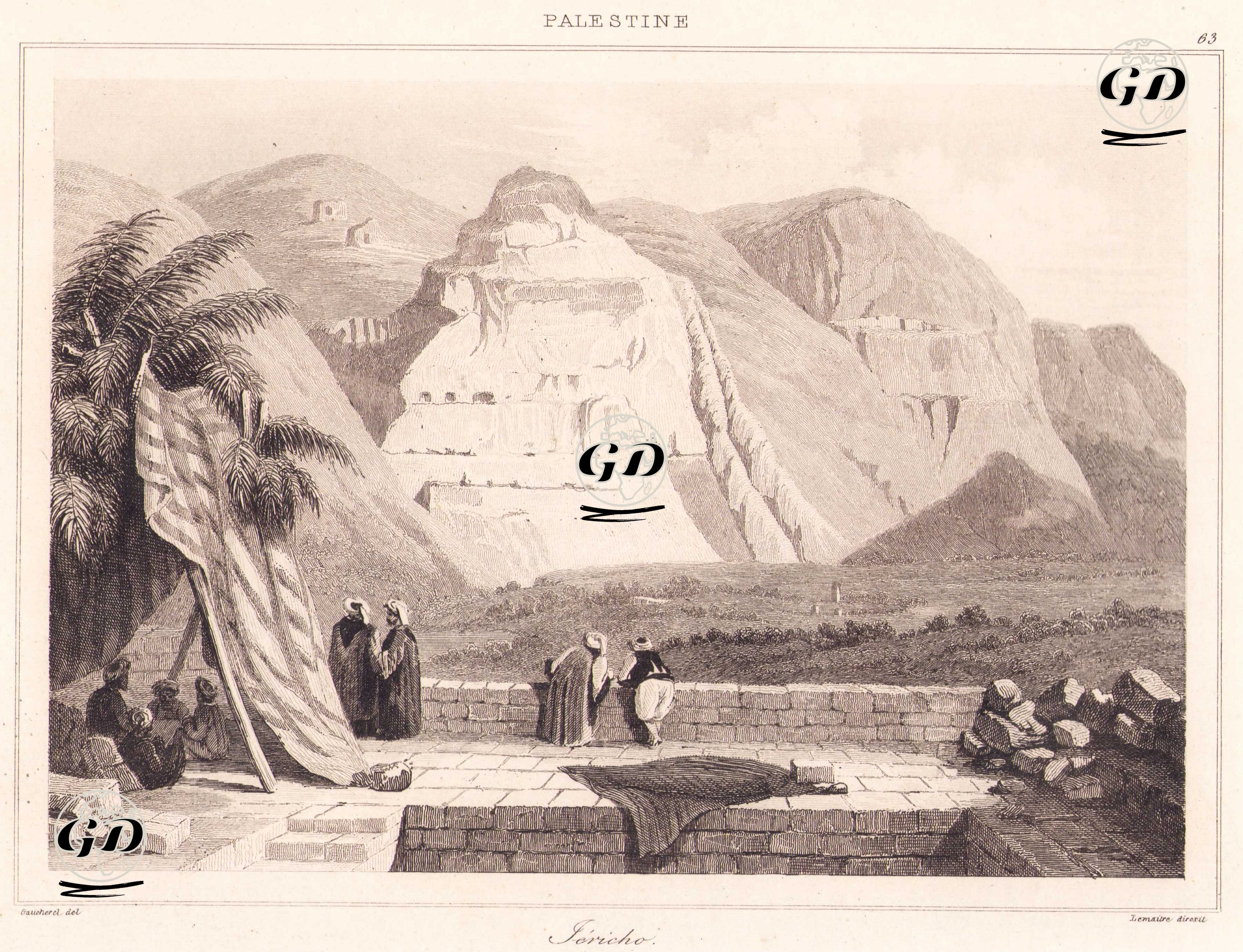
This engraving depicts the Jericho region, and specifically the steep limestone mountain range known as Mount of Temptation or Mount of Experience (dark mountains in ancient travel accounts), northwest of the Dead Sea. Jericho is considered one of the world's oldest continuously inhabited sites, both archaeologically and religiously. It holds a significant place in the scriptures as the biblical setting for the Israelites' siege of the city and the collapse of the walls (Joshua 6). The steep-sided mountain in the center of the engraving, carved with horizontal layers, is Mount of Temptation or Mount of Experience (Jebel Quruntul/Mount of Temptation). According to Christian tradition, this is where Jesus was tempted by Satan during his 40-day ordeal. The hollows and traces of small structures visible on the mountainside also point to early hermit cells and hermitages constructed in accordance with this tradition. The figures seated and strolling under the shaded structure depicted in the foreground reflect the tradition of ethnographic and travel scenes common in 19th-century Palestinian engravings. The broad valley in the background refers to the Arapah Depression (Arapah Depression, Arabah, or Arava Valley), the characteristic geography of Jericho, and the low-lying lands extending towards the Dead Sea. Jericho's location approximately -250 to -300 meters below sea level is a key geomorphological detail that explains this deep pit image. The engraving's use of chiaroscuro highlights the sharp contrasts of the desert climate and the erosional surfaces of the limestone cliffs.