GRAVÜR DÜNYASI
Digital Engraving Library
| Engraver | Augustin Francois Lemaitre (1797-1870) |
| Date | 1845 |
| Technique | Copper Engraving |
| Category | Uncategorized |
| Source | Palestine, Description Geographique, Historique et Archeologique par S.Munk, Firmin Didot Freres, Editeurs, Paris |
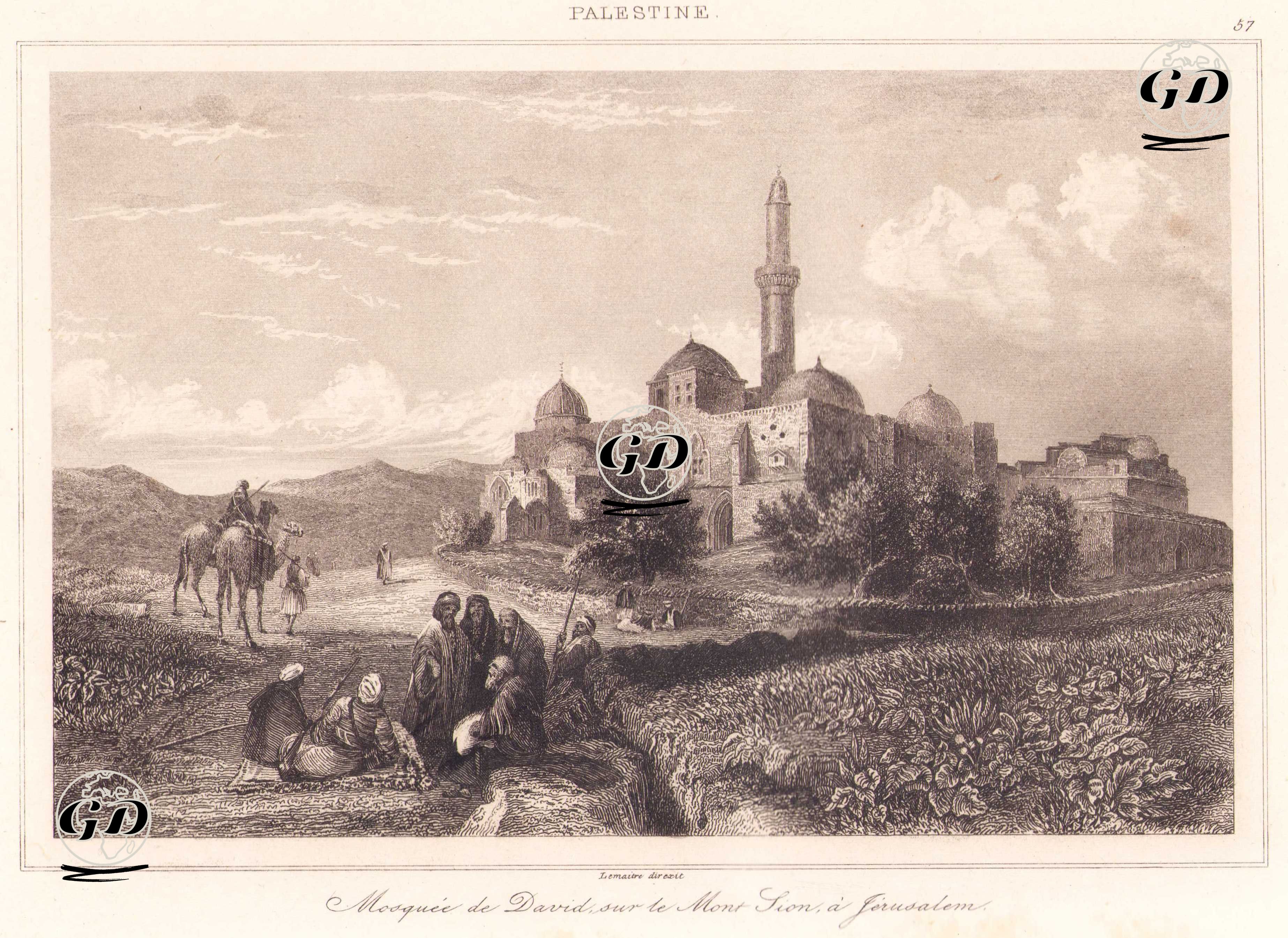
This engraving depicts the multi-layered sacred space on Mount Zion in Jerusalem, historically known as both the "Mosque of David" and the "Tomb of David." This structure holds profound historical and religious significance for the three major Abrahamic religions. In Judaism, it is recognized as the burial place of King David, in Christianity as one of the sites associated with the Last Supper of Jesus, and in Islam as a sanctuary dedicated to the Prophet David, a prominent member of the prophetic lineage. Known as the "Tomb of King David" since the Middle Ages, this site was transformed into a dervish lodge and mosque complex during the Ottoman period, particularly after the 16th century. The high minaret, domed side sections, arched windows, and massive stone masonry seen in the engraving reflect Ottoman-era restoration and architectural styles. The vast domes and vaulted structures in the background reveal structures from different periods articulated throughout this multi-layered historical process. The seated, chatting, and walking local figures and the passenger on a camel in the foreground of the engraving's composition embody the ethnographic observation often found in 19th-century Eastern depictions. The gently sloping landscape of Mount Zion, along with the mountain silhouette in the background, is masterfully depicted. The engraving's use of light and shadow highlights the details of the structure, emphasizing the sanctity and historical depth of the space. This group of structures still stands in Jerusalem today. However, the site's religious and administrative use has changed numerous times throughout history. The section considered "David's Tomb" is now a space open to Jewish worship and functions as a synagogue. The upper floor, considered the "Last Supper Room" by Christians, attracts Christian visitors, while the sections historically used as mosques by Muslims are now closed to worship. This multi-layered sacred site is at the center of both religious and political tensions in the context of the Israeli-Palestinian conflict. Today, the site attracts both tourist and religious visitors.