GRAVÜR DÜNYASI
Digital Engraving Library
| Artist | Leon Gaucherel (1816-1886) |
| Engraver | Augustin Francois Lemaitre (1797-1870) |
| Date | 1845 |
| Technique | Copper Engraving |
| Category | Uncategorized |
| Source | Palestine, Description Geographique, Historique et Archeologique par S.Munk, Firmin Didot Freres, Editeurs, Paris |
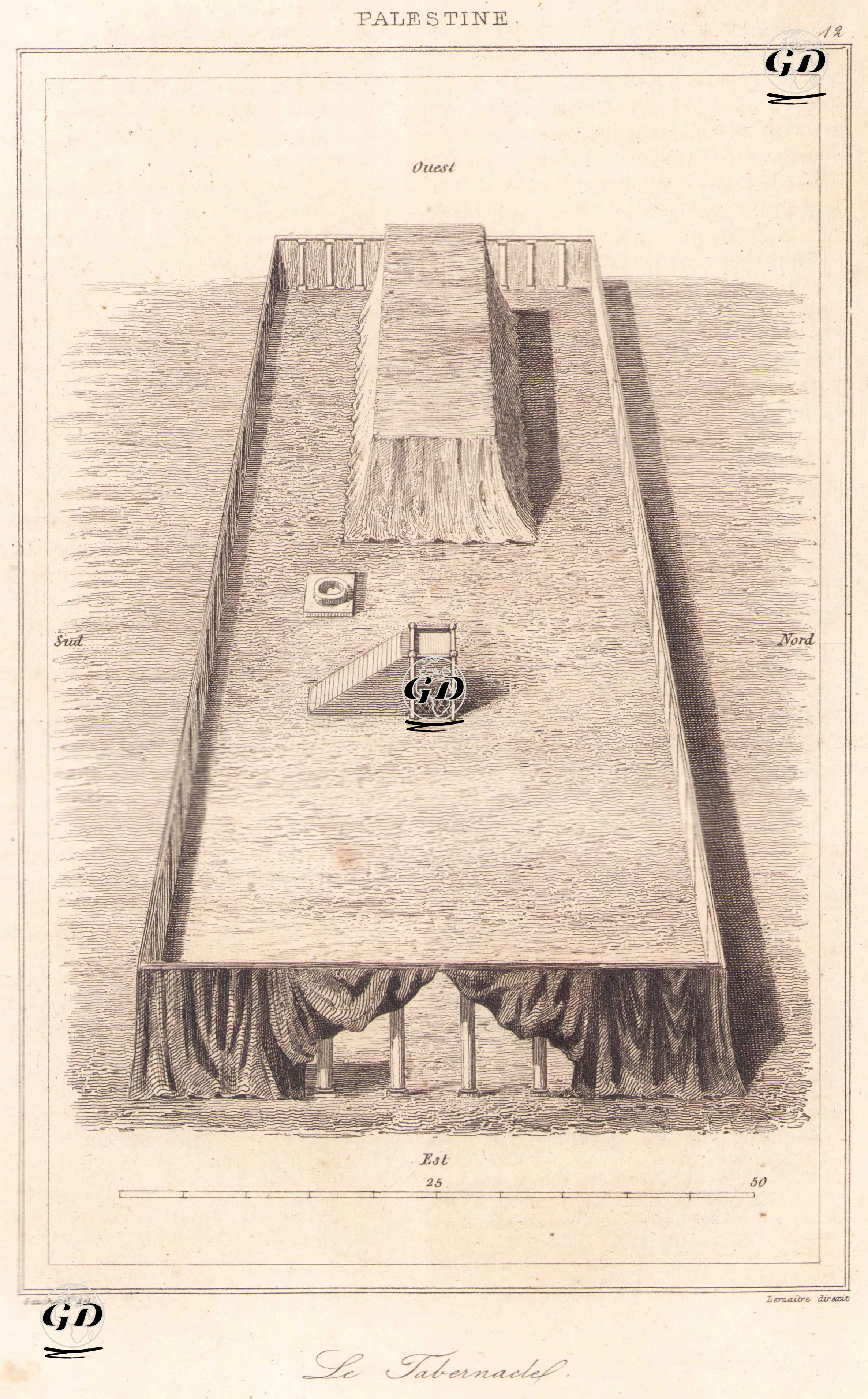
This engraving, titled "The Tabernacle," reconstructs the idealized architectural scheme of the portable Tabernacle (Mishkan/Tabernacle) revealed to Moses on Sinai according to the tradition of 19th-century orientalist printmaking. According to Hebrew sacred tradition, the Tabernacle is a portable sacred tabernacle that embodied God's presence during the Israelites' forty-year exodus through the desert (Exodus 25–31). This structure is considered a theological prototype for the later Temple of Solomon (the First Temple) in Jerusalem and the subsequent Second Temple. The engraving's layout (courtyard, curtained-off section of the sanctuaries, the inner tent of the "Most Holy Place," and the sacrificial altars positioned in the outer courtyard) is based on biblical measurements. Such engravings are a typical product of the effort in 19th-century academic historiography to “concretize” Old Testament texts topographically and archaeologically. The textual meaning of the word is spatialized and the sacred text is depicted as an idealized architectural model.