GRAVÜR DÜNYASI
Digital Engraving Library
| Artist | Guido Reni (1575-1642) - Carlo Maratta |
| Engraver | Friedrich John (1769-1843) |
| Date | 1827 |
| Technique | Mezzotint-Steel Engraving |
| Category | Uncategorized |
| Source | Published in the pocket book “Aglaja” by J. B. Wallishausser |
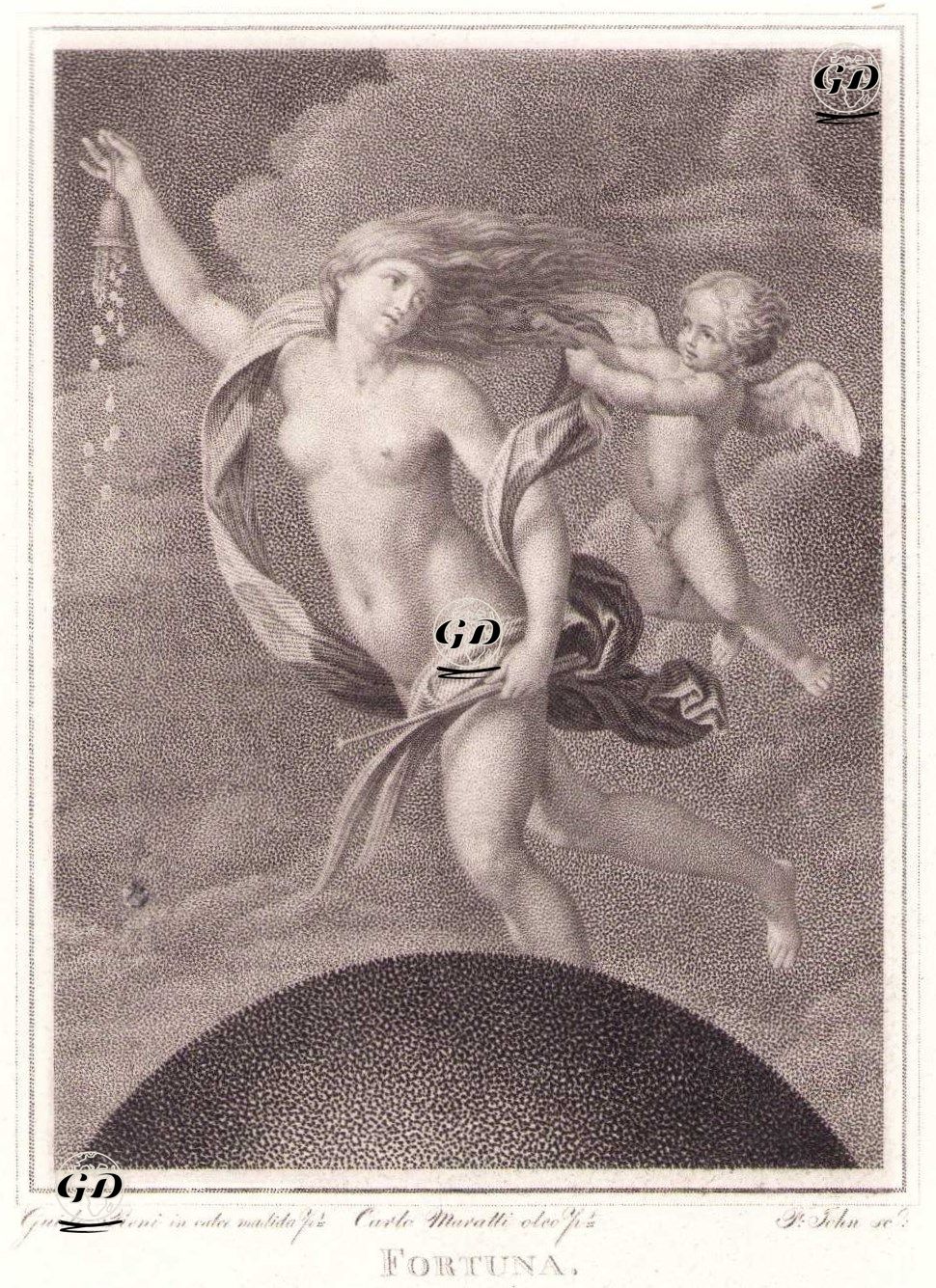
This engraving was inspired by Guido Reni's original painting "Fortuna (Goddess of Luck)" and masterfully engraved on steel by Friedrich John in the 19th century. The composition depicts the classical iconography of Fortuna, one of the oldest allegorical figures in human history. In the engraving, a half-naked female figure floats above the earth, pouring gold from a purse she holds in one hand while holding a scepter in the other. This symbolizes the both generous and changeable nature of fate and fortune. Beside her, a winged putto (little angel/eros) tries to guide her by grabbing her hair. This gesture highlights the volatile and uncontrollable nature of luck. Guido Reni's interpretation of "Fortuna" reflects the classical idealism of the Baroque period. Fortuna is depicted in the engraving with celestial grace and restraint. Instead of emotional exuberance, cosmic balance and the graceful power of fate are emphasized. The nudity of the Fortuna represents the naked truth of both nature and fate, while her veil and hair, blowing in the wind, represent the transience of life. In Guido Reni's art, Fortuna is not portrayed as a blind goddess of fate, but as a divine force guided by God's will. Therefore, her facial expression is not harsh, but possesses a serene and sublime beauty. In the engraving, the figure's elegant anatomical structure is modeled with soft transitions using John's dot engraving technique. The distribution of light on the chest and face successfully conveys Reni's idealized figure aesthetic. The globe seen at the bottom of the composition symbolizes the universality of this cosmic power, which rises above humanity's destiny. The coins spilling from the purse represent the gifts of fortune and the world's fleeting riches. Putto's grip on her hair stems from the depiction of Fortuna as a "forelock" (forehead lock) in ancient texts. Luck can only be seized the moment it arrives; it cannot be held once it has passed. Ultimately, Guido Reni's "Fortuna - Goddess of Chance" elegantly allegorizes the tension between fate, fortune, and human freedom in 17th-century Italian art. This engraving by Friedrich John reproduces Guido Reni's spiritual idealism and figurative aesthetic with technical perfection, balancing the mutability of fate with the permanence of beauty.