GRAVÜR DÜNYASI
Digital Engraving Library
| Artist | J. Cramb (Photographer-Fotoğrafçı) |
| Engraver | R.Dawson |
| Date | 1860`s |
| Technique | Steel Engraving |
| Category | Uncategorized |
| Source | William Collins, Glasgow |
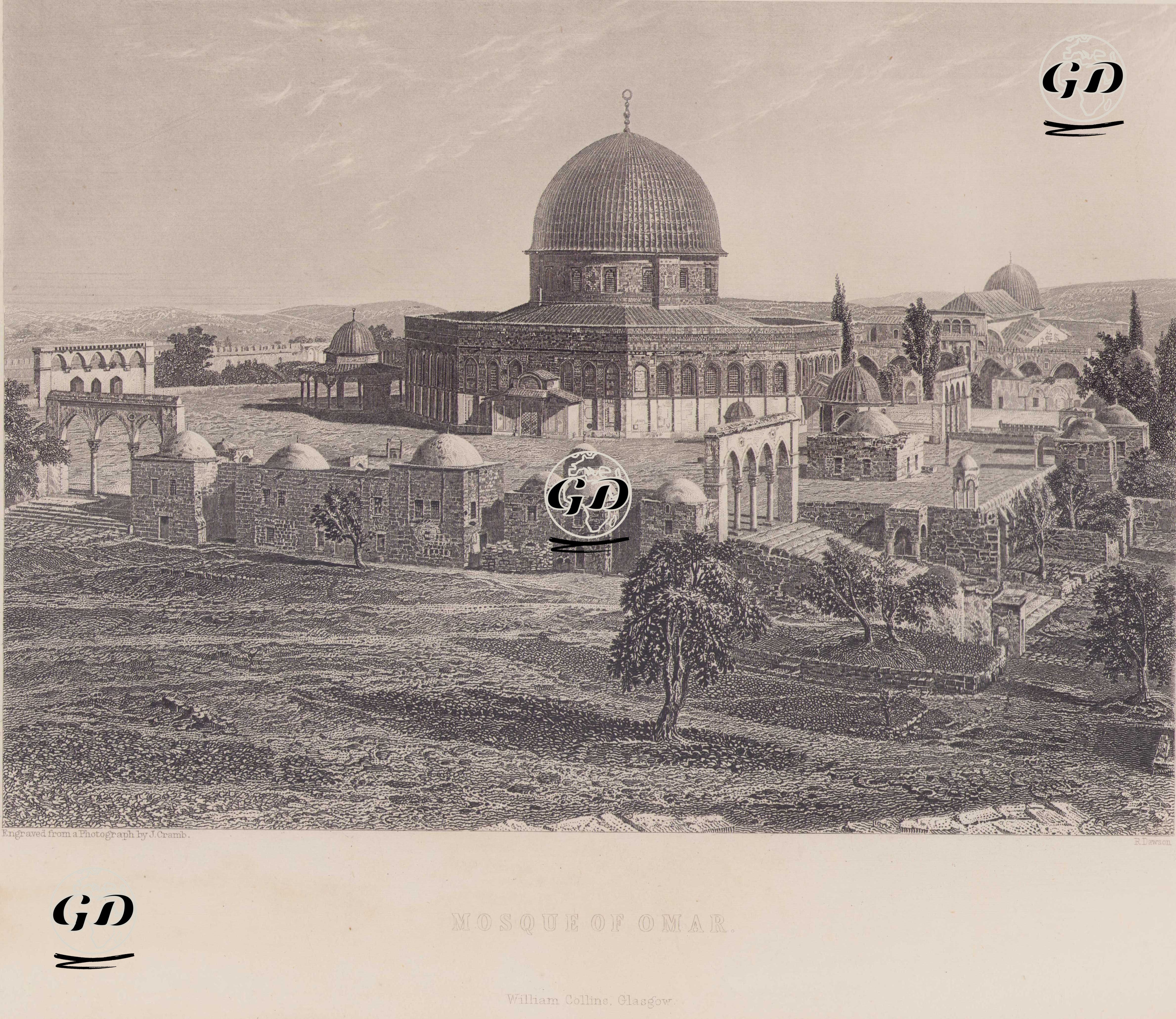
This engraving, titled "Omar Mosque," depicts the Dome of the Rock (Dome of the Rock) in present-day Jerusalem. Referred to as the "Omar Mosque" in 19th-century Western publications, this structure is one of the oldest and most impressive examples of Islamic architecture, built not during the reign of Caliph Omar but by the Umayyad Caliph Abd al-Malik ibn Marwan between 691 and 692. The engraving is a significant work documenting both the architectural fabric of Ottoman Jerusalem and the way Western artists viewed the Holy City. Situated on Jerusalem's highest plateau, this structure is located at the center of the Al-Aqsa Mosque complex, a shared sacred site for Islam, Christianity, and Judaism, with both religious and symbolic significance. The Dome of the Rock is built upon the Sacred Rock (Sakhra), which in Islamic tradition is considered the site of Muhammad's ascension to heaven during the Night of Ascension. In the engraving, the octagonal plan of the building, its elegant arches and its massive dome are masterfully reflected with the linear depth and tonal transitions frequently used in Western engraving art. The artist's choice of perspective positions the Dome of the Rock at the center, highlighting both its architectural grandeur and the surrounding structural order. The small domed structures in the foreground represent the complex units of madrasas and cells, while the Al-Aqsa Mosque, blending into the city's skyline in the background, enhances the depth of the composition. This visual arrangement emphasizes both the architectural hierarchy and the spatial integrity of the sacred space. In the mid-19th century, the intense interest in Jerusalem in the West transformed into artistic documentation through engravings of biblical geography, travel albums, and archaeological reports. This engraving was published by William Collins (Glasgow), a popular publisher of the time, and the primary source of the image is likely a photograph taken in the 1850s. The shading in the engraving's details highlights the play of light on the stone textures and dome surfaces, successfully conveying Jerusalem's identity as a "city of stone." The Dome of the Rock is not only a place of worship, but also a symbol of Umayyad architecture and is considered one of the aesthetic pinnacles of early Islamic art. Its mosaic decorations combine the elegance of Byzantine art with Islamic geometric abstraction, making the structure a bridge between both Eastern and Western artistic traditions. The composition in the engraving conveys this aesthetic fusion through a European lens.