GRAVÜR DÜNYASI
Digital Engraving Library
| Artist | J. A. Houston (after Laborde) |
| Engraver | H. Adlard |
| Date | 1850`s |
| Technique | Steel Engraving |
| Category | Uncategorized |
| Source | Blackie & Son, Glasgow, Edinburgh & London |
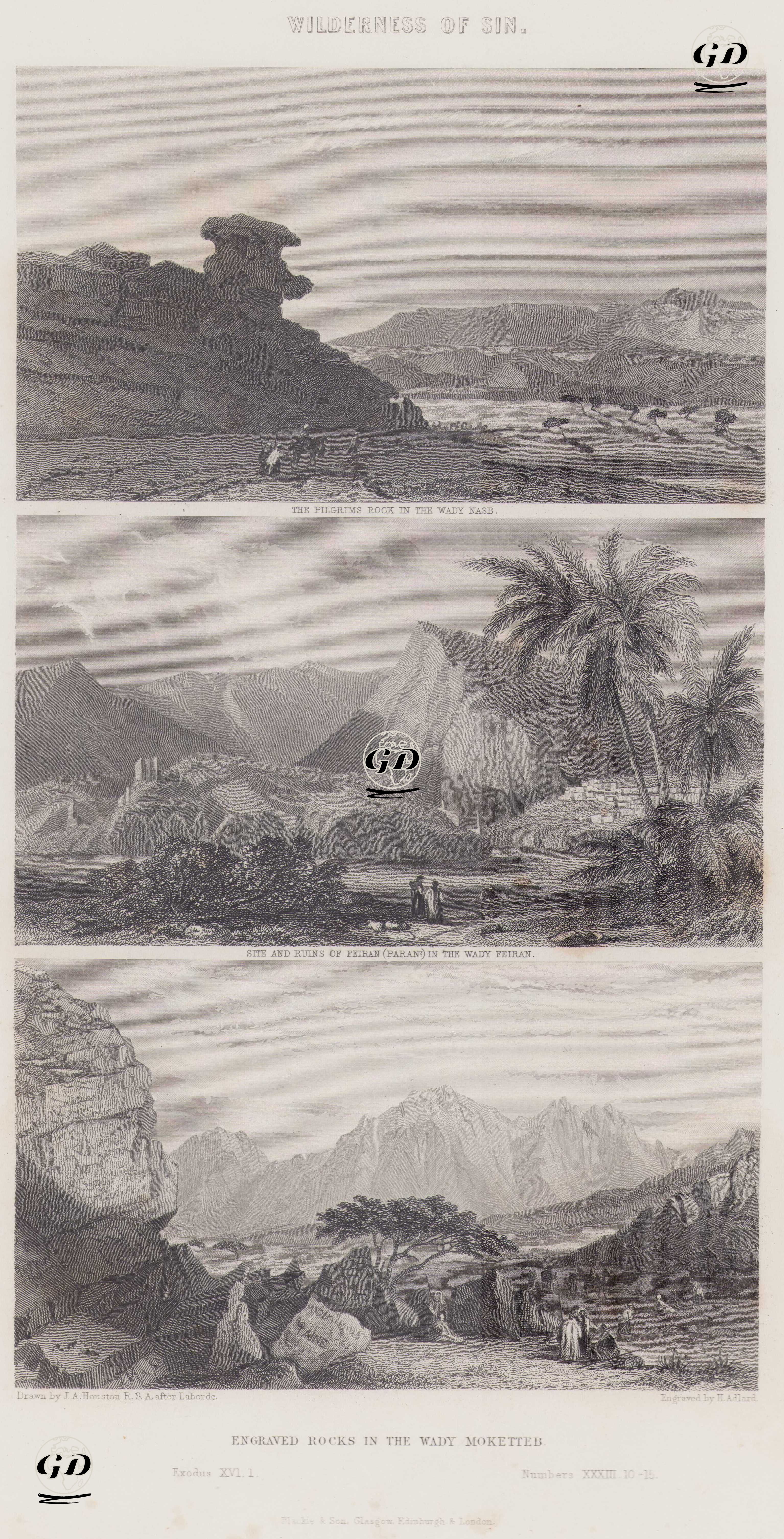
This engraving consists of three separate engravings under the title "Desert of Sin." These engravings depict Moses' journeys through the Sinai Peninsula and the landscapes traversed by the Israelites during their Exodus from Egypt. The top scene depicts Wadi Nasb, traditionally identified as one of the places where the Israelites stopped in the desert after their exodus from Egypt. The monumental rock formation featured in the engraving is called "Pilgrim's Rock." For centuries, this rock has served as a guiding beacon for travelers and monks making the pilgrimage to Mount Sinai. The mountains in the background and the wide valley floor reflect the arid topography of the Sinai Desert. The middle section depicts Wadi Feiran, one of the most fertile valleys in the Sinai Peninsula. Known in ancient times as "Paran," this site appears in the Bible both as the region where Ishmael's descendants settled and as one of the sacred stopping points on the Israelite migration route (Numbers 10:12). The engraving shows the remains of a mountainside settlement nestled in a valley floor surrounded by date palms and lush vegetation. It also held great religious significance in the early Christian era, as Feiran was a bishopric and the core of the Sinai monastic communities. Below, the area known as Wadi Muqattab (now known as the "Valley of Inscriptions") is depicted. This valley is famous for its Sinai inscriptions (mostly in a mixture of Nabataean, Greek, Aramaic, and early Arabic) carved into the rock surfaces. These inscriptions are the traces left by pilgrims, traders, and monks who passed through the region. In the foreground, the inscription-covered rock surfaces are depicted in detail, while in the background, the sharp peaks of the Sinai Mountains are depicted.