GRAVÜR DÜNYASI
Digital Engraving Library
| Artist | W.Westall |
| Engraver | W.S.Wilkinson - W.H.Deeble - H.Adlard |
| Date | 1845 |
| Technique | Steel Engraving - Sepia toned |
| Category | Uncategorized |
| Source | W. R. McPhun, Publisher, Glasgow - Printed by W.H.M.Farlane Edinburgh |
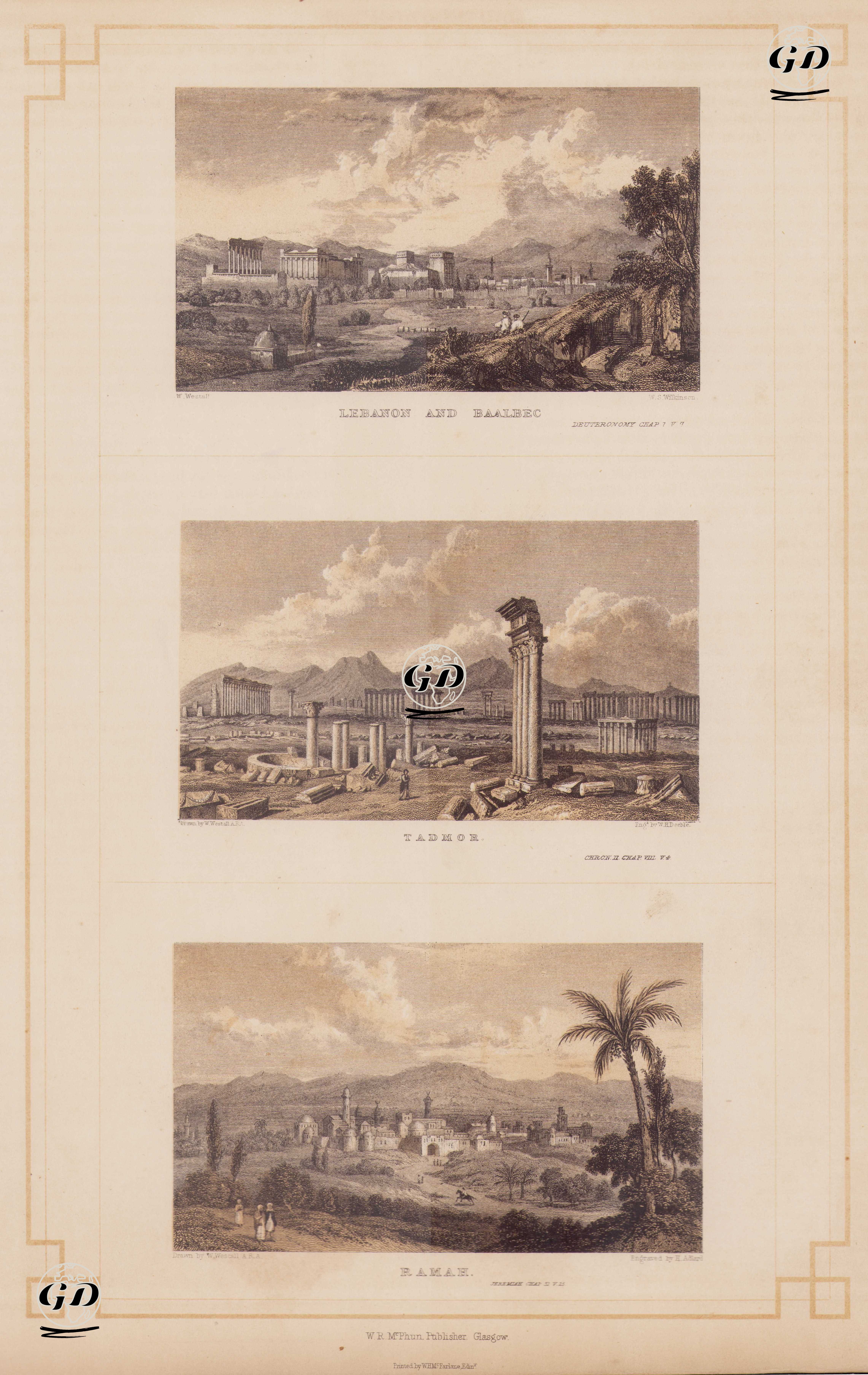
This engraving is part of a series of biblical geography works published by W. R. McPhun (Glasgow) in the mid-19th century. The "Lebanon and Baalbec" scene at the top depicts the ancient city of Heliopolis (modern-day Baalbek) and its surroundings, nestled in the foothills of the Lebanon Mountains. The temples of Jupiter, Bacchus, and Venus, built during the Roman period and still standing, are considered some of the most magnificent religious structures of the ancient world. The engraving depicts these monumental structures in an exalted perspective against the backdrop of the Lebanon Mountains. Baalbek was a sacred center in both the Phoenician, Roman, and early Christian periods and was named after the god Baal. The engraving's verse, Deuteronomy 1:7 ("Go to Lebanon and to the mountains therein"), identifies this region as a sacred boundary, alluding to the geographical extent of the land promised by God to his people. The “Tadmor” (present-day Palmyra) scene in the middle shows the legendary ancient city located in the middle of the Syrian Desert. According to legend, Tadmor was founded by King Solomon, and is mentioned in 2 Chronicles 8:4 as "Solomon built Tadmor in the desert." The city, which flourished as a trading center during the Roman period, was at the heart of the Eastern Mediterranean's trade routes with its colonnaded streets, temples, and monumental arches. The engraving, with Tadmor's massive columns, crumbling temple facades, and desert mountains looming on the horizon, reflects the romantic tension between the splendor and decadence of the ancient world. The "Ramah" (modern-day al-Ram) in the lower section is an ancient settlement located approximately 8 kilometers north of Jerusalem in the central West Bank of Palestine. Its name means "high place" in Hebrew and derives from the site's location on a commanding hill. Jeremiah 35:15, cited in the engraving, reminds the people of Israel of the warnings of God's prophets and calls for repentance and fidelity. The engraving shows a modest village settlement surrounded by palm trees and minarets rising in the distance.