GRAVÜR DÜNYASI
Digital Engraving Library
| Date | 1720`s |
| Technique | Copper Engraving |
| Category | Uncategorized |
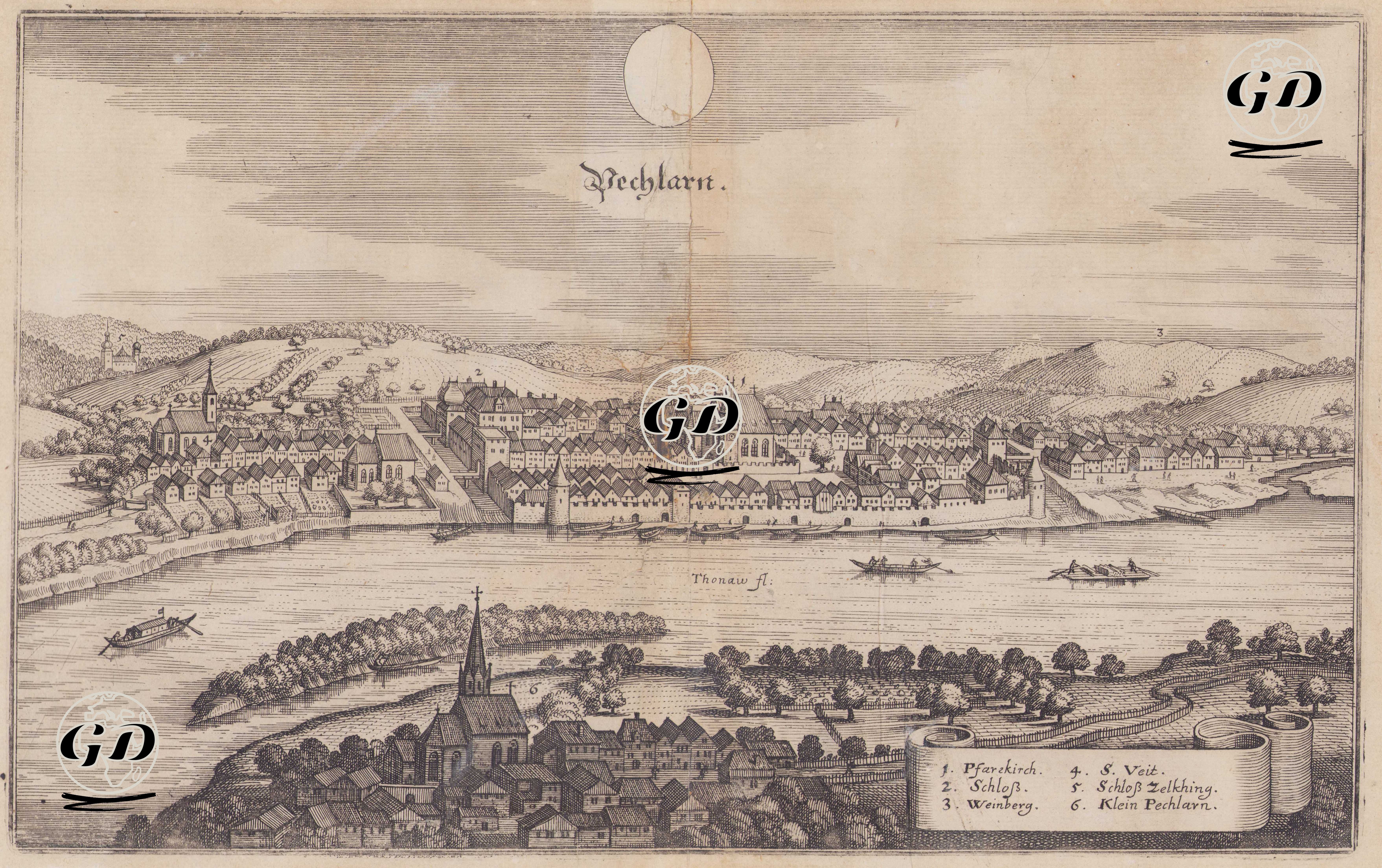
This engraving depicts the town of Pöchlarn (Pöchlarn an der Donau), located in Lower Austria (Niederösterreich), on the south bank of the Danube River. The word "Pechlarn" appears in the center of the engraving, and the Danube River is depicted in the lower section, marked by the words "Thonaw Fl." The engraving's composition is designed to unite the two banks of the city. In the foreground, a small settlement along the shore and a prominent church with a bell tower are displayed, while in the background, the city center of Pöchlarn, surrounded by walls, is prominent. Three key architectural elements define the town's skyline: the Stadtpfarrkirche Pöchlarn (a 13th-century Gothic church), Pöchlarn Castle (Schloss Pöchlarn), and the surrounding Weinberg (vineyard hillsides). The numbered headings in the cartouche in the lower right corner (Pfarrkirch, Schloß, Weinberg, S. Veit, Schloß Zelking, and Klein Pechlarn) indicate the city's main topographical landmarks. The engraving also depicts boats on the river and fields on the opposite bank, illustrating the Danube trade route and rural production economy of the period. Pöchlarn's origins date back to Roman times. At that time, the settlement was known as Arelape, a Roman garrison on the Limes Noricus border crossing along the Danube. This location explains the city's military and commercial importance from antiquity. In the Middle Ages, Pöchlarn appears as "Bechelaren" in the German epic poem Nibelungenlied, achieving literary immortality as the seat of the reign of Markgraf Rüdiger von Bechelaren. In the modern era, Pöchlarn, in addition to its rich historical heritage, also holds significance as the birthplace of the world-renowned expressionist painter Oskar Kokoschka in 1886.