GRAVÜR DÜNYASI
Digital Engraving Library
| Artist | Louis Fabricius Dubourg (1693-1775)-Luke Limner (1822-1912) |
| Engraver | Charles Holl (1810-1882) |
| Date | 1864 |
| Technique | Steel Engraving |
| Category | Religion |
| Source | Brown's Self interpreting Bible With Numerous Additional Notes By The Rev.Henry Cooke And John Brown (Blackie & Son, Glasgow, Edinburgh & London) |
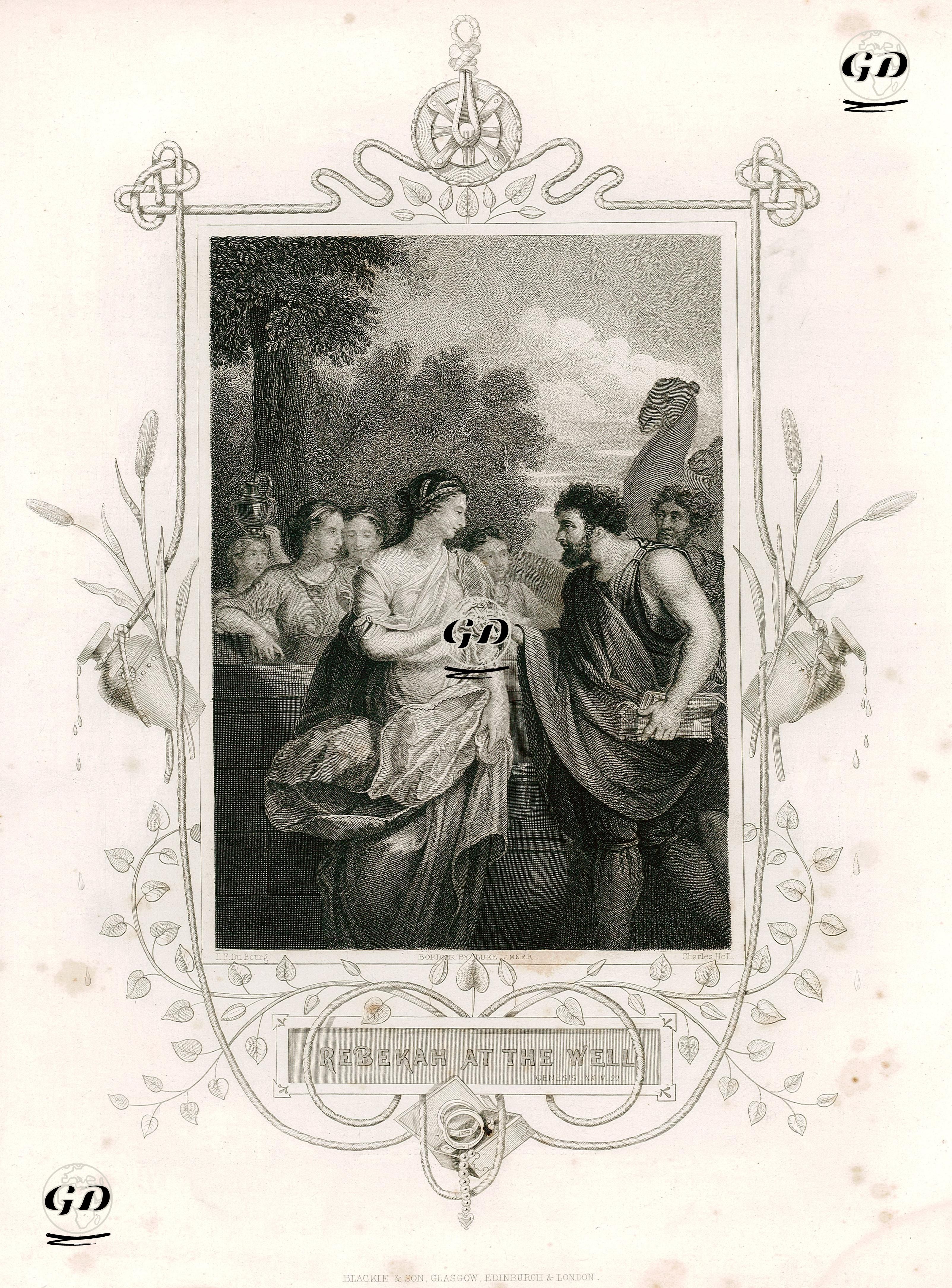
This engraving depicts the scene "Rebekah's Encounter at the Well," recounted in the 24th chapter of Genesis, part of the Old Testament. The scene takes place in Mesopotamia, where Abraham's faithful servant Eliezer is sent by Abraham to find a suitable wife for his master's son Isaac. Eliezer prays to God, "May the woman who gives me water when I come to the well and ask for it before I do, be chosen as Isaac's wife." Upon this prayer, Rebekah appears before him and waters not only Eliezer but also his camels, thus confirming God's will. As a sign of this, Eliezer bestows gold bracelets and a nose ring (some translations simply refer to them as bracelets) on Rebekah. The engraving depicts Eliezer reaching out to place the jewels on Rebekah's wrist, or having already placed them. The female figures and camel depictions in the background emphasize that this event is not an ordinary meeting, but a moment of social and sacred choice.The attentive and resigned gaze Eliezer directs at Rebekah represents the moment he recognizes the divine sign that comes with prayer. The engraving elegantly captures this moment of encounter, offering a symbolic reflection of divine providence, humility, and the ancient tradition of hospitality.