GRAVÜR DÜNYASI
Digital Engraving Library
| Date | 1860's |
| Technique | Chromolithography |
| Category | Religion |
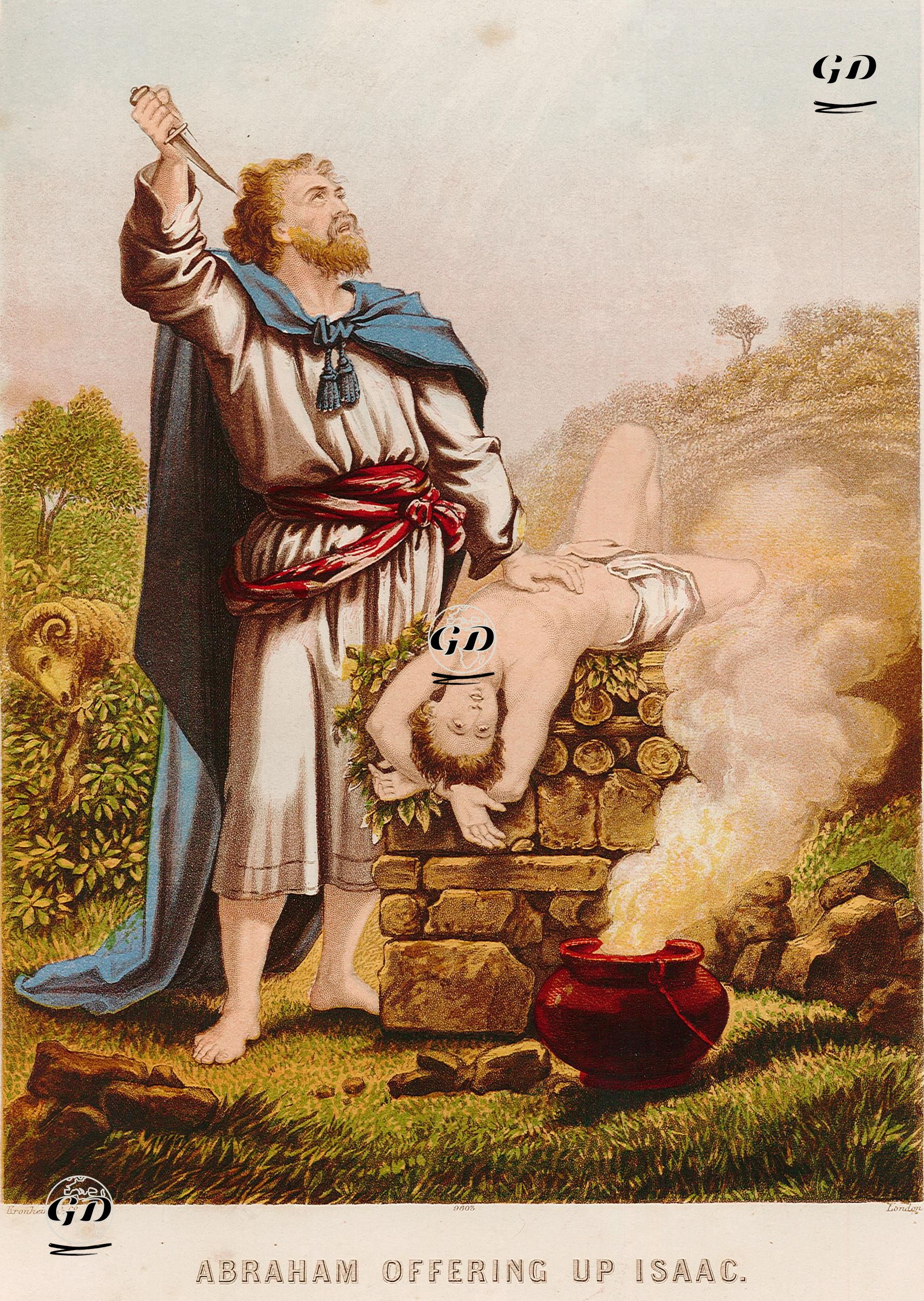
| Source | Browns Self-Interpreting Family Bible, containing the Old & New Testaments (Kronheim & Co., London) |
This engraving is based on chapter 22 of the Book of Genesis (Creation), part of the Old Testament of the Bible. The scene depicts the dramatic moment when Abraham was tested by sacrificing his son, a moment of shared significance in Jewish, Christian, and Islamic traditions. Abraham has laid his son on the altar, holding a sharp knife in one hand and grasping his son's head with the other. His face reflects a mixture of determination, terror, and faith. Isaac lies resigned to being sacrificed. This submission symbolizes not only the son's, but also the prophet's son's, absolute fidelity to God's will. This scene depicts Abraham about to fulfill God's command to test his faith, but is stopped by an angel's intervention. The offering of a ram in place of the son to be sacrificed also forms the symbolic basis of Eid al-Adha in Islam. However, Ishmael is accepted as the son instead of Isaac. The ram figure on the floor next to the altar is a visual symbol of this transformation and grace. This scene is not only a test of sacrifice but also defines the boundaries of obedience and submission, the relationship between humanity and God.