GRAVÜR DÜNYASI
Digital Engraving Library
| Artist | T.Shilippoteow |
| Engraver | Leon Chapon (1836-1918) |
| Date | 1860's |
| Technique | Wood Engraving (Text on Reverse) |
| Category | Religion |
| Source | The Holy Bible Containing The Old and The New Testaments with References and a Condensed Concordance published Cassell, Petter and Galphin, London and Newyork |
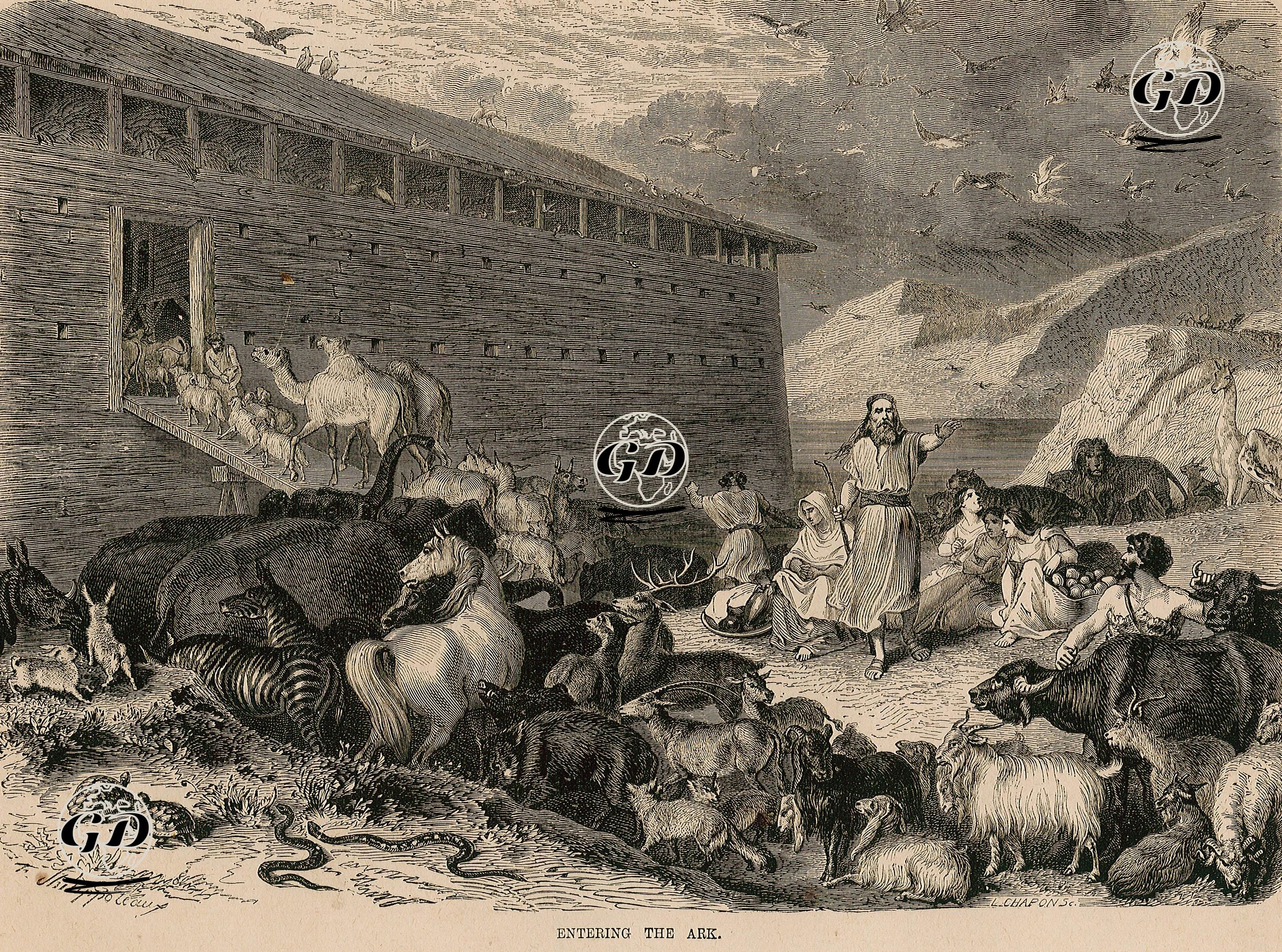
This engraving depicts the scene of the "Entry of the Animals into Noah's Ark," referring to the phrase "Birds, animals, and reptiles of every kind will come to you in pairs to keep them alive" in Genesis, chapter 6, verse 20 of the Old Testament. The engraving depicts a diverse group of animals advancing toward the Ark, in accordance with God's command before the Flood that Noah take a pair of each animal species, one male and one female. This scene reflects the theological idea that God tests creation with a devastating flood, yet also contains a plan to somehow restore life. Noah's Ark (Ark), depicted as a large wooden structure at the center of the engraving, is drawn multi-story and elongated, in line with the Biblical description. Animals are guided through the open door of the ark in a systematic manner. In the engraving, the animals are arranged in pairs according to their species. In the foreground, horses, goats, zebras, deer, camels, turtles, and even reptiles can be discerned. Numerous flocks of birds fly overhead. These details visually support the principle of "one male and one female of each species." The long-bearded figure in the center right of the scene is most likely Noah himself. His outstretched hand suggests he is organizing the order to enter the ark. Female figures (Noah's brides) and children are also seated, symbolizing the continuity of the human race that will survive the flood. This engraving represents not only the animals and Noah's family, but also the balance between God's mercy and justice. God has determined to destroy humanity's perversion. However, he does not aim to restore all of life, but rather through a clean core group. In this respect, Noah's Ark functions as a "divine instrument of salvation," or a transitional space between the end of the old world and the beginning of the new.