GRAVÜR DÜNYASI
Digital Engraving Library
| Artist | Raphael (1483-1520) |
| Date | 1829-1834 |
| Technique | Etching |
| Category | Religion |
| Source | Louis Eustache Audot Edit. - Musee de Peinture et de Sculpture ... de l'Europe, Paris |
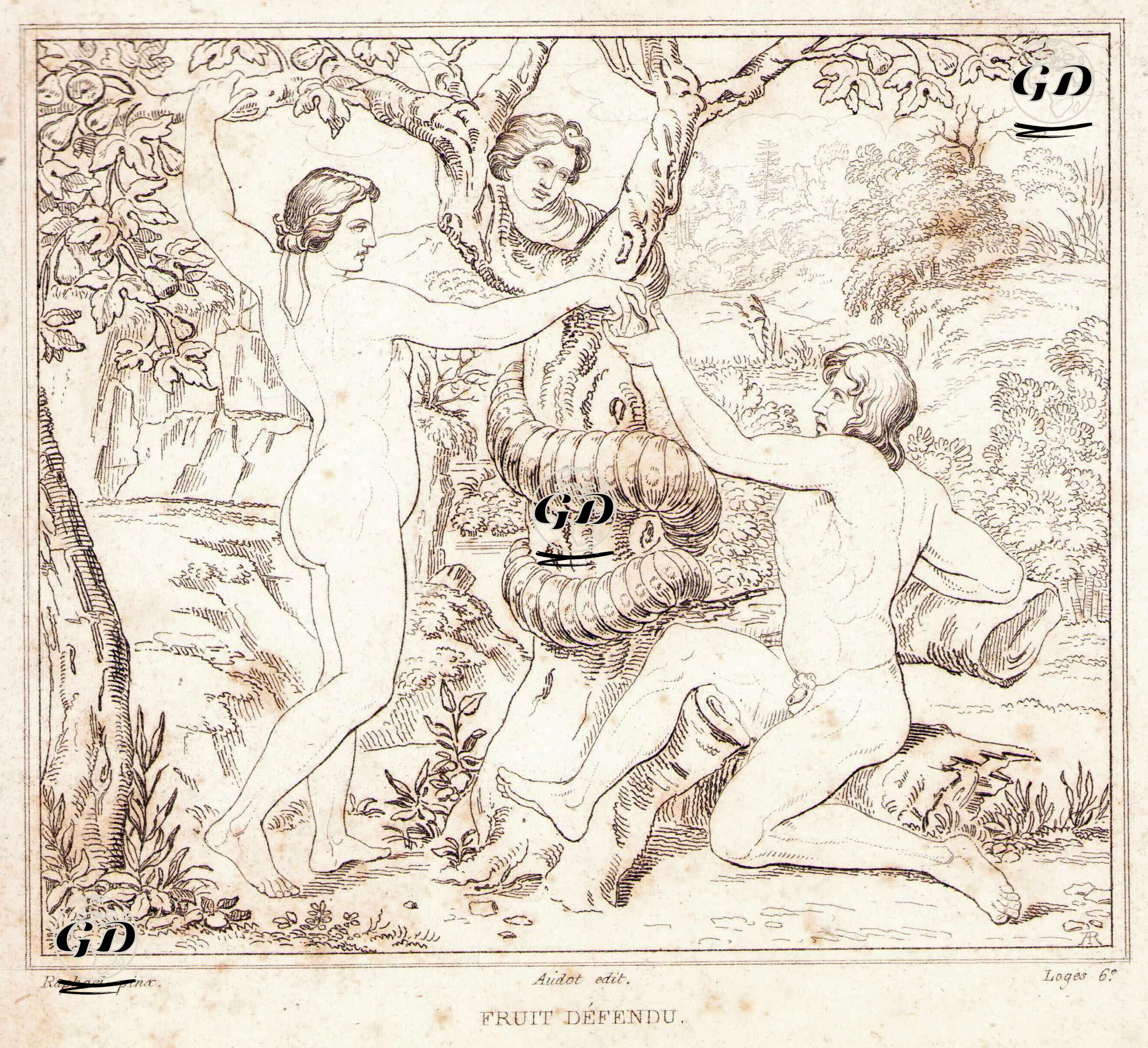
This engraving depicts the scene of the first sin, presented under the title "The Forbidden Fruit" (The Fall of Man), as recounted in the Book of Genesis in the Old Testament of the Bible. In the context of religious iconography, this engraving dramatically portrays the first prohibition God placed on humanity in the Garden of Eden—the command not to eat the fruit of the tree of the knowledge of good and evil—and the violation of this prohibition. The engraving depicts the moment when Eve offers the forbidden fruit to Adam, symbolizing humanity's fall from paradise and the moral responsibility that comes with free will. The central tree is the biblical "tree of knowledge," and the serpent coiled around it is a symbolic representation of Satan, who deceived Eve. The depiction of the serpent's head as resembling a woman is a symbolic interpretation common in post-Renaissance iconography and alludes to Satan's deceptive nature. The linear simplicity of the engraving, combined with the dramatic poses of the figures, offers both an aesthetic and theological intensity.