GRAVÜR DÜNYASI
Digital Engraving Library
| Artist | William Simpson (1823–1899) |
| Engraver | Edmund Walker (1814-1882) |
| Date | 1856 |
| Technique | Lithography, Sepia-toned |
| Category | Military |
| Source | The Campaign in the Crimea: An Historical Sketch by George Brackenbury, London, Published Oct. 1, 1856 by Paul & Dominic Colnaghi & Co., Day & Son Lithographers to the Queen |
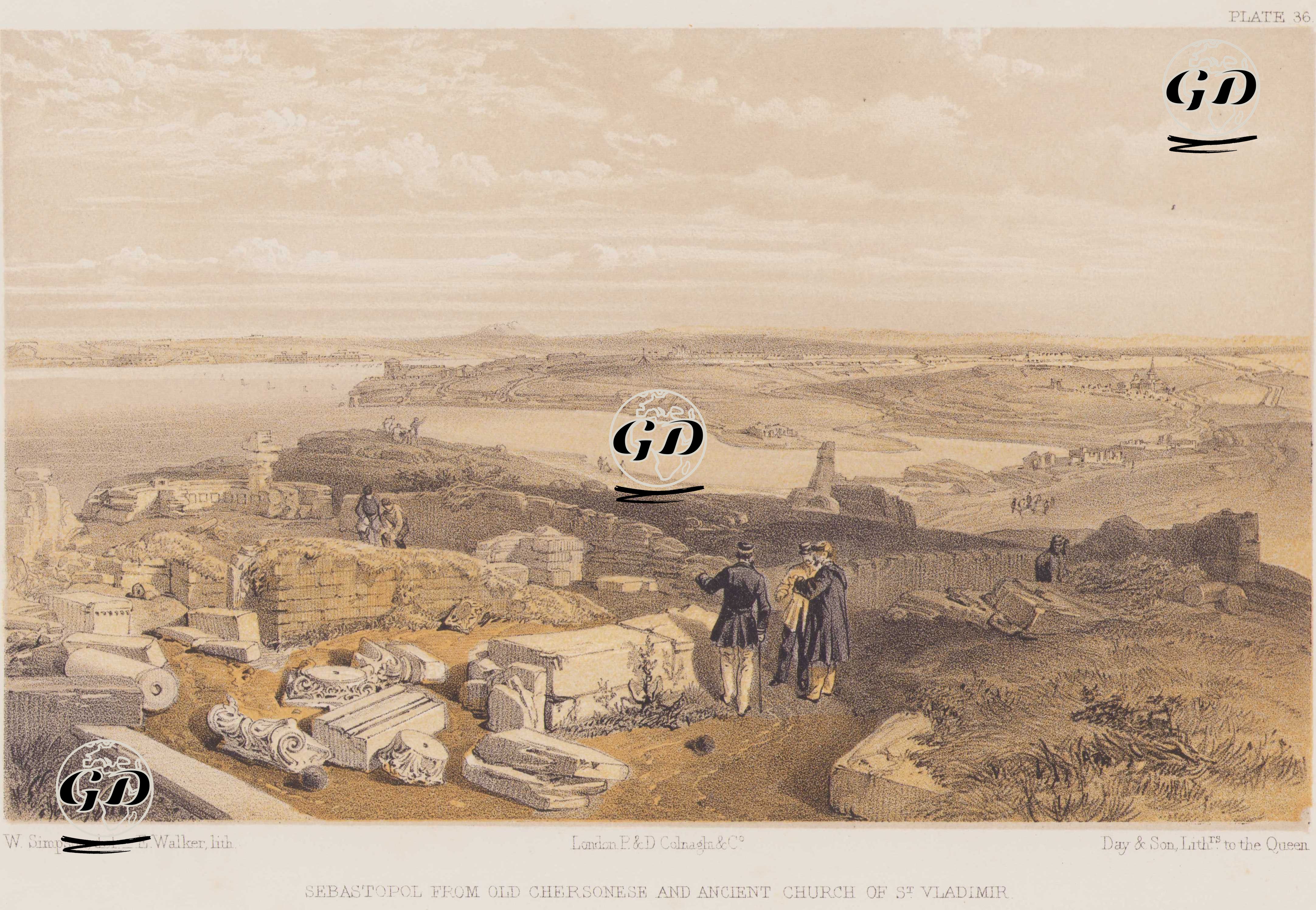
This engraving shows the ruins of ancient Chersones (Khersonisos), the Church of St. Vladimir, and a vast landscape with Sevastopol and the Black Sea in the distance. Chersonesus Taurica (Khersonisos) was founded in the 5th century BC as an ancient Greek colony, and was an important city during the Roman and Byzantine periods. It is located on the Crimean Peninsula of Ukraine, west of Sevastopol. St. Vladimir's Church is the old Byzantine church where St. Vladimir was baptized. St. Vladimir's baptism is considered the beginning of the adoption of Christianity in Russia. Today's St. Vladimir Cathedral was built on this sacred site in the 1890s. In the foreground of the engraving, stone columns and architectural fragments from the ancient Greek and Byzantine periods symbolize the grandeur of the past and the deep historical layers of the region. In the background of the engraving, the war environment of Sevastopol in the 19th century and the historical continuity that has continued until today are presented together. Therefore, the engraving is important in terms of emphasizing the historical heritage of the Crimean Peninsula, extending from ancient Greece to Byzantium and from there to the 19th century. William Simpson, who painted this engraving, was a painter and engraver sent to the war zones for The Illustrated London News during the Crimean War.