GRAVÜR DÜNYASI
Digital Engraving Library
| Artist | William Simpson (1823–1899) |
| Engraver | Edmund Walker (1814-1882) |
| Date | 1856 |
| Technique | Lithography, Sepia-toned |
| Category | Military |
| Source | The Campaign in the Crimea: An Historical Sketch by George Brackenbury, London, Published Oct. 1, 1856 by Paul & Dominic Colnaghi & Co., Day & Son Lithographers to the Queen |
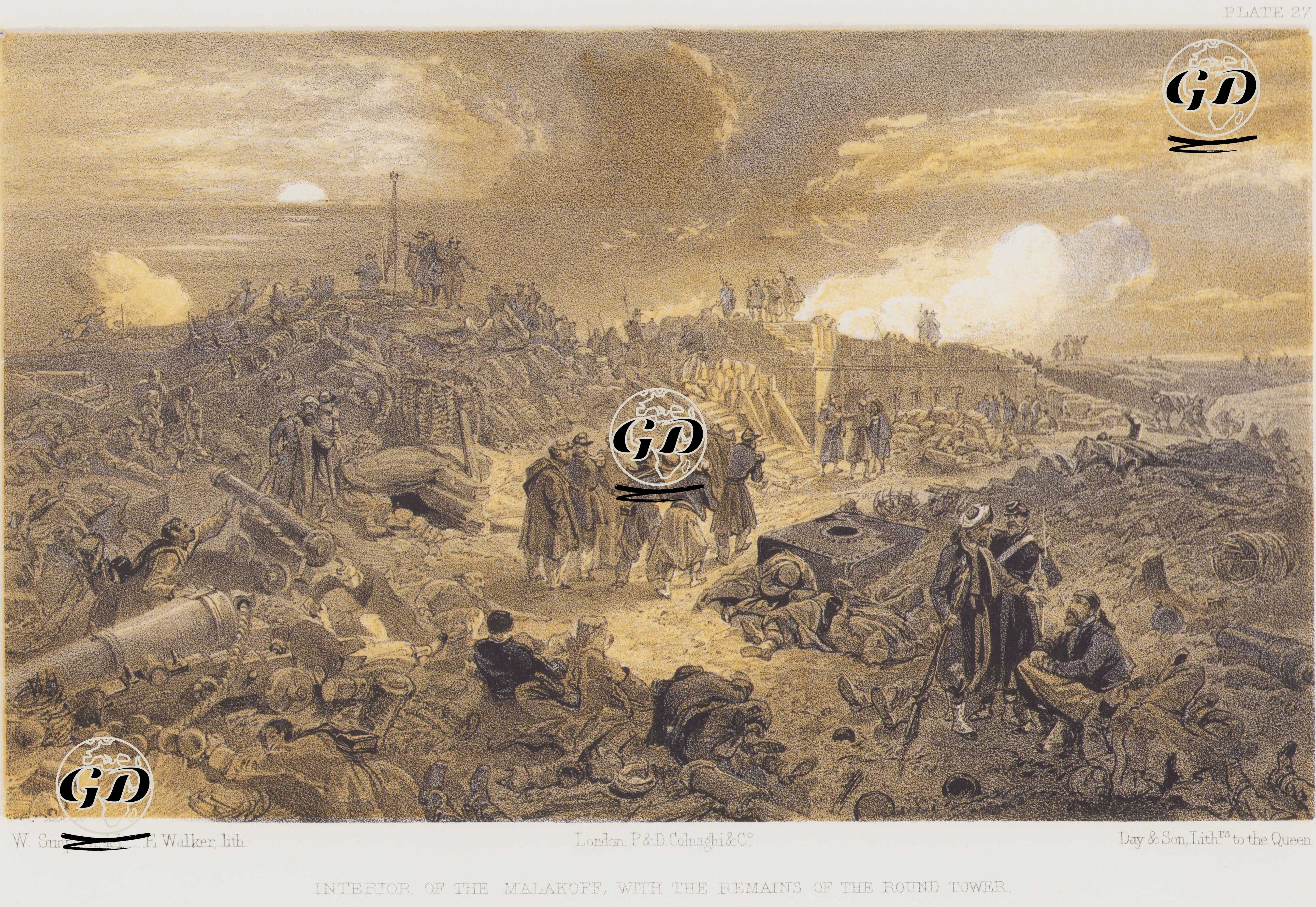
Malakoff Redoubt is one of the most critical military positions of the Russian Army located in the center of the Sevastopol defense line, southeast of Sevastopol. On September 8, 1855, troops under the command of French General MacMahon successfully attacked Malakoff Redoubt and captured the position. The fall of Malakoff led to the Russian army abandoning Sevastopol. Since it was a very important event in French military history, names such as Porte de Malakoff and the Malakoff district were given in Paris in honor of the victory in France. The Round Tower was a cylindrical observation and defense tower with a stone foundation located in the center of Malakoff Redoubt. Due to its height and central location, the tower was used as both a command post and an observation post for Malakoff Redoubt. The tower became a constant target for French artillery and snipers in the summer of 1855. This impressive engraving depicts the interior of the Malakoff Redoubt after its capture by the French on September 8, 1855, and the ruins of the Round Tower, one of the most iconic structures of the defensive system. William Simpson, who painted this engraving, was a painter and engraver sent to the war zones for The Illustrated London News during the Crimean War.