GRAVÜR DÜNYASI
Digital Engraving Library
| Artist | William Simpson (1823–1899) |
| Engraver | Edmund Walker (1814-1882) |
| Date | 1856 |
| Technique | Lithography, Sepia-toned |
| Category | Military |
| Source | The Campaign in the Crimea: An Historical Sketch by George Brackenbury, London, Published Oct. 1, 1856 by Paul & Dominic Colnaghi & Co., Day & Son Lithographers to the Queen |
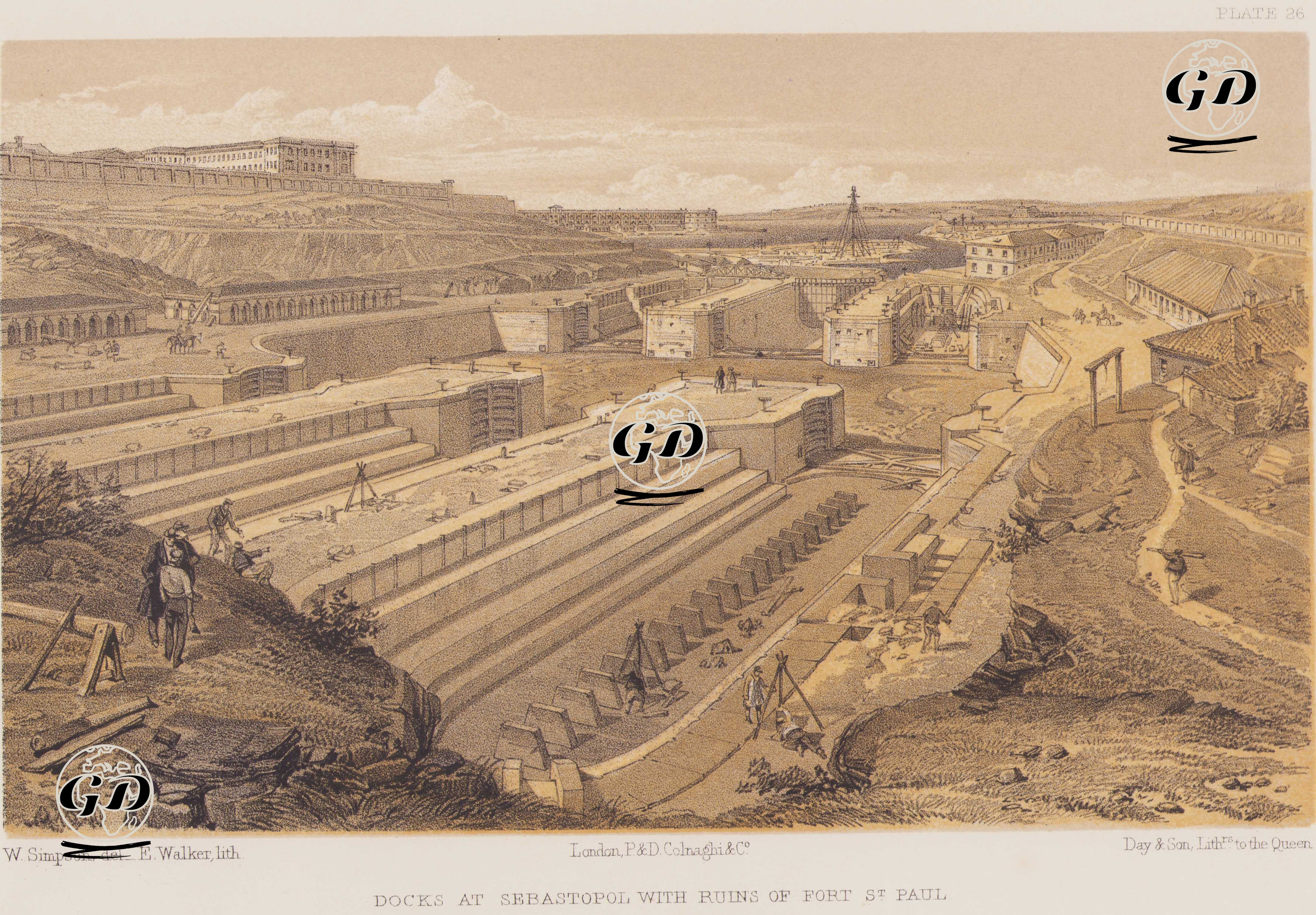
This engraving depicts the destroyed naval docks, the heart of the Russian navy, and Fort St. Paul (Fortifications of St. Paul) which formed its defensive line after the siege of Sevastopol. Fort St. Paul was one of the main fortifications protecting the military port of the Black Sea Fleet on the southwestern coast of Sevastopol. During the siege of Sevastopol (September 1854 – September 1855), this area was particularly targeted by British artillery and was repeatedly bombarded. In the engraving, the quay lines, ammunition depots, blockhouses and the ruins of Fort St. Paul (Fortifications of St. Paul) with their partially collapsed walls in the background are clearly visible in the area known as Karakol Burnu (Karantinny Point). Ruined vaults, burnt scaffolding and scattered stone blocks reflect both the violence of the artillery bombardment and the abandonment of the city after the war. William Simpson, who painted this engraving, was a painter and engraver sent to the war zones for The Illustrated London News during the Crimean War.