GRAVÜR DÜNYASI
Digital Engraving Library
| Engraver | Corsi |
| Date | 1820's-1840's |
| Technique | Aquatint |
| Category | Military |
| Source | il Costume Antico e Moderno.. (Giulio Ferrario's Ancient and Modern Costumes of All the Peoples of the World) |
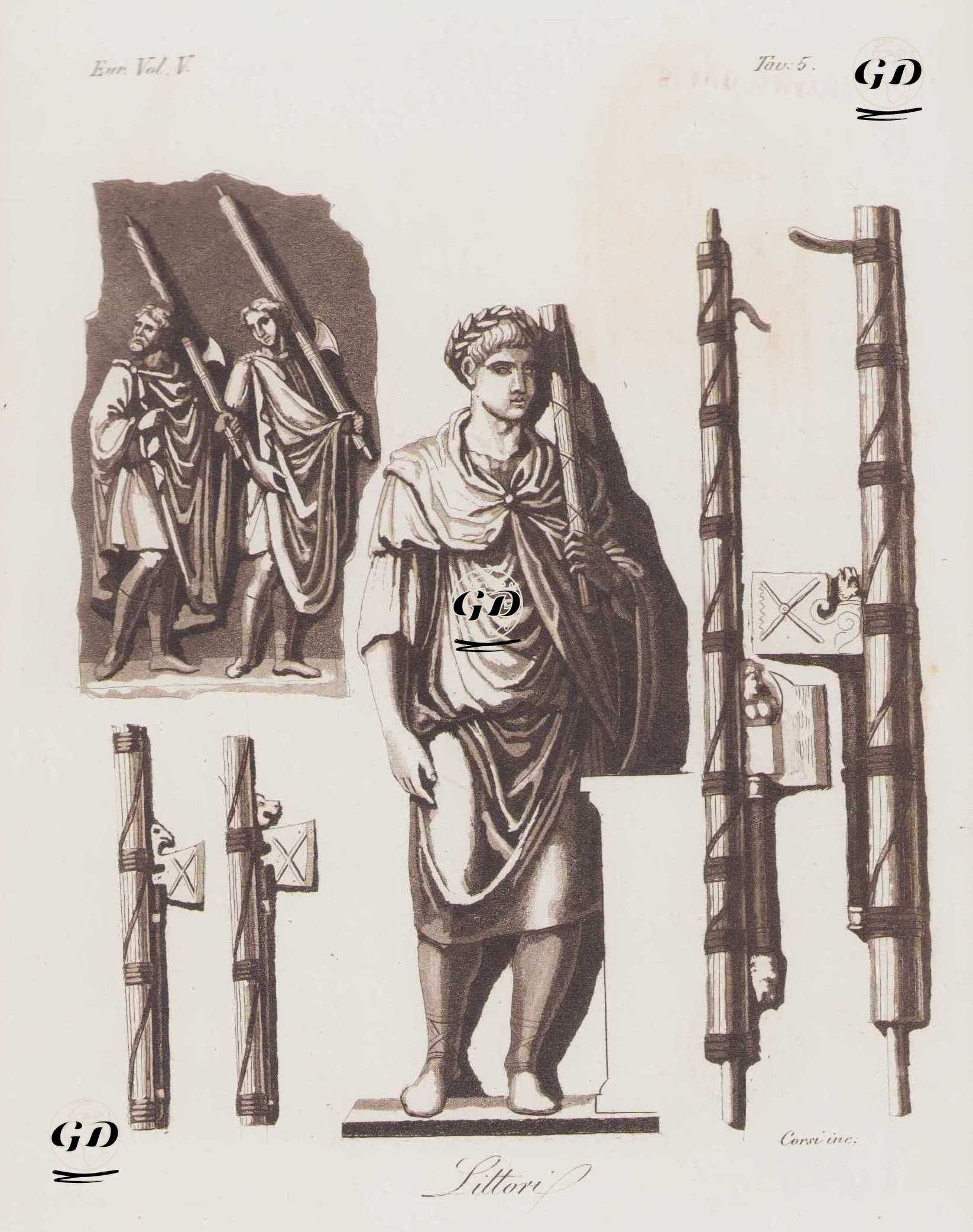
In ancient Rome, lictors were a special class of civil servants, or bodyguards, tasked with ensuring the personal safety of judges and certain high-ranking public officials. In addition to their protective duties, lictors also had the duty of administering punishments to those convicted by the judiciary. During these duties, lictors carried staves adorned with fasces within Rome. The fasces (from the Latin word fascis, meaning "bundle") symbolized power and jurisdiction, and/or "strength in unity." A fasces, a bundle of wooden sticks tied with red leather strips containing an axe, symbolized the judge's power, authority, and unity. The wooden sticks represented unity while the axe represented state power, and the red stripes marked the limits of state power. Because the rods are difficult to break or cut, the fasces symbol, representing the durability of unity and strength, was adopted by many governments and authorities after the fall of the Roman Empire, such as the United States Senate Emblem and the French National Emblem, and has been used in various eras and geographies. Furthermore, the fasces symbol reminds us of the obligation to exercise restraint in the exercise of power. Highest judges would issue a warning by untying the fasces when limits were exceeded. Let us not forget that the true meaning of power lies in responsibility and moderation.