GRAVÜR DÜNYASI
Digital Engraving Library
| Artist | Roberd Hind (1817-1879) |
| Engraver | George Greatbach (1819-1884) |
| Date | 1858 |
| Technique | Steel Engraving |
| Category | Military |
| Source | The History of the War with Russia: Giving Full Details of the Operations of the Allied Armies By Henry Tyrrell (The London Printing And Publishing Company Limited) |
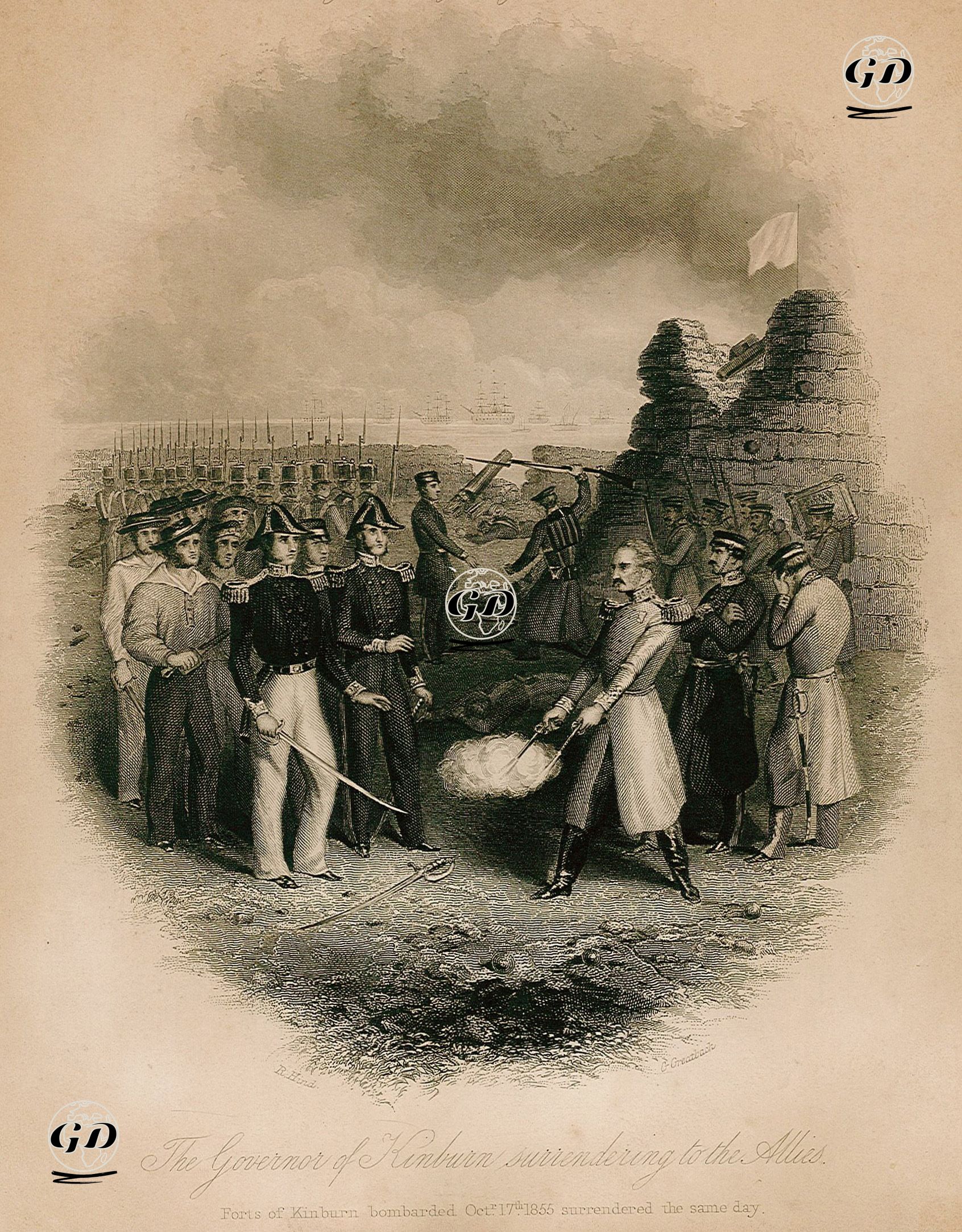
Kinburn is a strategic peninsula located at the mouth of the Dnieper-Bug estuary, where the Dnieper River flows into the Black Sea, in the north of the Black Sea. Ochakov (Özi) is located on the opposite shore. It was an important position protecting Russia's entrances to the Black Sea and the Sea of Azov. A month after the fall of Sevastopol (September 8-9, 1855), the Allies (France and England) launched a naval attack on Kinburn on October 17, 1855, in order to break the Russian rear lines. The French navy was at the forefront of this operation. During the bombardment, ironclads were used for the first time. (A turning point in the history of naval warfare.) The Russian garrison surrendered on the same day. The engraving depicts a Russian officer (probably the Governor of Kinburn) laying down his sword to a French officer and other allied officers and firing his guns towards the ground. An officer's sword is a symbol of his rank, honor, and command. In martial tradition, a commander who surrenders hands over his sword to the enemy. This signifies the transfer of authority. However, laying down the sword symbolizes surrender without dishonor, rather than giving it directly to the opponent. The gun being fired into the ground means "we have fought our war, we have fired our last bullet into the ground, we are now surrendering." In addition, in terms of the effects of the destruction and bombardment, a destroyed gun emplacement and ruined walls can be seen on the right of the engraving, a white surrender flag in the distance and warships belonging to the Allied navy on the horizon (to emphasize that the attack was carried out from the sea).