GRAVÜR DÜNYASI
Digital Engraving Library
| Engraver | William Johnston (1802-1888) - Alexander Keith Johnston (1804-1871) |
| Date | 1856 |
| Technique | Lithography-Colored |
| Category | Military |
| Source | Pictorial History Of The Russian War 1854-5-6 - W.R.Chambers London & Edinburgh -Printed in Colours by Schenck & McFarlane, Edinburgh |
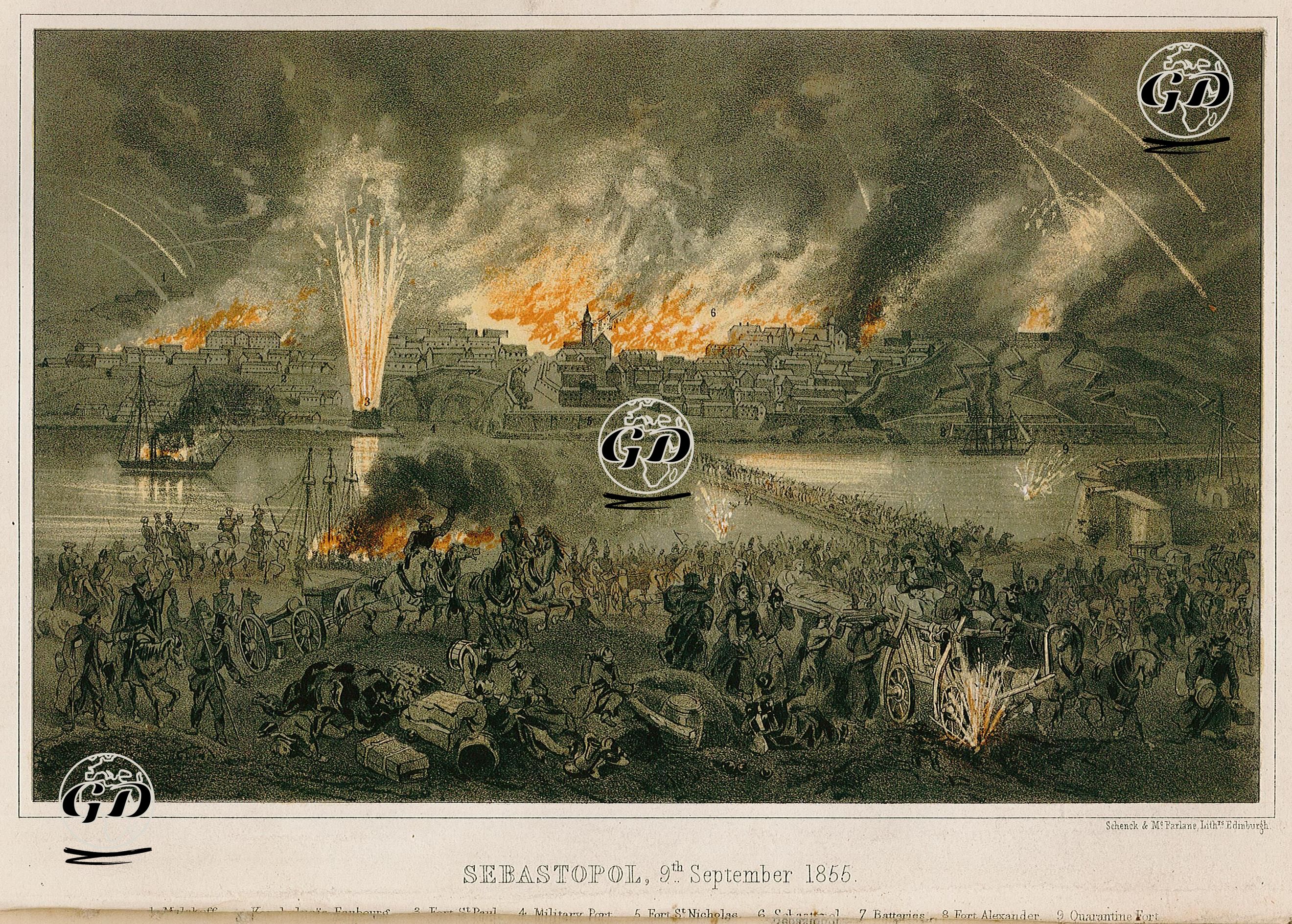
This impressive and dramatic scene depicts one of the most critical moments of the Crimean War, the fall of Sevastopol. Sevastopol was the main base of the Russian Black Sea Fleet and was the site of the longest and bloodiest siege of the war (October 1854 – September 1855). The French capture of the Malakoff Redoubt on September 8, 1855 and the British assault on the Redan fortifications on the same day led to the collapse of the Russian defenses. On the morning of September 9, the Russian army evacuated the city and withdrew to the northern shore of the Sevastopol Bay (Severnaya Storona), and the military structures behind were blown up by the Russian Army and by the Allied forces. In the engraving, flames and smoke rising from all sides of the city represent the destruction of its ammunition depots, naval vessels and fortifications. In addition, a huge explosion in the middle (probably near Malakoff) illuminates the darkness of the night, the ships in the foreground that have been pulled into the harbor and are ablaze, the soldiers, cars, horses, ammunition crates and wounded in disarray are noticeable. The chaotic movement of the military units towards the harbor symbolizes the chaos and destruction of the evacuation. The flames and destruction symbolize the end of an era, the collapse of the Russian defenses and the final victory of the siege. Beyond being a visual document of an epic historical moment, the engraving also conveys the destructiveness of war to the viewer on a sensory level.