GRAVÜR DÜNYASI
Digital Engraving Library
| Engraver | Johann Baptist Hoessel (active 1799-1824) |
| Date | 1802 |
| Technique | Copper Engraving-Original Hand Colored |
| Category | Military |
| Source | Bilderbuch für Kinder, Bd. 4 by Friedrich Justin Bertuch |
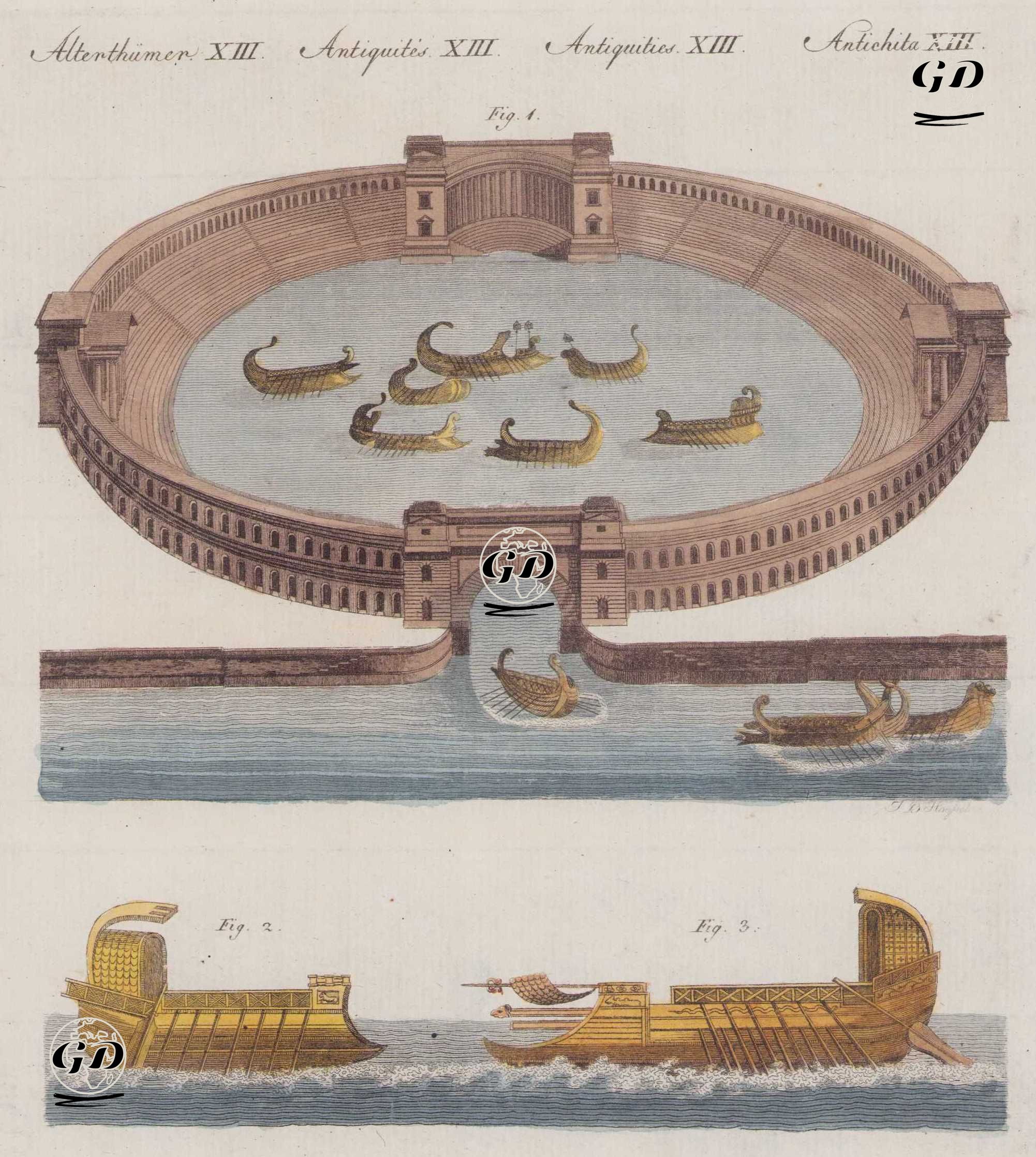
This engraving depicts naumachia performances held in ancient Rome. The term "naumachia" refers both to the specific architectural structures (amphitheaters) where these performances took place and to the mock naval battles held within them. The engraving features three distinct figures: the main figure at the top shows the naumachia, built as a large amphitheater filled with water. The oval-shaped structure resembles the classical amphitheaters in Rome, but its floor is entirely covered with water. This arena was designed to mimic famous naval battles. Several rowing warboats stand at the center of the structure, while tribunes, suggesting seating for the spectators, stand out at the edges. These performances became quite magnificent during the Augustan era; for example, the naumachia commissioned by Augustus was 550 feet long and 60 feet wide. Furthermore, the structure could be filled by connecting it to the Tiber River via a canal. This technical detail is also illustrated in connection with the water channels at the bottom of the engraving. The boats shown below in Figures 2 and 3 detail the types of ships used in the demonstrations. The boat in Figure 2 shows a warship (galley) with only one row of oars. At its rear, there is a high shelter, housing the commander or captain. Such boats were used for smaller-scale engagements or rapid maneuvers. Figure 3 shows a two-row warship (Bireme). This warship is larger and equipped with two rows of oars. The "ram" detail at the front was used in naval battles to sink enemy ships by ramming them directly. Some sources also indicate the use of three-row boats. The combatants in these spectacles were usually criminals sentenced to death or prisoners of war, and these bloody scenes were staged for public entertainment and to promote the power of the emperors. In this era, before firearms, combats were fought with weapons such as spears, harpoons, and swords; the parties brutally killed each other. Emperors would stage these displays with grand ceremonies to solidify their power in the eyes of the people, and victorious warriors would sometimes be freed and rewarded. Therefore, naumachia were not merely displays of war but also powerful scenes where Roman society intertwined concepts of death, violence, entertainment, and political authority. The engraving reflects this scene on architectural, sociological, and aesthetic levels, providing a comprehensive visual and textual document of ancient social structure.