GRAVÜR DÜNYASI
Digital Engraving Library
| Artist | Clarkson Stanfield (1793-1867) |
| Engraver | John Cousen (1804-1880) |
| Date | 1853 |
| Technique | Steel Engraving |
| Category | Military |
| Source | The National Gallery Div 4 Comprising The Pictures Known As The Vernon Collection And A Selection From The Works Of Modern Sculptors |
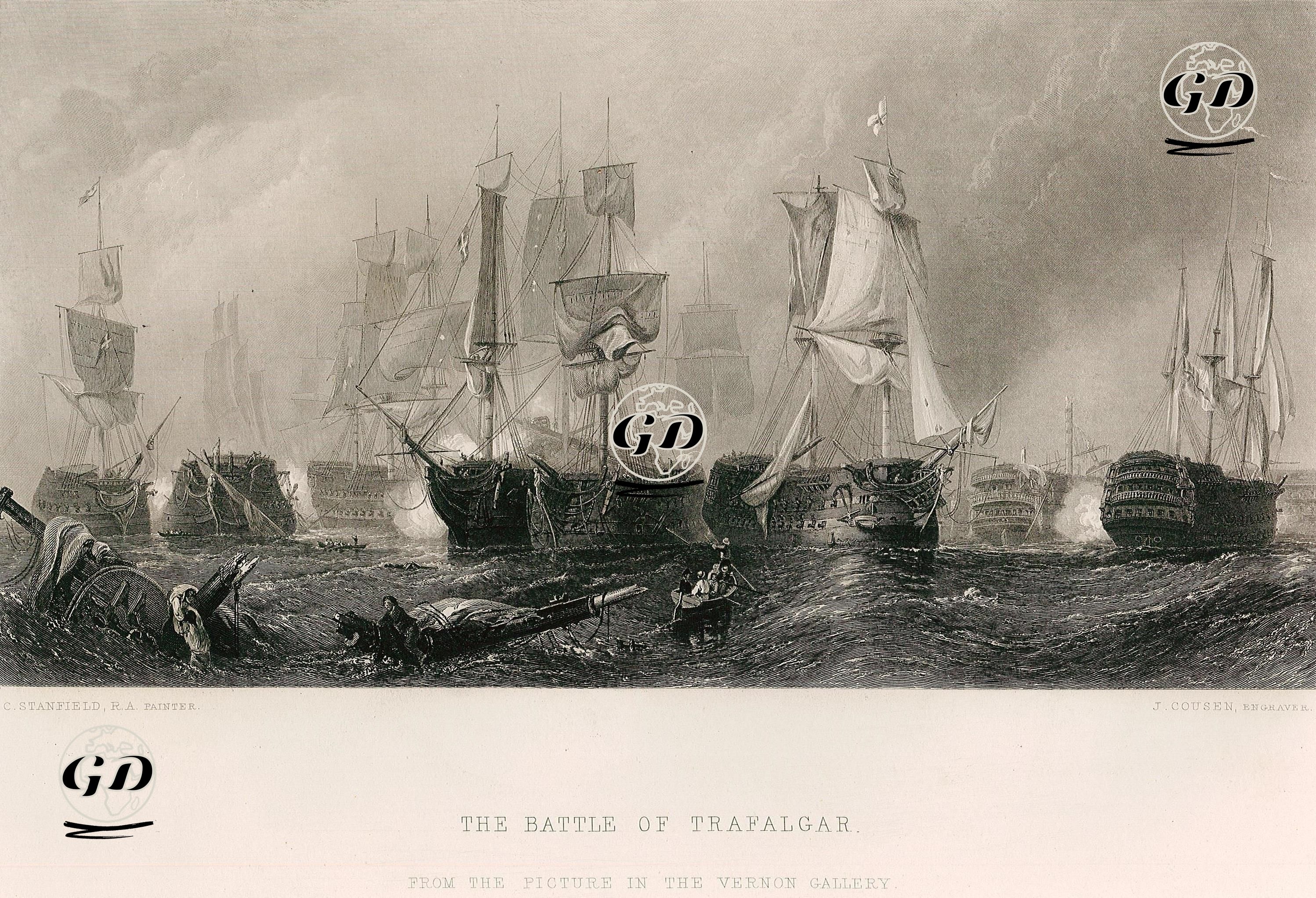
The Battle of Trafalgar, which took place on October 21, 1805, was fought off Cape Trafalgar in southern Spain between the British fleet under the command of Admiral Lord Nelson and the combined French and Spanish fleet. The battle resulted in a decisive victory for Britain under Admiral Lord Nelson's leadership. Nelson's death in this battle made Trafalgar not only a military victory but also a symbol of national heroism and sacrifice for Britain. Furthermore, by thwarting Napoleon Bonaparte's plans for naval supremacy, the battle marked a turning point in history, marking the beginning of Britain's long-lasting dominance of the seas. An intense naval battle scene stands out at the center of the composition. The engraving depicts one of the most heated clashes between the combined French and Spanish fleets around 2:30 in the afternoon, approximately an hour and a half before Admiral Lord Nelson was mortally wounded. HMS Victory, flying Nelson's flag, attempts to disengage from the French 74-gun Redoutable (the ship that had boarded HMS Victory and mortally wounded Admiral Lord Nelson) after coming under intense fire from four enemy ships. Next to Victory, a British warship is seen moored to the French Temeraire. Meanwhile, another French ship, Vengeur, is surrendering. On the left side of the engraving, Lord Collingwood's Royal Sovereign is depicted alongside the captured Spanish ship Santa Anna. On the right, Admiral Villeneuve's Bucentaure has lost its masts. Nearby, the massive four-deck Spanish ship, Santissima Trinidad, is seen heavily damaged by the intense fire of Victory and Neptune. The battleships, ablaze with cannon fire within a hazy and smoky atmosphere, are dramatically depicted alongside the grandeur of the sailing navy of the period. In the engraving, the sea's undulating motion and the ships' angled positions reflect a chaotic yet majestic battle formation. In the foreground, fallen soldiers, shattered masts, and a small rowboat with oars are seen. This detail combines the majesty of battle with human tragedy in the same frame, reminding the viewer of its destructive nature. The ships in the engraving represent different types of warships of the period. The most striking are the galleons (ships of the line). Galleons were massive three-masted, multi-decked warships capable of carrying over 100 cannons. During the Battle of Trafalgar, galleons formed the backbone of the battle, deployed alongside each other as a tactic to wear down the enemy with cannon fire. The most famous example of this type is HMS Victory, Lord Nelson's flagship. The engraving also features frigates, known for their smaller and more agile builds. These single-gun-deck vessels were used for reconnaissance, carrying messages, aiding damaged ships, and providing maneuverability. In this engraving, marine painter Clarkson Stanfield, with his masterful use of chiaroscuro, presents the chaotic nature of battle within an orderly framework. The sheer size of the ships, combined with the light filtering through the smoke, imbues the painting with both theatrical intensity and romanticism. The engraving's technical mastery is particularly evident in the movement of the waves, the details of the masts, and the visual chaos of the battle.