GRAVÜR DÜNYASI
Digital Engraving Library
| Artist | George Jones (1786-1869) |
| Engraver | James Baylis Allen (1803-1876) |
| Date | 1853 |
| Technique | Steel Engraving |
| Category | Military |
| Source | The National Gallery Div 4 Comprising The Pictures Known As The Vernon Collection And A Selection From The Works Of Modern Sculptors |
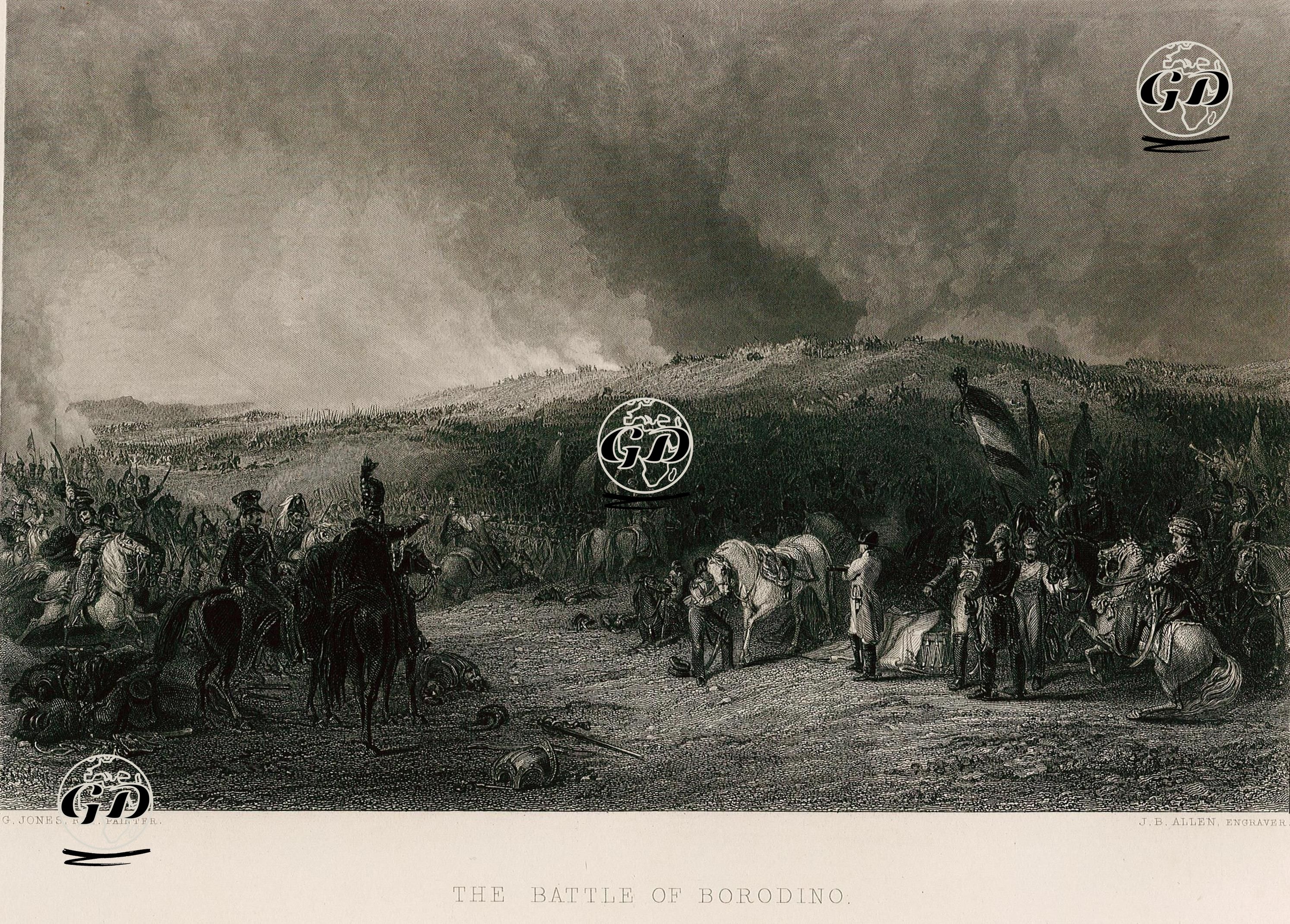
This engraving depicts the Battle of Borodino, which took place on September 8, 1812, during Napoleon's Russian campaign. Based on a painting by French artist George Jones and exhibited at the Royal Academy in 1829, the engraving, adapted by James Baylis Allen, depicts one of the largest and bloodiest battles fought by Napoleon's army on the front lines of Moscow. The French army, comprising approximately 120,000 men, marched from Smolensk to Moscow, encountering a nearly equal number of Russian forces under General Kutuzov on September 8, 1812. In the right foreground of the engraving, despite his illness, Napoleon Bonaparte is seen on the battlefield astride his white horse, Marengo. Napoleon, along with his staff, personally oversees the attack on the main Russian defensive positions (Raevsky Redoubt) from the field. Immediately behind him are the standard-bearers and marshals. In the left foreground, Marshal Joachim Murat, commander of Napoleon's magnificent cavalry, attracts attention with his flamboyant attire and encourages his troops by charging forward. At the center and top of the composition, a French infantry unit is depicted advancing up the hill, with light cavalry on the left and armored cuirassiers on the right, under the command of French General Caulaincourt. Dense smoke and gloomy clouds overshadowing the sky enhance the destructiveness and dramatic atmosphere of the battle. Although the French forces under General Caulaincourt succeeded in capturing the main defensive position (Raevsky Redoubt), General Caulaincourt lost his life during the heroic Russian defense, and despite the extraordinary losses, the battle failed to result in a decisive French victory. Indeed, although Napoleon won this engagement, his army was so exhausted that his advance on Moscow ended in disaster, marking the turning point in the campaign. The engraving is notable for the dramatic light-and-shadow contrasts typical of war engravings of the period. The fallen swords, helmets, and horse corpses in the foreground embody the devastation of the battle.